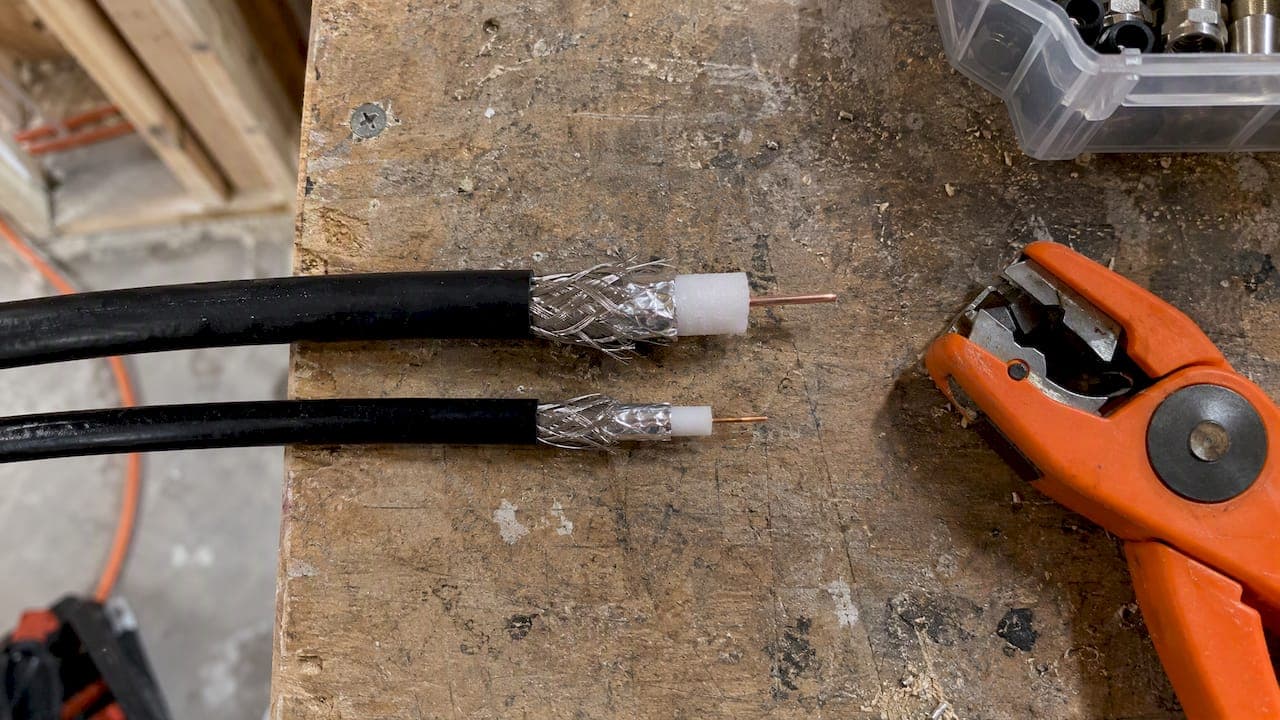
For almost every new home or business job, use RG6. It has a thicker centre conductor, better shielding and lower signal loss, so it carries cable TV, satellite, cable internet and HD-over-coax security video farther and more cleanly. RG59 still has a place: short analog CCTV runs, legacy video connections and tight spots where a thinner cable has to fit. Both are 75-ohm cables, and they look alike from across the room, but they are not interchangeable.
Below, we compare the two on the specifications that matter, show where each belongs, and flag the installation details that decide whether a run performs as expected.
TL;DR
- Choose RG6 for cable TV, satellite, DOCSIS internet and HD-over-coax CCTV. It has an 18 AWG conductor, heavier shielding and lower attenuation, especially above 100 MHz.
- RG59 suits short analog video and older CCTV runs, and places where cable diameter is limited. It is a legacy choice, not a default.
- Connectors are cable-specific. An RG59 connector will not properly fit RG6, so buy the connector for the cable you actually have.
- "RG6" is not one product. Check the shielding, jacket (indoor, direct-burial, plenum) and conductor type on the spec sheet before you buy.
Table of Contents
- RG6 vs RG59 at a glance
- What actually separates the two cables
- Where each cable belongs
- Installation conditions that change the answer
- Connectors: the detail that trips people up
- Not all RG6 is the same
- Our perspective
- Planning a build or upgrade in Calgary?
- Quick decision guide
- FAQ
- Sources
RG6 vs RG59 at a glance
The table below pulls together the differences that show up on manufacturer and utility spec sheets. Figures are typical; individual products vary, so read the datasheet of the cable you are buying.
| Feature | RG6 | RG59 |
|---|---|---|
| Centre conductor | 18 AWG | 20 AWG |
| Dielectric | Thicker, usually foam polyethylene | Thinner |
| Shielding | Dual or quad shield, commonly foil plus braid | Typically lighter, often braid only |
| Impedance | 75 ohm | 75 ohm |
| Max attenuation at 750 MHz | 1.60 dB/100 ft | 2.26 dB/100 ft |
| Usable frequency | Up to about 3 GHz | Up to about 1 GHz |
| Minimum bend radius (CATV/SMATV type) | 68 mm | 60 mm |
| Max pulling tension (same type) | 560 N | 350 N |
| Typical use | Satellite, digital cable, DOCSIS internet, HD-over-coax CCTV | Analog CCTV, legacy cable TV, short baseband video |
The conductor sizes and the frequency ranges come from a coaxial cable guide from a US wire distributor and a comparison from a US cable maker. The attenuation figures come from Toronto Metropolitan University's coaxial cabling specification, and the bend radius and pulling tension from a CATV and SMATV coax datasheet.
What actually separates the two cables
The name "RG" stands for a military-era radio guide designation, and today it tells you little on its own. What matters is construction. Three physical differences explain almost everything.
Centre conductor and dielectric
RG6 uses an 18 AWG centre conductor. RG59 uses a thinner 20 AWG one. A thicker conductor has less resistance, and that matters most for anything carrying power or low-frequency signals along the cable. In a Pelco guide to selecting video coax, the 18-gauge RG6/U conductor measures about 8 ohms of DC resistance per 1,000 feet, against about 10 ohms for the 20-gauge conductor in RG59/U. That is why, for analog video runs between 800 and 1,500 feet, the same guide says RG6/U is the better choice.
The dielectric, the insulating layer between the conductor and the shield, is also thicker in RG6. Together with the larger conductor, it gives RG6 a larger overall diameter. A solutions guide from a major electronics distributor puts it plainly: the larger RG6 can deliver the same signal level over a greater distance, though whether the gap matters depends on your input signal level and run length.
Shielding
Shielding keeps outside interference from getting into the signal and keeps your signal from leaking out. RG6 normally has dual shielding (foil plus braid) or quad shielding. RG59 typically has lighter shielding, often just a braid. One long-running discussion of the two cables notes the older split: RG-59 was used for up to several hundred MHz with braided shields, while RG-6 was used for GHz-range signals with foil shields.
This matters in a house. Cable internet, satellite and over-the-air signals share the same frequencies as wireless gear, LED drivers and other household electronics. Good foil coverage is the first defence against pixelation and dropouts.
Signal loss and frequency
Attenuation is the signal you lose per length of cable, measured in decibels. Lower is better, and it climbs with frequency. At 750 MHz, the maximum attenuation in the Toronto Metropolitan University specification is 1.60 dB per 100 ft for RG6 and 2.26 dB per 100 ft for RG59. That is roughly 40 per cent more loss in the thinner cable over the same distance.

For a real RG6 product, a Canadian manufacturer's RG-6/U data sheet lists nominal loss of 0.58 dB per 100 ft at 5 MHz, 7.45 dB at 1,000 MHz and 13.07 dB at 3,000 MHz. You can see the curve: loss is small at low frequencies and grows steeply as you head toward satellite-band frequencies. RG6 remains usable up to about 3 GHz, while RG59 handles up to about 1 GHz and its attenuation keeps rising beyond that, according to the coaxial cable guide.
A worked example: a 100 ft run behind a TV carrying a 1,000 MHz signal on the RG6 above would lose around 7.45 dB. That is acceptable for most home setups. Triple the run and you are near 22 dB, at which point amplifier placement and signal levels at the source start to matter. Thinner, lossier cable pushes that point closer.
Where each cable belongs
Use RG6 for
According to the coaxial cable guide, RG6 is the go-to cable for virtually all residential and commercial video, satellite and broadband installations. In practice that means:
- Cable TV and digital cable. Higher channel counts and digital modulation need the extra headroom.
- Satellite TV. Satellite receivers run signals in the GHz range, which is where RG59 falls apart.
- Cable internet (DOCSIS). The modem connection is exactly where lower loss and better shielding pay off.
- HD-over-coax CCTV. Modern HD analog systems carry high-bandwidth video, so RG6 is the safer pick.
The Canadian carriers draw the same line. In its guide to telling the two cables apart, Bell describes RG59 as house cable for basic connections between a TV, VCR and satellite equipment, and RG6 as the stronger grade used for satellite transmission.
RG59 still makes sense for
RG59 is suitable for analog CCTV runs under 500 feet, legacy cable TV and short baseband video connections, including places where conduit limits cable diameter, again per the coaxial cable guide. A typical case: a building with an existing analog camera system where the cable already sits in conduit, the runs are short, and the cameras are standard-definition. Replacing good cable inside finished walls costs far more than it saves.
If you are planning new cameras, though, the cable is the smaller decision. Whether you want analog, IP or a hybrid system changes what you pull. Our guides on NVR vs DVR systems and wired vs wireless cameras walk through that choice, and the cost of CCTV installation in Alberta shows how cabling fits into a quote.
Is RG59 obsolete?
Not entirely, but it is no longer the default. RG59 has become less popular and is mostly used for analog video and CCTV, while RG6 is generally recommended for internet, cable TV and satellite TV, per the US cable maker's comparison. Coax overall is still widely used for premises video, including CATV and CCTV, although some surveillance systems move to fibre for long distances or to twisted-pair cabling with adapters, as the Fiber Optic Association's premises coax reference explains.
Installation conditions that change the answer
Spec sheets assume ideal conditions. Walls, conduit, attics and Calgary winters are not ideal.
Bends, pulling and conduit
The thicker cable is also stiffer. On the CATV and SMATV cables in the datasheet above, RG6 has a minimum installation bend radius of 68 mm and a maximum recommended pulling tension of 560 N, while RG59 is rated for 60 mm and 350 N. The gap is small, but it explains why RG59 is easier in tight corners and why an installer pulling through a crowded conduit pays attention to both numbers. Tight kinks change the cable's geometry and cause reflections, so the rule is to bend gently and never pull harder than the rating.
Quad-shield RG6 is thicker again, and a bundle of them can fill a small conduit quickly. If you are running coax together with speaker wire and network cable in a new build, plan the conduit size up front. Our guide to speaker wire gauge and in-wall code rules in Canada covers the same planning problem on the audio side.
Jacket type: indoor, outdoor, burial and plenum
The cable should match where it lives. Pelco's guidance is that transmission characteristics are influenced by the physical environment and installation method, so you match the cable to the environment, for example direct-burial cable underground or a jacket rated for the space it passes through. A Canadian RG6 spec sheet lists a direct-burial-rated variant alongside the standard one, and a Canadian coax spec sheet shows a burial cable with a polyethylene jacket and slightly higher velocity of propagation (83 per cent) than the standard PVC-jacketed cable (81 per cent).
In commercial and institutional buildings, fire rating is part of the spec. Toronto Metropolitan University's coaxial cabling section requires cable that meets applicable codes and standards, with non-plenum inside-plant requirements and a non-contaminating jacket. If your cable passes through return-air spaces or similar areas, ask the installer which rating applies; do not assume the cheapest roll qualifies.
Cable that runs outdoors to a camera or outdoor TV faces freezing, UV and moisture. If that is your project, our guides to outdoor TV installation in Calgary and outdoor TVs in the cold cover the weather side. For the wiring side of cameras, this explanation of PoE security camera wiring shows how jackets, routing and distance limits shape the choice of cable.

Connectors: the detail that trips people up
RG59 and RG6 differ in diameter, and connectors are made for a specific cable size. They are not interchangeable between RG sizes, as the coaxial cable guide notes. An RG59 F-connector crimped on RG6 will sit loosely or not reach the shield properly; an RG6 connector on RG59 will grip poorly. Either gives you an intermittent connection that looks like a bad cable or a bad TV.
Practical rules:
- Match the connector to the cable's printed designation and, where it applies, to the shield type (standard or quad).
- Use the crimp tool or compression tool sized for that connector.
- Check that the centre conductor protrudes just enough, and that no stray braid strands touch it.
- Keep outdoor connections sealed against moisture.
One more habit that saves callbacks: do not mix cables in the same run. Joining RG59 to RG6 with a coupler creates an impedance and loss step, even though both are nominally 75 ohm.
Not all RG6 is the same
Buying "RG6" is like buying "lumber". The grade matters. One Canadian maker's RG-6/U sheet describes a cable with a copper-clad-steel conductor, gas-expanded polyethylene dielectric, 100 per cent aluminum foil plus 60 per cent aluminum braid, 75-ohm impedance and flame-retardant PVC. A second Canadian spec sheet lists standard RG6 as 18 AWG solid copper-clad steel with foam PE, 100 per cent foil and 60 per cent braid, PVC jacket, 16 pF/ft capacitance and 81 per cent velocity of propagation.
A separate datasheet for CATV cables lists an RG6 with a nominal 6.8 mm diameter, 1.02 mm conductor, 60 per cent braid coverage and 75 ± 3 ohm impedance, with attenuation of 19.69 dB per 100 m at 870 MHz and 39.83 dB per 100 m at 3,000 MHz. Three cables, all called RG6, three slightly different sets of numbers.
When you compare quotes or buy a roll, check:
- Conductor material. Solid copper-clad steel is common; the spec sheet will state it.
- Shielding. Foil plus braid, or quad. Coverage percentages differ between makers.
- Impedance. It should be 75 ohm.
- Attenuation at your frequencies. Look for the figure at 750 to 1,000 MHz for cable TV and internet, and at 2,000 to 3,000 MHz for satellite.
- Jacket rating. Standard indoor, direct-burial, aerial or plenum.
- Return loss. The university spec above asks for 26 dB, a useful benchmark for a quality cable.
Our perspective
Most coax questions we hear are really system questions. Homeowners ask which cable to buy when the better question is what the cable must serve in five years. A few things we have learned in custom installs:
- Pull more than you need. Cable is cheap, drywall is not. When walls are open in a new build or a renovation, we run RG6 alongside network cable and, where relevant, speaker wire, so the house can adapt as equipment changes.
- Do not reuse mystery cable. Old cable in the wall may be RG59, or RG6 with minimal shielding. If a TV, satellite feed or camera misbehaves, test it before blaming the equipment, and replace the run if the numbers do not hold.
- Design the whole path. Antenna, satellite and CCTV coax, network, power and surge protection all interact. Our note on two-layer surge protection for AV in Canada explains why coax entering the home needs thought as well as the power line.
- Hide the work. Our installs are meant to disappear into the architecture. That starts with planning cable paths, bend radii and conduit before the drywall goes up.
We would rather spend an hour planning cable runs than a day opening a finished wall. The right cable is the one you never think about again.
— JupiterAV
Planning a build or upgrade in Calgary?
If you are building or renovating and want the low voltage wiring, TV, audio, security cameras and networking done as one coordinated job, that is what we do. JupiterAV offers custom engineered AV, smart home and security installations with a single point of contact, from pre-wire through to final setup and ongoing support, for homeowners, businesses and home builders across Calgary and the surrounding area. See what we offer on the JupiterAV site and tell us about your project.

For security projects, we can advise on camera placement and on PoE camera wiring that meets Canadian code before cable is pulled.
Quick decision guide
| Your situation | Use |
|---|---|
| New cable TV, internet or satellite run | RG6 |
| New HD-over-coax CCTV | RG6 |
| Long analog video run (hundreds of feet) | RG6 |
| Short analog CCTV extension on an existing system | RG59 can be acceptable |
| Tight conduit or sharp corners with short run | RG59 may fit where RG6 will not |
| Underground or outdoor run | Burial-rated or outdoor-jacketed cable, usually RG6 |
| Passing through ceiling spaces in commercial buildings | Cable with the rating your local code and building spec require |
| New IP camera system | Network cable rather than coax |
When you are unsure, RG6 is the safer choice. The extra cost per metre is small next to the cost of running a second cable later.
FAQ
Can I use RG6 instead of RG59?
Usually yes, for the cable itself. RG6 carries the same 75-ohm signals with less loss. The catch is the connectors and the physical fit: you need RG6-size connectors, and the thicker cable may not bend or pull as easily in tight spaces.
Is RG6 better than RG59 for CCTV?
For HD-over-coax systems and long runs, yes. RG6 has lower resistance and attenuation, and Pelco's guidance favours it for analog video runs of 800 to 1,500 feet. RG59 remains workable for short analog runs on existing systems.
Why is RG59 not used much anymore?
Its thinner conductor and lighter shielding cause more loss at higher frequencies, and modern services such as satellite and cable internet use those frequencies. It remains in use mainly for analog video, legacy systems and low-frequency signals.
Are all RG6 cables the same?
No. Conductor, shielding coverage, dielectric and jacket vary by product, and variants exist for direct burial, aerial and plenum use. Read the spec sheet and match the cable to the signal and the environment.
Can I use RG59 connectors on RG6 cable?
No. Connectors are made for a specific cable size and are not interchangeable between RG59 and RG6. Using the wrong one produces a loose or poorly shielded connection that shows up as dropouts or pixelation.
Sources
- How to differentiate between a RG59 and RG6 coaxial cable (Bell)
- RG59 vs RG6: Key Differences (TrueCable)
- Coaxial Cable Guide: RG59, RG6, RG8, RG11 and LMR (Ramcorp)
- RG-6/U Coaxial Cable spec sheet (Priority Wire)
- RG-59, RG-6 and RG-11 sweep tested coaxial cables datasheet (B3 International)
- Section 27 15 33 Communications Horizontal Coaxial Cabling (Toronto Metropolitan University)
- Selecting a Video Coaxial Cable (Pelco)
- Coaxial cable solutions guide (Digi-Key)
- Coax spec sheet (ReadyWire)
- Coax Cable in Premises (Fiber Optic Association)
- PoE security camera wiring