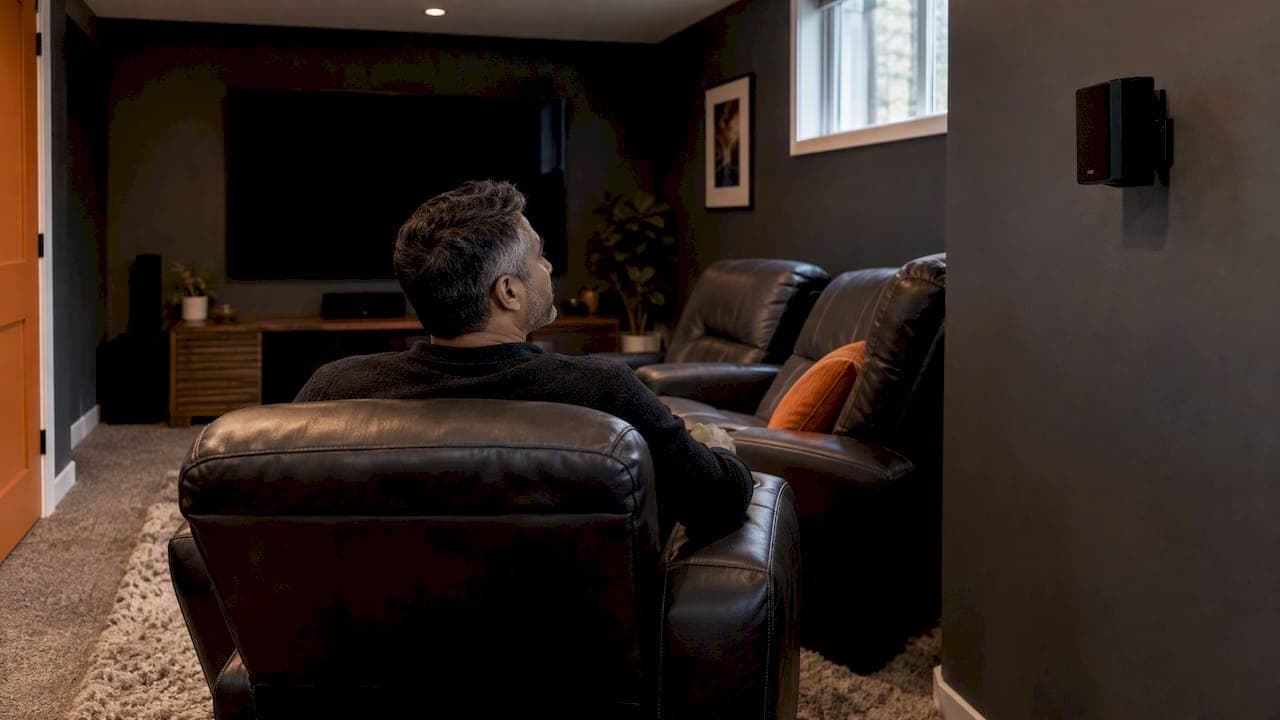
Mount side surround speakers slightly above seated ear level, and keep rear (surround-back) speakers at about ear height. Dolby's reference for listener-level speakers is roughly 3.9 feet (1.2 m) off the floor for an average seated listener, and most rooms land in a band a little above that. The details change with your layout, your seating and what is inside your walls, so this guide walks through the numbers and the judgment calls.
TL;DR
- Use your seated ear height as the starting point. Dolby's guidelines put listener-level speakers at about 3.9 feet (1.2 m) for an average seated listener.
- In 5.1 and 7.1 systems, side surrounds sit just above ear height and 7.1 surround-backs sit at ear height, per Onkyo's installation instructions.
- Sonos specifies 5.1 surrounds at 5 to 7 feet (1.5 to 2.1 m) from the floor, 2 to 6 feet (0.6 to 1.8 m) behind the listening position.
- If the room forces you higher, Dolby says rear speakers should not exceed 1.25 times the front-speaker height.
- Decide on height before drywall goes up. Moving a wired speaker later is the expensive part.
Table of Contents
- Start with seated ear level, not the wall
- Why a little above ear level works
- Surround speaker height in a 5.1 system
- Rear speaker height in a 7.1 system
- Height versus distance: you need both
- When the room fights you
- Get the height right before the drywall
- How to check it by ear
- Our perspective: scale it to the room
- Planning a theatre or whole-home audio in Calgary?
- FAQ
- Sources
Start with seated ear level, not the wall
The most common mistake is picking a height because it looks balanced on the wall. Surround speakers are not decor. They exist to place sounds around you, and your ears are the reference, not the TV, the window trim or the light switches.
Sit where you actually sit, in the main seat, and have someone measure from the floor to the middle of your ear. For most adults on a standard sofa or theatre recliner that is somewhere near 3.9 feet, which matches the figure in Dolby's Home Theater Installation Guidelines for listener-level speakers. Your own number matters more than the average. A deep recliner with the footrest up puts your ears lower than a firm dining-height chair does, and a riser row in a dedicated theatre changes it again.
Write that number down. Every other height in this article is expressed relative to it.
Why a little above ear level works
Side surrounds in a 5.1 or 7.1 system are usually mounted slightly above ear height rather than exactly at it. Onkyo's installation instructions say 5.1 and 7.1 side surrounds should be just above ear height.
The practical reasons are straightforward:
- Diffuse sound. Surround channels carry ambience and effects: wind, rain, crowd noise, a passing car. When the speaker is slightly above the listeners, the sound arrives over the heads of everyone on the sofa instead of hitting the nearest person in the ear.
- Multiple seats. In a two-row room, a speaker aimed at one person's ear level is too low for the person behind. A modest lift evens things out.
- Clearance. Sofa backs, end tables and people standing up all block low speakers.
"Just above" is deliberately loose. Think inches to a foot or so, not several feet. Once you climb well above that, the surrounds start to behave like height speakers, and the sense of sound travelling around the room gets weaker. If you want true overhead effects, that is a different job with its own rules. We cover it in where to put your Atmos speakers.
Surround speaker height in a 5.1 system
In a 5.1 layout you have two surround speakers, one on each side of the seating area, usually level with or slightly behind the listener. Dolby notes that a good 5.1-channel system already gives a full surround experience.
For in-wall installs, Sonos gives a concrete window. Its In-Wall by Sonance guide specifies 5.1 surrounds 2 to 6 feet (0.6 to 1.8 m) behind the listening position and 5 to 7 feet (1.5 to 2.1 m) up from the floor. Note how that compares with ear level: 5 feet is about a foot above a 3.9-foot ear, and 7 feet is a much bigger lift. The bottom half of that range gives the tightest, most natural result in most rooms. The top of it is there for rooms where furniture, windows or ceiling slope leave no alternative.
A quick worked example:
| Item | Value |
|---|---|
| Seated ear height (measured) | 3.9 ft (1.2 m) |
| Side surround, just above ear | roughly 4.5 to 5 ft (1.4 to 1.5 m) |
| Sonos in-wall window | 5 to 7 ft (1.5 to 2.1 m) |
| Distance behind main seat | 2 to 6 ft (0.6 to 1.8 m) |
The middle row is our reading of "just above" against a typical ear height, not a published figure. Where it overlaps the Sonos window, around 5 feet, is a sensible target for a standard living room or basement.
Rear speaker height in a 7.1 system
Seven-channel layouts add two surround-back speakers on the rear wall. They are a different job from the side pair: they sharpen sounds moving behind you. Dolby's setup guide says moving from 5.1 to 7.1 improves the directionality of sound effects.
Onkyo's instructions say the 7.1 surround-back speakers should sit at ear height, while the side surrounds stay just above it. So the side pair is a touch higher than the rear pair. In a lot of rooms people mount all four at the same height for neatness. That is workable, but if you can choose, follow the stagger.
Two more numbers help with spacing. Sonos recommends 7.1 surround-back speakers be 3 to 6 feet (0.9 to 1.8 m) apart, so they stay close enough to read as a rear pair rather than a second set of side speakers. If your rear wall is wider than that, centre them behind the main seat anyway, not at the corners.
What if the room makes ear height impossible, say a shelving unit, a bar counter or a stair? Dolby's guidance allows rear speakers to be raised when the room design requires it, but not beyond 1.25 times the front-speaker height. If your fronts are at 3.9 feet, that cap is about 4.9 feet (1.5 m). It is a useful ceiling for a compromise.

Height versus distance: you need both
Height is only half of the placement. A speaker at the perfect height in the wrong spot still sounds wrong.
- Side surrounds belong beside the main seats, or a short distance behind them, not in front of the listeners. The Sonos range of 2 to 6 feet behind the listening position is a good check.
- Rear surrounds go on the back wall, centred, and spread within the 3 to 6 foot span above.
- Toe-in. Aim side surrounds so they point across the room, not directly at the listener's ear. This helps blend the channel with the room's sound rather than turn it into two obvious point sources.
If the seating is against the back wall, the side speakers will often be level with or even slightly ahead of the ears. In that case height matters more, because the lift above ear level is what keeps them from sounding like a pair of left and right speakers.
When the room fights you
This is where most real projects get decided. Here are the situations we see most often in homes around Calgary, and what to do about each.
Windows and doors on the side wall
A window often lands right where a surround wants to be. Do not shift the speaker far forward to avoid it. Move it up or down within the height window, or step to the other end of the seating area, as long as it stays beside or just behind the listener. A small bookshelf-style speaker on a bracket above a window trim line is a common fix.

Sloped or vaulted ceilings
On a sloped wall you may be tempted to follow the ceiling. Do not. Keep both surrounds at the same height from the floor so the image stays balanced left to right, even if that means one sits closer to the slope.
Basements with low ceilings
A basement ceiling of about 8 feet gives you plenty of room to stay in the 5 to 7 foot band, but bulkheads, ducts and beams can interrupt. This is exactly where deciding early pays off. Our basement home theatre ideas for Calgary homes covers the layout side of that conversation.
Open-concept living rooms
In a big open room there may be no wall behind or beside the seating at all. Options are in-ceiling speakers, floor-standing wireless speakers on stands, or a bracket on a half wall. In-ceiling surrounds are a compromise on height, since the angle is steeper, so check our ceiling speaker placement guidance before choosing them.
Soundbar and wireless setups
If you use a soundbar with wireless rears, the same logic applies: ear level to a bit above, beside or slightly behind the seat. A speaker sitting on a low side table sounds boomy and directional. A stand or shelf near ear height usually fixes it. For the soundbar itself, see how to mount it to your TV, and for a full Sonos system, our Calgary installer's guide to Sonos home theatre setup.
Hard walls and reflections
A surround mounted close to a bare, hard side wall will reflect more sound back toward the room. If it sounds harsh or smeared, treating the first reflection points can help. Controlling noise and echo with acoustic panels is one route, and our own guide to acoustic panels for a home theatre covers how many you typically need and where they go.
Get the height right before the drywall
This is where a plan matters most. Wall-mounted surrounds that sit at 5 feet versus 7 feet need the wire to be in two different places. Once drywall is up, correcting a wrong height means patching, repainting and sometimes opening up insulation or vapour barrier.
A short pre-wire checklist:
- Measure seated ear height for the main seat, with the furniture you actually plan to own.
- Mark side surround positions 2 to 6 feet behind the main seat, at roughly 5 feet off the floor, then adjust for windows and framing.
- Mark surround-back positions at ear height, centred, 3 to 6 feet apart.
- Add a spare cable run if you might upgrade to 7.1 or add height speakers later.
- Check that the framing and blocking are in the right place for brackets or in-wall enclosures.
Builders will find a fuller list in our audio rough-in checklist. If the theatre will share a wall with bedrooms, think about sound transfer too: see soundproofing a home theatre.
How to check it by ear
Numbers get you close. Your ears finish the job. Before fixing anything to a wall:
- Temporarily hold or tape each speaker at the planned height.
- Run your receiver's or processor's calibration, then play a surround test track or a scene with obvious movement, such as a helicopter pass or rain.
- Sit in each main seat. The effect should feel like it surrounds you, not like two speakers on the sides.
- If the effect feels localized to a single point near your ear, go higher or toe the speaker slightly away. If it feels detached or vague, come down a little.
That ten-minute test has saved many clients from drilling twice.
Our perspective: scale it to the room
We design systems so the speakers disappear into the architecture, and that changes how we think about height. A rule of thumb is a starting point. The right height is the one that satisfies the ear-level reference, the room's framing and the way people really sit, with the speaker nearly invisible when the lights are up.
In practice, that means we decide surround positions early, usually with the builder or designer, and we plan the wiring around them. We would rather lock in a 5-foot position on paper and run the cable once than try to fix a wrong mark later. We also favour a single point of contact for the whole job: the person who specifies the speaker is the same one who confirms the stud locations, the cable route and the final calibration.
One firm opinion: do not chase a perfect number at the cost of a good seat position. If the sofa moves, the "perfect" height moves with it. Plan for the seat first, the speaker second.
— JupiterAV
Planning a theatre or whole-home audio in Calgary?
If you are building or renovating and want surround speakers placed correctly the first time, we handle the design, wiring, installation and calibration of custom home theatres, whole-home audio and video, and smart home systems for homeowners and builders across Calgary. Our Immersive Sound & Cinema service covers the speaker layout, the low-voltage wiring and the finishing, so the result is discreet and balanced.

Bring us your floor plan or your framed basement, and we will mark up speaker heights and wire runs before drywall. See the full range on jupiterav.ca.
FAQ
How high should surround speakers be?
Start from seated ear level, which Dolby puts at about 3.9 feet (1.2 m) for an average listener. Side surrounds go just above that, and Sonos specifies 5 to 7 feet (1.5 to 2.1 m) from the floor for its 5.1 in-wall surrounds. In most rooms, the lower part of that range sounds more natural.
How high should rear surround speakers be?
In a 7.1 system, Onkyo says the surround-back speakers should be at ear height. If the room design forces them higher, Dolby's guidance is to stay under 1.25 times the front-speaker height. Keep the pair about 3 to 6 feet (0.9 to 1.8 m) apart, centred behind the main seat.
Should surround speakers be higher than the front speakers?
Slightly, yes, for side surrounds, which sit just above ear height. Not by a lot, though. Raising them far above the fronts makes them behave like overhead speakers and weakens the sense of sound moving around you. Overhead effects are better handled by dedicated height speakers.
Does the height change between 5.1 and 7.1?
The side surrounds follow the same rule in both: just above ear level. The extra pair in 7.1 sits on the back wall at ear height. Going to 7.1 adds directionality to effects, according to Dolby, so it matters most in larger rooms with seating well away from the back wall.
Can I fix the height after the walls are finished?
It is possible, but usually messy. In-wall speakers need new cutouts and drywall repair, and a cable has to be fished to the new location. Planning heights before drywall avoids this, and a wireless or bracket-mounted speaker is much easier to adjust later.
Sources
- Dolby Atmos Home Theater Installation Guidelines
- TX-RZ50 Speaker Installation, Onkyo Product Support
- Sonos In-Wall by Sonance product guide
- Surround Sound Speaker Setup Guides, Dolby