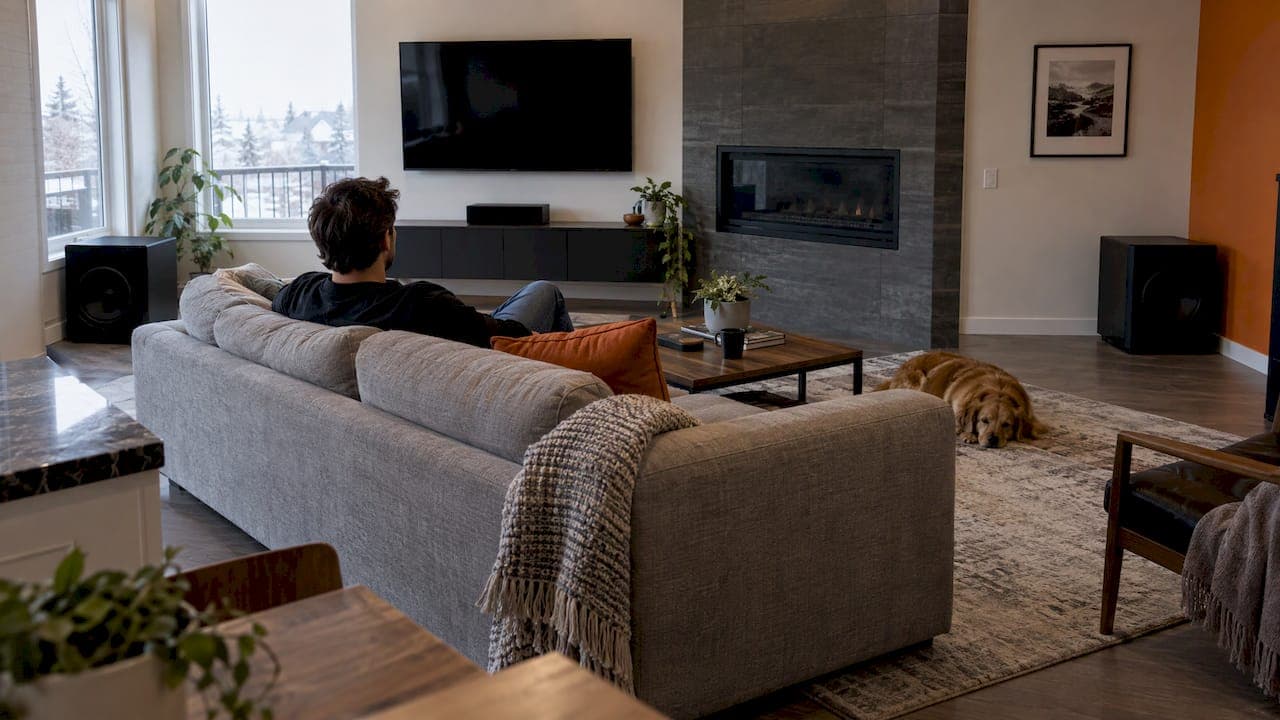
For most living rooms and home theatres with more than one seat, two subwoofers sound better than one. The gain is mostly evenness: bass that feels the same on the sofa, in the end seat and in the back row, instead of booming in one spot and thin in another. A single good subwoofer can still be the right answer in a small, simple room. This guide helps you decide which camp your room is in, and how to set up two subs if you go that way.
TL;DR
- Two subs mainly fix uneven bass across seats. Extra loudness is a bonus, not the main reason.
- Two subs at opposing wall midpoints come close to the best result of four subs, according to a well-known Audio Engineering Society study on multi-sub optimization.
- One sub is often enough for a small room with one main seat. Large, open or multi-row rooms benefit most from a second.
- Placement and calibration matter as much as the hardware. Two badly placed subs can sound worse than one well-placed sub.
- The two subs do not have to be identical, but they should be of similar quality.
Table of Contents
- Why two subwoofers sound smoother than one
- Headroom: the other reason to go dual
- When one subwoofer is enough
- When a second sub makes a noticeable difference
- Where to put two subwoofers
- Do both subs need to match?
- Calibrating two subs
- Perspective
- Building new? Plan the sub wiring early
- Let us design the bass for your room
- FAQ
- Sources
Why two subwoofers sound smoother than one
Every room has its own bass personality. Low frequencies have very long wavelengths, so they bounce between walls, floor and ceiling and set up standing patterns called room modes. In some spots those patterns add up and bass booms. In others they cancel and bass nearly disappears. Move a seat by a metre and the bass can change completely.
A single subwoofer has one source feeding that pattern, so you are stuck with whatever peaks and nulls it creates. Two subs in different positions excite the room in different ways. The peaks of one tend to fill in the dips of the other, and the overall response flattens out across more of the seating area. The research behind this is clear on one point: bass should be optimized over a whole seating area, not just at one "hot seat". The AES paper by Todd Welti makes that case, noting that modern film soundtracks demand more low-frequency output and that tuning for a single listening spot does not serve a room full of people.
The same study looked at more than 100,000 subwoofer configurations. It found that wall-midpoint locations were optimal for one to four subs. In a rectangular room, four subs at wall midpoints gave the most consistent bass, while two subs at opposing wall midpoints were nearly as good. It also found that going beyond four subs was not advantageous, especially once cost is counted. That is useful for a buyer: the biggest jump is from one to two, and the returns shrink quickly after that.

What you actually hear
In a room with one sub, the usual complaints are:
- Boomy, one-note bass in the main seat that muddies dialogue and music.
- A seat or two where the bass nearly vanishes, often the ones nearest the walls.
- A sub that needs to be turned up to fill the room, which makes the loud spots even louder.
With two well-placed subs, the same room usually gives you tighter bass that you can turn down a notch, because you are no longer fighting a big dip somewhere. That is why people who add a second sub often describe it as cleaner rather than louder.
Headroom: the other reason to go dual
Two subs also share the work. When two subwoofers sit close together and play the same signal, they produce roughly 6 dB more level in the room than one. Flip that around: for the same volume, each sub has to move less air. That means each driver and amplifier works further from its limits, so explosions, pipe organs and bass drops stay controlled instead of compressing or distorting.
That same source also points out that a sub that cannot keep up with the peak output of the main speakers limits the dynamic range and low-frequency balance of the whole system. In a home theatre with big floorstanding speakers, a single small sub can be the weak link. Two subs, or one larger sub, raise that ceiling.
Here is a simple way to think about it:
| Question | One subwoofer | Two subwoofers |
|---|---|---|
| Bass evenness across seats | Depends heavily on one position | Smoother across more seats when well placed |
| Output headroom | Limited by one driver and amp | Load shared, less strain at high levels |
| Setup effort | Simple | More placement and calibration work |
| Wiring and space | One cable run, one footprint | Two cable runs, two footprints |
| Best for | Small rooms, one main seat | Medium to large rooms, several seats, open plans |
When one subwoofer is enough
A second sub is not a rule. One good sub is a sensible choice when:
- The room is small and enclosed, and most listening happens from a single seat.
- You mostly watch TV and stream music at modest levels.
- Your main speakers are compact and you simply need low-end support.
- The room already has awkward furniture or layout, so there is no sensible place for a second cabinet.
In those cases, spending on one better sub, and on getting its position right, usually beats buying two entry-level units. Our guide to subwoofer placement for balanced bass walks through that single-sub process.
When a second sub makes a noticeable difference
The benefit grows with room size and seating spread. Look at your own space against this list:
- Open floor plans. Kitchens, living areas and hallways that flow into each other let bass spread unpredictably. When you size up the room, count the whole connected volume, not just the seating zone.
- Multiple rows or a wide sofa. More seats means more places where a single sub can fail.
- Large basements and bonus rooms. Many Calgary basement theatres are long and rectangular with a low ceiling, which sets up strong modes. See our basement home theatre ideas for Calgary homes for how those rooms are usually laid out.
- Two-channel music systems. Dual subs in a stereo setup can preserve left and right bass cues, which helps the soundstage stay intact, especially with small bookshelf speakers.
- Loud, dynamic listening. If you watch action films at reference levels, the extra headroom pays off.
A word on numbers: you will see rules online that tie a specific room volume to a specific sub count. Treat them as rough guides. Room shape, ceiling height, construction and seating matter as much as cubic feet, and the best check is how bass sounds in each seat once the system is set up.
Where to put two subwoofers
Placement decides whether the second sub is a big upgrade or an expensive disappointment. For a typical rectangular room, this is the order to try:
- Opposing wall midpoints. One sub at the middle of one wall, the other at the middle of the opposite wall. This is the configuration the AES research found nearly as consistent as four subs and with stronger low-frequency support.
- Opposite corners. Corners increase output, which helps in very large rooms, but can also increase boominess. Use this when midpoints are not practical.
- Mirrored positions. Symmetrical spots on the left and right of the front wall are the easiest to hide in furniture. They work, but usually deliver less smoothing than the first two options.
One more principle from room-optimization guides: in a regular grid layout, subs nearest the walls are often spaced half as far from the wall as the gaps between subs, so the wall reflections act like virtual subs. You do not need to build a grid for a two-sub living room, but it explains why "slightly off the wall" often sounds better than "jammed against it".
Try before you commit
Before fixing positions, run a quick test. Play a bass-heavy track or test tone, then walk the seating area and note where bass is boomy or thin. Move the subs a little at a time and repeat. Tape on the floor marks each trial position. It is slower than it sounds, but it is the cheapest way to avoid drilling or running cable to the wrong spot.
Acoustic treatment can help alongside this. Bass is hard to absorb, but taming reflections higher up makes the whole system clearer. Our guide to acoustic panels for a home theatre covers what to use and how many.
Do both subs need to match?
No. They do not have to be identical models. The advice from audio reviewers is simply to avoid pairing a small, cheap sub with a large, good one. The weaker unit becomes the limit on how loud and clean the pair can play, and the two respond differently, which makes them harder to blend.
What to check when combining subs:
- Similar output and extension. Both should reach about the same low frequencies and play at similar levels.
- Level controls and connections. You will need to set each sub's volume individually, so look for accessible controls or app-based adjustment.
- Amplifier type. Wireless and app-controlled subs from different families rarely mix, so staying in one ecosystem simplifies things. If you already have a wireless system, ask whether a second matching sub can be added to it.
- Size and look. Two matching cabinets are easier to place symmetrically, and easier to hide.
If you are building around a Sonos or WiiM system, the pairing options are specific to the brand. Our Sonos home theatre setup guide goes through how those systems are laid out.
Calibrating two subs
The hardware is half of the job. Without calibration, two subs can interfere with each other and cancel bass where you most want it. Here is the sequence that most experienced installers follow:
- Connect both subs and set the receiver or processor crossover so the main speakers hand off cleanly to the subs.
- Match the level of each sub individually, using a test tone and a sound meter, before combining them.
- Set the phase or polarity and the distance or delay so the subs and the main speakers add up properly at the listening position.
- Run the room correction in your receiver or processor, then listen and fine-tune by ear.
For more advanced setups, dedicated optimization software exists. The Multi-Sub Optimizer tool, for example, is designed to optimize two subwoofers and speakers together, reducing differences in bass between seats and choosing the crossover frequency. Not every home needs that level, but it shows what is possible when the room is awkward.
Perspective
When we design a room, we start from the seats, not the equipment. The question is always the same: will everyone on that sofa hear the same film? For a small den with one chair, one well-chosen sub, placed carefully, is a great answer. For a family room, an open-plan main floor or a dedicated theatre, we usually recommend planning for two.
The reason is practical. A second sub is far easier to add during the design stage than after the drywall is up, because the cable runs and the cabinet positions can be planned together with the seating, the screen and the rest of the system. A good installation should disappear into the architecture, and subs are no exception. Hiding two cabinets symmetrically, with clean wiring and a calibration that suits the room, is exactly the kind of detail a single point of contact can look after.
We also scale systems to the space. If one sub is the right size for your room, we will say so. If a pair will give you smoother, cleaner bass, we will design it that way, using quality brands and ongoing support so the system keeps performing years after the install.
JupiterAV
Building new? Plan the sub wiring early
If you are a homeowner or builder in the Calgary area planning a theatre, basement or great room, decide on two subs before the walls close. Running a second sub cable is a small job at rough-in and a bigger one afterwards. Our audio rough-in checklist for builders covers what to put in the walls, and our guide to multi-room audio wiring explains how to avoid retrofits.
For existing homes, a wireless sub can often be added without opening walls, though positions that suit the room may still need power nearby. If sound leaking to other rooms is a concern with bigger bass, our soundproofing guide for home theatres outlines a realistic retrofit plan.
Let us design the bass for your room
JupiterAV designs, installs and services immersive sound and cinema systems for homes, businesses and builders in Calgary. We handle the whole job: speaker and sub layout, wiring, calibration and ongoing support, with one point of contact from first sketch to final tuning. Whether you need one sub placed properly or a dual-sub theatre, we scale the system to your room. See our Immersive Sound & Cinema services or get in touch to talk through your space.

Bring your floor plan, a few photos and a sense of how you listen, and we can recommend a layout that fits.
FAQ
Are two subwoofers worth it?
For medium and large rooms, or any room with several seats, usually yes. The main benefit is smoother bass across more seating positions, with extra headroom as a second benefit. In a small room with one main seat, one well-placed sub often does the job.
Is one big subwoofer better than two smaller ones?
A single large sub can deliver plenty of output, but it still has one position and one set of room modes to deal with. Two subs spread the bass more evenly. For a pair, choose units of similar quality so neither one holds the other back.
Do I need two identical subwoofers?
No. Matching models make placement and calibration simpler, but similar-quality units work. The thing to avoid is pairing a small, cheap sub with a large, good one.
How many subwoofers is too many?
Research on multi-sub systems found that more than four subs was not advantageous, especially when cost is considered. For most homes, two is the sweet spot.
Where should I put two subwoofers in my living room?
Start with the midpoints of two opposing walls. If that is not practical, try opposite corners or mirrored positions on the front wall, and listen from every seat before fixing anything in place.
Sources
- Low-Frequency Optimization Using Multiple Subwoofers (AES, Todd Welti)
- What are the benefits of having one or multiple subwoofers? (Genelec support)
- Guidelines for Subwoofer Layouts (Trinnov)
- Sub integration and MSO with dual subs (miniDSP)
- Do You Need Two Subwoofers? (ecoustics)