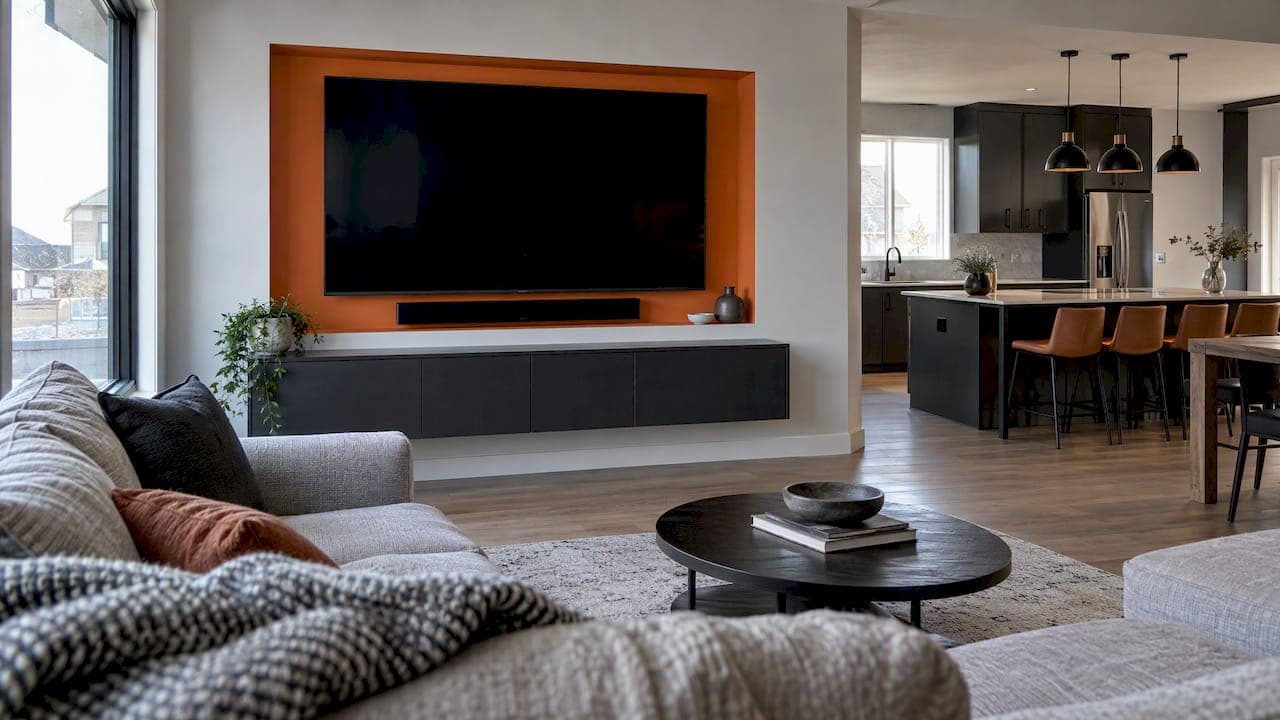
A TV wall niche is a framed recess in the wall that lets the screen sit flush with the surface. Done well, it hides the mount, the cables and the bulk of the set. Done badly, it traps heat, blocks access to your connections and has to be torn out when you buy a bigger TV. This guide covers how deep to build, how big to make it, how to keep the TV cool, what wiring to plan before drywall, and what to expect in Calgary on permits and cost.
TL;DR
- Plan the niche at about 6 to 8 inches deep, and frame it 4 to 6 inches larger than today's TV in both width and height so a future upgrade does not mean demolition.
- Never seal a TV in. Check the clearances in your TV's manual and leave room for air to move around the set.
- Run conduit and spare HDMI lines to the niche before the drywall goes up. This is the cheapest part of the job and the most expensive to fix later.
- In Calgary, residential electrical work needs a permit, and low-voltage cables must stay separated from power cables.
- Decide the TV size, height, speakers and lighting together, before framing starts.
Table of Contents
- What a TV niche does for a room
- Is a recessed niche the right choice?
- Getting the size right
- Ventilation: the part people skip
- Wiring and cable management
- Calgary code and permits
- Lighting and finish
- What does a TV niche cost?
- Our perspective
- Planning a niche with JupiterAV
- FAQ
- Sources
What a TV niche does for a room
A niche is more than a hole in the wall. One design guide on recessed TV walls describes it as a way to manage sightlines in open-concept plans: by creating a compressed, intentional zone for the TV, the wall acts as a pause in the architecture. In a Calgary home with a great room that flows into the kitchen, that matters. A TV floating on a big blank wall tends to dominate the space. A TV set into a defined bay reads as part of the architecture.
The current design direction goes further than a plain box. A niche media wall maker describes a trend toward composing the whole wall from planes, lighting and texture so that it still looks finished when the TV is off. That is worth borrowing even on a modest budget: a niche with a shadow line, a bit of indirect light and a considered finish looks intentional, while a bare recess looks like a mistake.
You will see the same idea called a recessed TV niche, a TV alcove or a media wall. The terms overlap, but they are not identical. A niche is the recess itself. A media wall is the larger composition around it, which may include a fireplace, shelving, cabinets and a speaker layout.

Is a recessed niche the right choice?
A niche suits you if:
- You want the TV as flat to the wall as possible, in a room where depth is tight, such as a hallway-adjacent living room or a narrow condo.
- You are building new or opening the wall anyway, so the extra framing is a small step.
- You want cables and equipment hidden but still reachable.
A niche is harder to justify if the wall is an exterior wall, a load-bearing wall, or has ductwork, plumbing or a structural element in the way. Exterior walls in Alberta also carry insulation and a vapour barrier that you should not casually cut into. Ask your builder or a qualified contractor before you frame into one.
If you are choosing between a niche and a simple wall mount, read our guide to TV mounting height first. The height decision affects where the niche sits, and it is easy to get wrong.
Getting the size right
Depth
A step-by-step niche build guide puts a standard niche at 6 to 8 inches deep, which covers the thickness of a modern TV (roughly 2 inches) plus room for the mount, plugs and connectors. A standard 2x4 wall has about 3.5 inches of cavity, and a 2x6 wall about 5.5 inches, so a niche that deep usually means building out a bay on the room side or the back side of the wall rather than cutting into the cavity alone. This is why the wall behind the niche matters before you commit.
If the wall is shallow, you have two options: build a shallow niche and accept that the TV sits slightly proud, or build the niche into a thicker, framed-out wall section. Both are legitimate. What does not work is cutting into insulation or a stud cavity with no plan for what fills the back.
Width and height
The most common mistake is building for the TV you own today. The same guide notes that a niche sized exactly for a 65-inch screen needs to be rebuilt if you move to a 75 or 85-inch model, and recommends framing 4 to 6 inches of extra width and height as a buffer. We agree, with one refinement: the buffer should look deliberate. A trim detail, an inset panel or a lighting reveal can make the extra margin look designed rather than leftover.
To pick the screen size itself, use viewing distance, not what the store has on sale. Our TV size by viewing distance guide explains the 1.6 rule for 4K and what we do when a room does not fit it neatly. If you might ever want a projector instead, projector versus TV is worth a read before you frame a niche that cannot accommodate a screen.
A quick sizing example
Suppose you plan a 75-inch TV. The set itself is roughly 65 inches wide and 37 inches tall, though you should always confirm the exact dimensions in the manufacturer's specifications for your model. Add a 4 to 6 inch buffer and the framed opening becomes about 69 to 71 inches wide and 41 to 43 inches tall. That opening accepts the 75 now and an 85 in a pinch only if you build with the larger set in mind, so if you suspect you will go bigger, size to the larger screen from the start and use trim to close the gap.

Ventilation: the part people skip
A TV in a tight niche has nowhere to put its heat. Manufacturers publish clearance requirements in their manuals, and they differ by model, so check yours before you finalise the opening. Blocking the vents at the back or bottom shortens a set's life. As a working rule, leave a gap of at least an inch or two around the sides and top, more at the rear, and never box in the bottom vents.
If you also plan to put a receiver, streaming box or amplifier in the niche, you have a bigger heat problem. Equipment generates far more heat than a TV, and it does not belong in a sealed cavity. Our piece on AV rack cooling explains how we size airflow, and the same principles apply to any enclosed space. The safest design puts source equipment in a ventilated rack or cabinet elsewhere, then runs HDMI to the niche.
If the niche sits above a fireplace, heat comes from below as well. We cover that in detail in our TV over fireplace guide.
Wiring and cable management
This is where niches succeed or fail. The niche build guide calls cable management the single highest-return detail: run flexible conduit, often called smurf tube, from the niche to the base of the wall or to a dedicated equipment rack. Without it, you cannot reach behind a flush-mounted TV to change anything. The same source recommends installing spare HDMI cables during the initial build.
Our practical checklist for the rough-in stage:
- Conduit, not loose cable. Run at least one empty conduit from the niche to the equipment location so cables can be pulled later.
- Spare HDMI and network. Install a second HDMI run and a network cable to the niche. A hard-wired connection is more reliable than Wi-Fi for streaming a 4K picture.
- Power at the niche. Use a recessed outlet or power relocation arrangement so the plug does not push the TV out from the wall. Have a licensed electrician do this.
- Speaker wire. If you plan in-wall or soundbar audio, pull speaker wire now. Our soundbar mounting guide covers the clearance a soundbar needs under or around the screen.
- Label everything. Both ends, every cable.
Builders should treat this as a standard checklist item. Our audio rough-in checklist for builders lists what to finish before drywall.
Calgary code and permits
Electrical work is where a DIY niche gets people into trouble. The City of Calgary's homeowner electrical wiring guide is the document to read. In practice, it means:
- Residential electrical work, including new outlets behind a TV, requires an electrical permit from the City of Calgary.
- Communication cables such as HDMI and speaker wire need to be kept apart from power and lighting cables. The guide's figure is 50 mm of separation.
- Non-metallic sheathed cable (NMD90) needs proper protection where it passes through metal studs, so it does not chafe on sharp edges.
The homeowner guide also lays out how cables must be supported near boxes and along runs. If you are hardwiring rather than plugging in, a DIY media wall guide similarly notes that a hardwired setup usually means an electrician and possibly permits.
Our advice: let a licensed electrician handle anything on the power side, and bring in an AV installer for the low-voltage side, ideally at the same time so both trades work to one plan. Low-voltage cabling is not zero-risk either. A poorly placed run can cause interference or fail an inspection if it crosses power lines incorrectly.
Lighting and finish
Lighting turns a niche from a hole into a feature. Three approaches work well:
- Indirect backlighting behind the TV reduces eye strain in a dark room and softens the contrast between the bright screen and the wall.
- Wall washing or shelf lighting on either side gives the wall presence when the TV is off.
- Dimmable control lets you drop the room to a cinema level with one button.
If the room doubles as a theatre, plan control from the start. Our home theatre lighting control guide covers how this works in Calgary homes.
For finishes, a recessed media wall design guide argues that the strongest walls do not try to disguise the screen. They make the screen one element in a composed wall. Painted drywall in a darker tone behind the screen, a wood slat panel, or stone cladding all work. If you want stone, see our guide on mounting a TV on stone for the anchors that hold.
What does a TV niche cost?
Costs vary widely because the niche may be a small framing job or a full wall. For reference, a custom niche media wall maker lists a professionally designed modern niche wall with integrated TV, optional fireplace and illuminated display niches starting at $9,500. That is one published starting price for a fully finished feature wall, not a quote for your project.
The cost drivers are consistent:
| Factor | What pushes cost up |
|---|---|
| Framing | Building out a thicker wall bay, bulkheads, structural changes |
| Electrical | New circuit, recessed outlet, permit and inspection |
| Low-voltage | Conduit, multiple HDMI runs, network, speaker wire |
| Finish | Stone, wood slats, custom millwork, painted shadow lines |
| Extras | Fireplace, built-in shelving, integrated lighting, in-wall speakers |
We do not publish fixed prices for our services, because a niche tied to a theatre, whole-home audio or lighting scene is scoped to the home. What we can say is that the lowest-cost point to add wiring is before drywall, and the highest-cost point is after the finish is done.
Our perspective
We install TVs, audio, lighting and smart home systems in Calgary homes, and we see the same pattern. The niche itself is rarely the problem. The problem is that the framing was done before anyone decided what would go in it.
Our approach is to treat the wall as a system. We want installs that are discreet and designed to disappear into the architecture, scaled to the space so control is intuitive. For a niche, that means agreeing on screen size, viewing height, speaker positions, lighting and equipment location on one drawing before the carpenter starts. It also means a single point of contact, so the framer, electrician and AV installer are not guessing at each other's work.
Three things we would never skip: conduit to a ventilated equipment location, a spare HDMI and network run, and a buffer around the screen. They cost little at rough-in and save a great deal later.
— JupiterAV
Planning a niche with JupiterAV
If you are building or renovating in Calgary or the surrounding acreage area and want a niche that works with your TV, audio and lighting, we can plan the low-voltage side with you and your builder. Our immersive sound and cinema, smart living, security and commercial AV services cover the wiring, TV supply and installation, and the systems that go around the wall. Contact us before framing, not after.
FAQ
How deep should a TV wall niche be?
Plan on about 6 to 8 inches for a standard niche, according to a DIY niche build guide. That allows for the TV's thickness of around 2 inches plus the mount and connectors. Check your model's specifications and build out the wall bay if the cavity is too shallow.
Can I put a TV in a niche without ventilation?
No. A sealed niche traps heat and can shorten the TV's life. Follow the clearances in your TV's manual, leave the vents unblocked, and keep heat-producing equipment such as receivers in a ventilated rack or cabinet instead.
Do I need a permit for a TV niche in Calgary?
Framing a niche on its own is a construction matter, but new electrical work does need an electrical permit from the City of Calgary, as set out in its homeowner wiring guide. Confirm your specific project with the City or your contractor before starting.
How big should the niche be compared with my TV?
Frame it 4 to 6 inches wider and taller than the screen, as the same build guide recommends, so you can upgrade later without rebuilding. Use trim or a lighting reveal to make the margin look intentional.
What do you call a recessed TV area in a wall?
It is usually called a TV niche, a recessed TV alcove or, when it is part of a larger feature wall with shelving or a fireplace, a media wall.
Sources
- How to Build a TV Wall Niche: Step-by-Step DIY Guide
- Recessed TV wall design guide
- Modern Niche Media Wall
- Homeowners electrical wiring guide, City of Calgary
- DIY Media Wall Build Guide: Costs, Steps, Pitfalls
- TV Niche Ideas: Design Approaches for a Recessed Media Wall