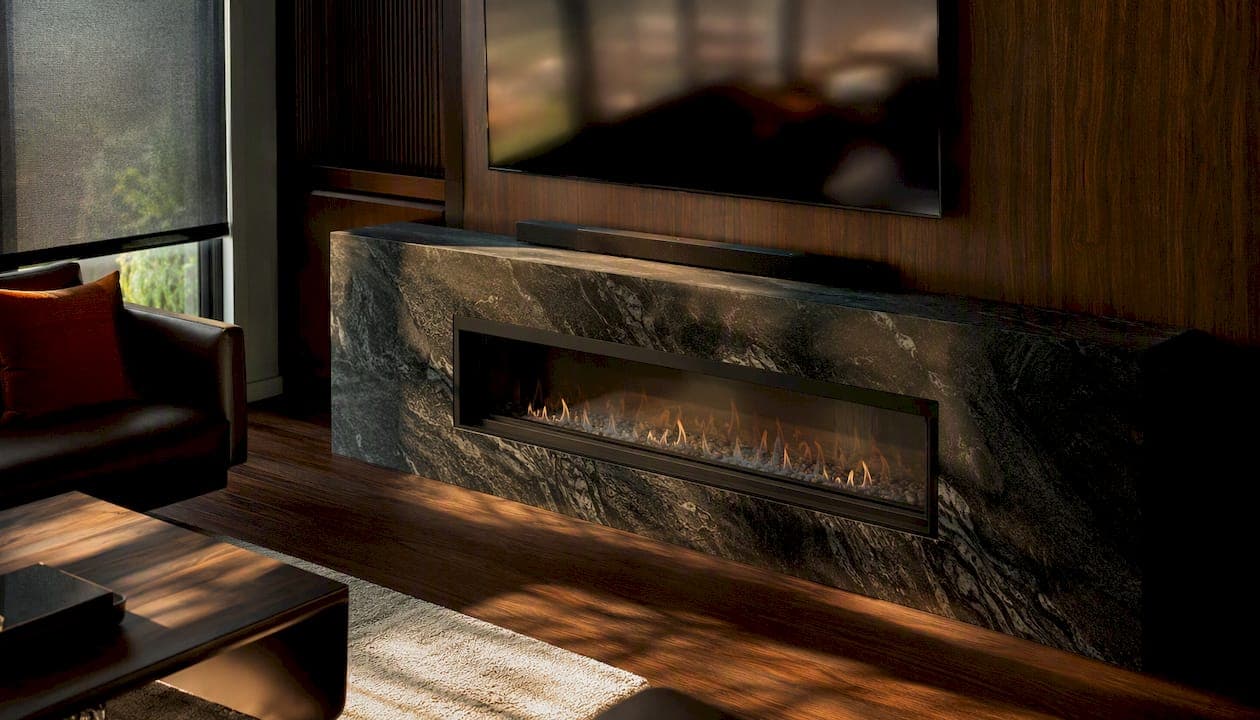
Yes, you can mount a TV over a fireplace, but only after you clear three checks: heat, viewing angle, and a solid mounting plan. Skip any one of them and you risk a shortened TV lifespan, a sore neck, or a wall that can't hold the bracket.
- Run the temperature test during a real fire or gas burn.
- Mock up the screen position and sit where you'd actually watch from.
- Confirm what's behind the wall (studs, brick, or masonry) and plan your wiring before you drill.
Pro Tip: If your fireplace runs hot no matter what you try, a pull-down mount or a switch to an electric fireplace insert solves the heat problem entirely instead of fighting it.
Key Takeaways
A TV can be safely mounted above a fireplace when the wall tests under 40°C, the viewing angle passes a real seating test, and the mounting hardware matches the wall substrate.
| Point | Details |
|---|---|
| Test heat before drilling | Run the fireplace 30 minutes and check the wall with an infrared thermometer against manufacturer limits. |
| Mock up the viewing angle | Tape a paper template at the planned height and sit in every seat before committing. |
| Match hardware to the wall | Studs need lag bolts and VESA-matched brackets; brick needs masonry anchors and spacer planning. |
| Plan wiring early | In-wall power kits and CL2/CL3-rated cable keep the install clean and code-aware. |
| Call a pro for complexity | JupiterAV handles site surveys, temperature testing, in-wall power, and finished trim work for above-fireplace installs. |
Table of Contents
- How to test if your fireplace wall is safe for a TV
- Best height for a TV over a fireplace without straining your neck
- Mounting methods for studs, brick, and mantels
- Wiring and power for a TV mounted above a fireplace
- Which TVs handle the heat and which ones to skip
- When to skip the fireplace wall entirely
- What a TV-over-fireplace project actually costs
- What a qualified installer checks before mounting your TV
- Sources
How to test if your fireplace wall is safe for a TV
Don't guess on this one. Light the fireplace and let it run for a full 30 minutes at your normal setting, then hold an infrared thermometer against the exact spot where the TV's back panel would sit.
Most TV manufacturers list a safe operating range somewhere near 95–104°F (35–40°C), and you want your readings well under that ceiling, not brushing up against it. A wall that hits 38°C after half an hour will keep climbing during a two-hour movie night or an all-day football marathon.
- Burn the fireplace for 30 minutes at typical use.
- Measure the mounting spot with an infrared thermometer, not a guess by touch.
- Repeat at the very top of the intended TV zone, since heat rises and the top edge often runs hotter than the centre.
- Compare your reading against the TV's rated operating temperature in the owner's manual.
If the wall runs hot, you've got options before writing off the location entirely. A deeper mantel acts as a physical heat deflector, a cool-wall or heat-shield kit adds a barrier behind the panel, and some installers add a small power vent to pull hot air away from the mount point. If none of that gets you comfortably under the limit, or if you see soot streaking near the mantel, that's your signal to relocate the TV or switch to an electric fireplace, which runs far cooler than a wood or gas unit.
Best height for a TV over a fireplace without straining your neck
The general rule for TV height puts the screen centre near seated eye level, but a fireplace throws that out the window because the mantel forces the TV higher than ideal. That's the trade-off nobody mentions until they're three episodes into a show with their chin tilted back.
Test it before you commit to a single hole in the wall. Tape a paper template cut to your TV's exact dimensions onto the wall, then sit in every spot people actually watch from, not just the centre of the couch.
- Sit for at least five minutes in each spot to see if your neck starts to ache.
- Check the angle from an armchair or ottoman, not just the main sofa.
- Note whether kids or shorter household members end up craning upward more than adults.
- Tape up the mock-up at your planned height.
- Sit and watch something for five to ten minutes per seat.
- Adjust the height down or add a tilting mount if the angle feels off.
- Confirm again after any furniture rearrangement, since seating distance changes the math.
A tilting or full-motion mount angles the screen downward toward your seating, which cuts a surprising amount of the strain a fixed mount creates. Fixed mounts are cheaper, but they lock you into whatever angle you install at, permanently.
Mounting methods for studs, brick, and mantels
The wall behind your fireplace decides everything about how you mount the TV. A framed wall with studs is the easiest scenario: locate two studs at the correct spacing, use lag bolts rated for your TV's weight, and match the mount's VESA pattern to the TV's rear bracket holes. Toggle anchors alone are not acceptable here. The TV is heavy, it's mounted high, and a drywall-only anchor can pull loose over time.
Brick and stone fireplaces need a different approach entirely. You'll want concrete anchors and a hammer drill, plus a plan for spacers if the veneer surface is uneven, since even small gaps between the mount and an uneven stone face can throw off the whole installation.
- Studs: lag bolts, VESA match, no drywall-only anchors.
- Brick or stone: masonry anchors, hammer drill, spacer plan for uneven veneers.
- Mantel-based mounts rely on mantel depth as part of the heat-management system, not just a decorative shelf.
- Pull-down and articulating mounts let you lower the screen to eye level for viewing, then push it back up flush against the wall when you're done.
A mantel projecting six to eight inches or more does real work deflecting heat away from the screen; a shallow two-inch ledge does almost nothing. Pull-down mounts cost more than a fixed bracket, but they solve the heat and ergonomics problems at once by physically moving the screen out of the hottest zone when the fireplace is running.
Pro Tip: If your fireplace has a stone veneer thicker than two inches, budget extra time. Uneven surfaces behind decorative stone are the number one reason DIY brick mounts run long.
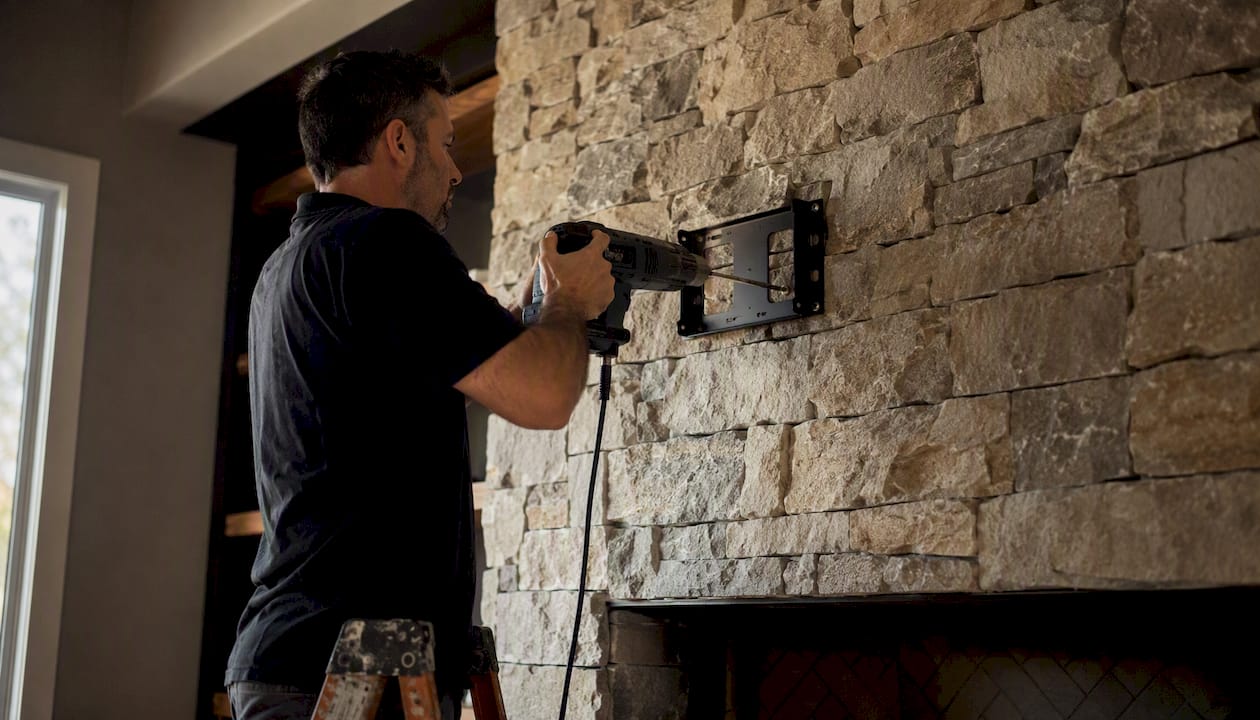
Call a professional when you're dealing with a heavy TV over 65 inches, a veneer you can't get a clean read on, or any hidden chase work needed to route cable through masonry. Guessing at what's behind a stone surround is how walls get cracked.
Wiring and power for a TV mounted above a fireplace
Nobody wants a cord dangling down the middle of their fireplace wall. An in-wall power bridge kit routes an extension cord safely inside the wall cavity between a new outlet behind the TV and your existing outlet, and it's the cleanest, most code-compliant fix for drywall installations.
- In-wall power kits hide the electrical cord without a new circuit.
- Run HDMI and ethernet cable rated CL2 or CL3 for in-wall use, never a standard consumer cable.
- Keep every cable run away from the fireplace's chase or vent path, since heat degrades cable jackets over time.
- On brick or stone, an external raceway or a paintable cord cover is a perfectly acceptable alternative to fishing wire through masonry.
A DIY installation with a basic power kit is well within reach for most homeowners. Where it gets complicated is a brand new outlet, a dedicated circuit, or running low-voltage cable through a wall with an existing gas line or a masonry chase. That's when you bring in a licensed electrician or an AV installer who pulls permits and knows what's legally required behind that wall.
Which TVs handle the heat and which ones to skip
Skip plasma entirely. That older technology was notoriously heat-sensitive and is largely off the market now anyway. Modern LED, LCD, and QLED panels tolerate a wider ambient temperature range, and most OLEDs perform fine too, provided you've confirmed the wall stays under the manufacturer's stated limit.
- Check the TV's maximum operating ambient temperature in the manual before you buy, not after.
- Sustained heat above spec can shorten backlight or panel life and may void your warranty outright.
- Look for a TV with a VESA pattern that matches tilting or full-motion mounts, since not every model supports the same bracket spacing.
- Thinner bezels help sightlines from an angle, and higher brightness compensates for the off-centre viewing a mantel position often creates.
Pro Tip: Before you buy, search the exact model number plus "operating temperature" in the specs sheet. Marketing pages rarely mention it, but the technical manual always does.
When to skip the fireplace wall entirely
Some fireplaces just aren't good candidates, and no mount or heat shield changes that. A wood-burning fireplace throwing visible soot and rising heat every time it runs is a red flag. So is a wall that keeps testing hot no matter what mitigation you try, or a mantel too shallow to function as a heat deflector.
- Mount the TV on an adjacent wall instead, out of the direct heat plume.
- Use a media cabinet at proper eye level below or beside the fireplace.
- Build a recessed alcove with ventilation if you're renovating and want a built-in look.
- Swap to an electric fireplace insert, which runs cool enough to make the mantel position viable again.
A projector setup is also worth a look if the fireplace wall keeps failing every test. You still get a single focal wall for movie night, minus the heat exposure.
What a TV-over-fireplace project actually costs
A basic DIY mount with a paintable cord cover runs the least, and takes one to three hours for someone comfortable with a drill. Add an in-wall power kit or a new outlet and you're looking at half a day to a full day, mostly because you're now fishing wire through a wall cavity.
- Mantel modifications or heat-shield installation: one to three days depending on finish work.
- Pull-down or motorized mounts: one to two days including trim and cable concealment.
- Masonry work, electrician scheduling, and finish carpentry all add contingency time, so budget extra days if your fireplace has a stone or brick surround.
What a qualified installer checks before mounting your TV
A professional doesn't start with the drill. They start with the fireplace itself: type, venting, mantel depth, and an actual temperature reading at the mounting point after a real burn.
- Confirm fireplace type (wood, gas, electric) and venting style.
- Measure mantel depth and verify it meets heat-deflection standards.
- Locate studs, header, or backing, and confirm the mount's weight rating against the TV.
- Plan masonry anchor points if the surface is brick or stone.
- Map in-wall power and low-voltage routing, and pull permits if a new circuit is required.
- Check for carbon monoxide alarms near any fuel-burning fireplace before finishing the job.
A good installer hands you documentation when the job's done, not just a mounted TV. That means recorded temperature readings, the mounting plan itself, photos of the wiring before the wall closed up, and a final post-install check with the fireplace running and the TV off to confirm the numbers still hold.
| Point | Details |
|---|---|
| Site survey first | Fireplace type, mantel depth, and wall temperature all get checked before any drilling starts. |
| Structural confirmation | Stud location, header backing, or masonry anchor plan must match the TV's actual weight. |
| Wiring and permits | In-wall power and low-voltage runs may require an electrician and local permits. |
| Documentation matters | Ask for temperature readings, wiring photos, and a post-install verification test. |
An installer's take on when to say yes
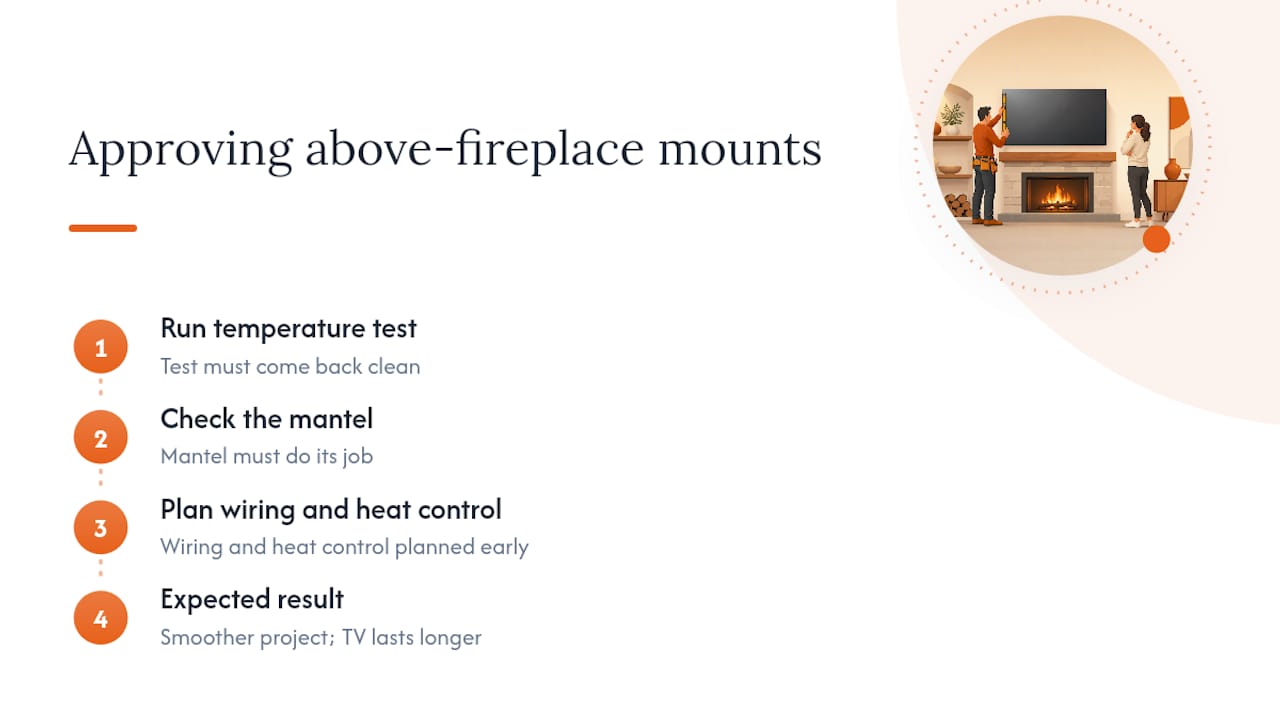
We approve an above-fireplace mount when the temperature test comes back clean and the mantel does its job. When wiring and heat control get planned early, the whole project goes smoother, and the TV lasts longer.
How JupiterAV handles your TV over fireplace project
Getting this right the first time saves you a re-drilled wall and a TV that dies two years early. JupiterAV runs the full process: a site survey to check your fireplace type and mantel depth, an actual temperature test during a live burn, mounting rated for your wall's substrate, in-wall power routing, and finished trim work that leaves no cord in sight.

Where a big-box install often stops at "the bracket is up," we don't consider the job done until we've verified the wall temperature with the fireplace running and the TV in place. If you're in Calgary and weighing a fireplace TV setup, book a site assessment with JupiterAV and get a plan built around your actual fireplace, not a generic checklist.
Sources
- How to Mount a TV Above a Fireplace Safely: Step-by-Step Guide | Pw Decor
- Can I Mount a TV Over My Fireplace | Heatilator