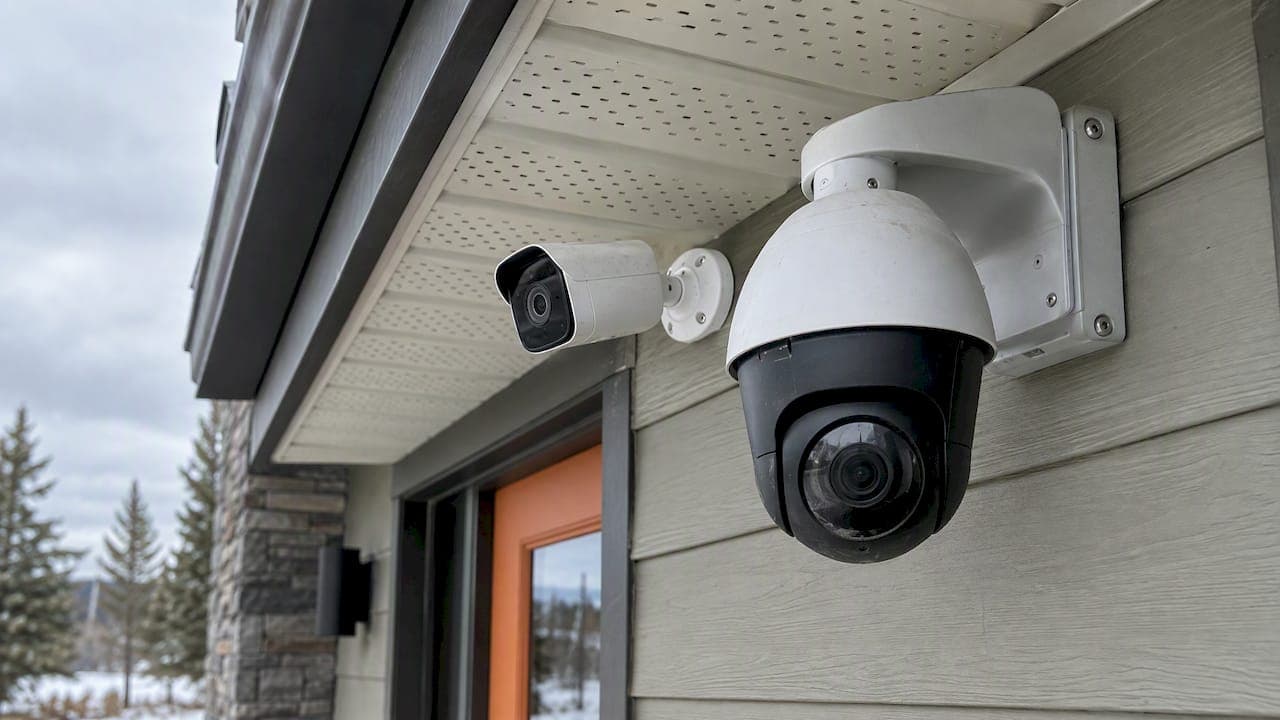
For most homes and small businesses, fixed cameras are the better foundation. They record their whole view all the time, they cost less, and they have no moving parts to fail through a Calgary winter. PTZ (pan-tilt-zoom) cameras earn their place on larger properties such as acreages, yards and parking lots, where one camera needs to cover a lot of ground or zoom in for detail. The strongest designs often use both: fixed cameras watch the key points, and a PTZ follows up on what they detect.
Below is how we think about the choice when we design security and CCTV systems, with the trade-offs, the mistakes we see, and the Alberta privacy considerations that apply either way.
TL;DR
- Fixed cameras record one view continuously. Use them for doors, driveways, gates and anything you may need to review after the fact.
- PTZ cameras pan, tilt and zoom, so one unit covers a wide area, but it only records where it is pointed at that moment.
- Best result on larger properties: pair fixed cameras with a PTZ so the fixed camera detects and the PTZ zooms in for identification.
- Bullet cameras are simply a fixed camera in a long, tube-style housing. The real comparison is fixed view against moving view.
- Privacy rules apply to both. Plan your viewing zones before installation, not after a neighbour complains.
Table of Contents
- What the two camera types actually do
- The catch with PTZ: it can only look one way at a time
- Side by side: PTZ vs fixed
- When fixed cameras are the right call
- When a PTZ earns its cost
- The best of both: fixed camera as trigger, PTZ for detail
- Wiring, recorders and network: the parts people forget
- Privacy: plan zones before you pick the camera
- Our perspective
- How to decide: five questions
- Planning a system with JupiterAV
- FAQ
- Sources
What the two camera types actually do
A fixed camera has a lens locked on one scene. Whatever is in that frame is recorded, around the clock, until you change the angle by hand. Bullet and dome cameras are the common housings. A bullet is the familiar tube shape that is easy to aim and visible as a deterrent. A dome is a smaller, more discreet housing, often chosen for soffits and ceilings.
A PTZ camera has motors. You, or software, can swing it left and right (pan), up and down (tilt) and zoom in and out. Some models patrol a set route, and some follow a person or vehicle automatically. Dome-style PTZs are sometimes called speed domes, which answers one of the questions people ask most.
So "PTZ vs bullet" is a slightly crooked comparison. A bullet describes the shape of a camera, while PTZ describes what it can do. In practice, when people compare the two they are really asking whether they want a camera that stays put or one that moves.
The catch with PTZ: it can only look one way at a time
This is the point most buyers miss. A PTZ camera can cover an area that might take several fixed cameras, but it cannot see everything at once. FLIR's comparison of bullet, PTZ and dome cameras makes the same point: relying on a PTZ alone for area coverage can leave a blind spot at the exact moment something happens, if the camera is aimed elsewhere.
Imagine a PTZ on the back corner of an acreage house, zoomed in on the shop door. Someone walks up the driveway behind it. Nothing is recorded of the driveway, because the camera was not looking there. A fixed camera on the driveway would have captured it.
That is why we ask one question first: will anyone be watching live, or will you only review footage after something happens?
- If footage is reviewed after an incident, which is how nearly every home system works, you want continuous recording of the places that matter. That means fixed cameras.
- If a person or an automated rule can react in real time, a PTZ becomes a real asset, because it can be steered to what is happening.
Side by side: PTZ vs fixed
| Factor | Fixed camera (bullet or dome) | PTZ camera |
|---|---|---|
| Coverage | One defined view, recorded constantly | Wide area, but only one view at a time |
| Detail on demand | Limited to what the lens frames | Optical zoom for faces, plates, activity far away |
| Best locations | Entrances, driveways, gates, garage doors, walkways | Large yards, parking lots, acreage yards, shop frontage |
| Moving parts | None | Motors and gears that wear over time |
| Setup | Aim once, check the frame | Presets, patrol routes, and calibration if using auto-tracking |
| Night performance | Strong, because the shutter and settings stay tuned to one scene | More demanding, because moving through dark scenes can mean blur |
| Cost | Lower per unit | Higher per unit, plus often a higher-grade recorder and network |
| Staff attention | None needed | Most useful when someone or something responds live |
On cost, we do not quote generic per-camera figures because they vary widely by brand, resolution, optics and weatherproofing. In general PTZ units cost noticeably more than fixed ones. For what a full installation looks like in this province, see our CCTV installation cost guide for Alberta.
When fixed cameras are the right call
Fixed cameras are the right default for the majority of Calgary homes and small commercial sites. Choose them when:
- You are covering chokepoints. Front doors, side gates, garage doors, back entries and the foot of a driveway are places people have to pass through. A fixed camera framed on that spot records everyone who does.
- You need a dependable record. If you want footage for an insurance claim or a police report, you want continuous recording, not a camera that may have been looking at the neighbour's tree.
- You want a deterrent. A visible bullet camera over a door tells people they are on camera before they try anything.
- You are on a tighter budget. Two or three fixed cameras covering the right angles often beat one expensive PTZ.
- You do not want maintenance. No motors means one less thing to fail in a −30 °C cold snap.
Our security camera placement guide for homeowners walks through where to put them around a typical house.
Mounting height matters more than most people expect
A common error is mounting a camera too high. The view turns into a bird's-eye shot that flattens faces and makes identification hard. Axis, a major camera manufacturer, recommends about 16 feet (5 metres) as the optimal mounting height for its Q6000-E PTZ line, balancing vertical coverage, image detail and zoom angle. That is guidance for a particular PTZ series covering a perimeter, so a one-storey home's front door camera will sit much lower. The principle holds, though: height is a trade-off between coverage and detail, and the mount must be firm, because vibration degrades the image.
When a PTZ earns its cost
A PTZ makes sense when the space is large, open or changeable and you need the option of seeing detail at a distance. Typical situations around Calgary include:
- Acreages and rural properties. A long driveway, a shop, a barn and a yard are a lot of ground for fixed cameras alone.
- Parking lots and yards at commercial sites. One PTZ can scan a lot and zoom in on a vehicle.
- New builds with large lots. Builders and owners often want one overview camera that can be directed to wherever attention is needed.
- Live monitoring. If someone is watching from an app or a monitor, or an alert prompts a response, the movement is useful.
To keep your expectations realistic, here are the limits:
- It records only where it points. Patrol routes help, but they do not replace continuous coverage of key points.
- Night footage can suffer. Moving cameras in low light can produce more blur, and in many cases two modest fixed cameras with good low-light performance give clearer night footage than one PTZ. Lighting the area properly helps both types.
- Moving parts wear. Motors that run patrols all day will age faster than a fixed housing, and outdoor models need to be rated for the weather.
- Auto-tracking is not plug and play. It needs calibration, which we cover next.
The best of both: fixed camera as trigger, PTZ for detail
On larger properties, the most effective approach is to stop treating this as either/or. Axis describes this pairing as a fixed camera providing continuous coverage and detection, while a PTZ steers to the detected object and zooms in for identification.
Here is what that looks like in practice on an acreage:
- A fixed camera at the gate or the corner of the house watches the approach all the time and records everything.
- When it detects a person or vehicle, the PTZ swings to the same spot and zooms in on a face, a licence plate or what the person is carrying.
- You get both the continuous record and the close-up detail.
The setup needs care. In Axis's own documentation for its PTZ auto-tracking plugin, the PTZ home position has to cover a minimum share of the fixed camera's detection area, and the angle between the two cameras has to be small for the hand-off to be accurate. That is vendor-specific guidance, but it shows why auto-tracking is a design job. Where each camera sits, and how they relate to each other, decides whether it works. If someone offers you auto-tracking as an add-on switch, ask how the two cameras will be positioned and calibrated.
If you are exploring AI features on either type, our guide to choosing the right AI security camera covers what smart detection can and cannot do.
Wiring, recorders and network: the parts people forget
The camera choice affects the rest of the system.
- Power and data. Most professional installs run a single network cable to each camera that carries both. PTZs can draw more power than fixed units, so the cabling and the switch need to be planned for it. We cover the trade-offs in wired vs wireless cameras.
- Recorder. PTZ and high-resolution streams put more load on your recorder. Whether you need a network video recorder or something older is covered in NVR vs DVR.
- Network. Several high-resolution cameras and a PTZ stream need a network that can handle them, with the cameras kept off your main household devices where possible.
This is one reason we handle low-voltage wiring and networking in the same project as the cameras. A camera is only as good as the cable, switch and recorder behind it.
Privacy: plan zones before you pick the camera
PTZ cameras raise a particular privacy question, because a camera that can swing and zoom can look into places a fixed camera never would: a neighbour's window, a yard or a public sidewalk.
Private-sector privacy law in Canada treats video surveillance as intrusive. The Office of the Privacy Commissioner of Canada's guidelines on overt video surveillance say organizations should consider less privacy-invasive options before turning to video, and that impact on privacy should be minimized. Alberta's commissioner publishes a matching guidance document on video surveillance in the private sector that applies to organizations in this province. These guidelines are aimed at organizations, so a business owner or a condo or strata board should pay close attention. A homeowner's situation differs, but the sensible habits are the same.
What that means when choosing between the two:
- Fixed cameras make zones easy. The frame is the boundary. Aim it at your own door and driveway and it stays there.
- PTZ cameras need limits built in. Use software privacy masks and restricted pan ranges so the camera cannot be steered toward a neighbour's property or the street, rather than trusting that nobody will aim it there.
- Document the purpose. Write down why each camera is there and what it covers. If you cannot explain a camera's purpose, reconsider it.
We have written more on this for local owners: Alberta security camera rules, privacy zones that hold up and home security camera privacy in four steps. For anything beyond a typical home setup, such as a business with staff or customers on camera, speak to a lawyer or to the Alberta privacy commissioner's office about your specific obligations.
Our perspective
We design security systems alongside the rest of a home's technology, and the camera question is rarely about the camera. It is about what the property needs to be protected from, and who will look at the footage.
Our starting point is almost always fixed cameras on the places people must pass through. They are dependable, discreet when specified well, and they give you a continuous record. We add a PTZ when the property genuinely calls for one: an acreage, a commercial lot, or a yard where an overview and a close-up are both worth having. When we do, we prefer to pair it with fixed cameras rather than leave it to cover an area alone.

We also care how a system looks. Our installs are designed to disappear into the architecture, with cable runs planned in advance, which is much easier when we are involved before the drywall goes up. For custom home and acreage builders, that means camera locations, wiring and network on the same plan as the audio, lighting and automation. One team and one point of contact, so nobody is guessing who ran which cable.
If a design includes a PTZ, we would rather tell you what it will and will not do than sell it as a cure-all.
— JupiterAV
How to decide: five questions
- What are you protecting? Entrances and valuables point to fixed cameras. A large open area points to a PTZ added to fixed coverage.
- Who will watch? If nobody watches live, build around continuous recording.
- How dark does it get? Rural and acreage properties are very dark at night. Plan lighting, and pick cameras with strong low-light performance.
- What is the weather exposure? Alberta winters are hard on moving parts and cables. Ask whether the housing and mounting are rated for outdoor use in cold conditions.
- What about the neighbours? Plan viewing zones and masks first.
Answer these on paper, with a sketch of your property, before you look at product pages. The right mix usually falls out of the answers.
Planning a system with JupiterAV
We design, supply, install and service security and CCTV systems in Calgary and the surrounding area, together with the wiring and networking behind them. We work with homeowners, businesses and home builders, including custom home and acreage builders who want cameras planned in at the wiring stage. If you want a recommendation that fits your property, get in touch with JupiterAV and tell us about the site. We will talk through fixed, PTZ or a pairing before anything is quoted.
FAQ
Is a PTZ camera better than a fixed camera?
Neither is better in every case. A PTZ covers more ground and can zoom for detail, but it only records what it is pointed at. A fixed camera records one view constantly, which is why we use it for entrances and driveways.
What is the difference between a PTZ camera and a dome camera?
PTZ describes what the camera can do: pan, tilt and zoom. Dome describes the housing. Many PTZ cameras use a dome housing (often called speed domes), but plenty of dome cameras are fixed and do not move at all.
Can one PTZ replace several fixed cameras?
It can cover an area that would otherwise need several, but not at the same time. It can only watch one part of that area at any moment. Where continuous recording matters, fixed cameras on the key points are the safer design.
Is a PTZ or a bullet camera better at night?
In many cases a well-chosen fixed bullet camera gives cleaner night footage, because it stays on one scene and is tuned for it. PTZ cameras can show more blur in low light when they move. Good lighting helps both, and a PTZ with strong low-light performance can do well.
Do privacy laws apply to PTZ cameras in Alberta?
Yes. Private-sector privacy guidance in Canada and Alberta asks organizations to limit the privacy impact of video surveillance, and a camera that can pan and zoom needs extra care about what it can see. Use masks and pan limits, and ask a lawyer or the Alberta privacy commissioner's office if your situation is commercial or unclear.
Sources
- FLIR: Bullet vs. PTZ vs. dome security cameras
- Axis: Mounting height recommendations for the Q6000-E (PDF)
- Axis: Perimeter Defender PTZ Autotracking
- Axis: Perimeter Defender PTZ Autotracking technical documentation
- Office of the Privacy Commissioner of Canada: Guidelines for overt video surveillance in the private sector
- Office of the Information and Privacy Commissioner of Alberta: Video surveillance in the private sector