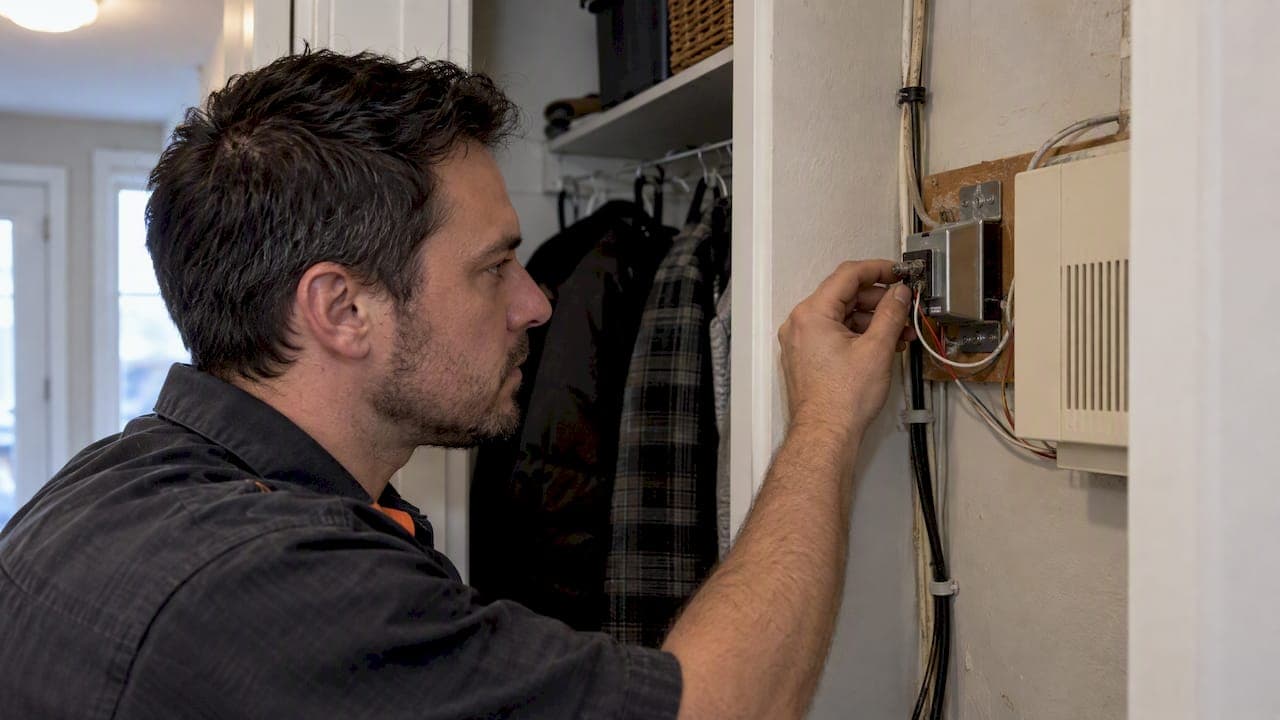
Most wired doorbells need a transformer rated 16 V AC at 10 VA or more, but that is only the legacy starting point. A modern video doorbell often wants 16 to 24 V AC and a higher VA rating, and many manufacturers recommend more than the old 10 VA box can give. Match the voltage first, then size the VA for everything on the circuit: the doorbell, the chime or chimes, and any second button. Replacing the transformer itself is line-voltage work, so treat it as a job for a qualified electrician.
This guide explains how to read what you have, how to size what you need, and where Calgary homes and acreages tend to go wrong.
TL;DR
- Voltage comes first. A transformer with more VA cannot fix a voltage that is outside your doorbell's or chime's range.
- A basic mechanical doorbell traditionally runs on 16 V AC and about 10 VA. The chime's label or manual has the final say.
- Many video doorbells accept 16 to 24 V AC and 10 to 40 VA. A 16 V, 30 VA transformer is a common choice when the model allows it.
- The doorbell side is low voltage, but the transformer's input is household line voltage, so replacement is electrical work.
- Building or renovating? Decide the doorbell model, chime plan and transformer location before drywall goes up.
Table of Contents
- What the two numbers on a transformer mean
- What size transformer a doorbell needs
- Can you use a 24 V transformer?
- How to find out what you already have
- Signs your transformer is too small
- Safety: low voltage on one side, line voltage on the other
- Perspective: what we see in Calgary homes
- Planning a doorbell for a new build or renovation
- Winter and seasonal checks
- Quick reference: choosing by situation
- Let us handle the doorbell power
- FAQ
- Sources
What the two numbers on a transformer mean
Every doorbell transformer is labelled with a voltage (V) and a volt-amp rating (VA).
Voltage is the AC output the doorbell and chime are designed to run on. Common outputs are 8, 16 and 24 V AC. Your doorbell, your chime and the transformer must all agree on this number.
VA is the capacity: how much power the transformer can deliver. Think of it as the size of the tank, not the pressure. A 30 VA unit can carry a bigger load than a 10 VA unit at the same voltage, but it does not change the voltage.
That is why sizing is two-dimensional. Get the voltage inside the accepted range, then pick a VA rating that covers the total load with headroom.

What size transformer a doorbell needs
A basic mechanical doorbell
For a traditional ding-dong chime with a plain push button, the long-standing common size is 16 V AC at 10 VA. Replacement units in that size are still sold as a drop-in swap for an old transformer, for example a 16 V/10 VA unit described by one hardware maker as working with any wired door chime. Treat that as a generalization. The chime manufacturer's specification controls, so read the label on the chime or the manual before you buy anything.
If you have several chimes, such as one in the front hall, one upstairs and one in a basement suite, the load adds up. One forum answer on the subject suggests a 16 V transformer at 20 to 30 VA for multiple chimes. Take that as a rule of thumb, then confirm against each chime's rating.
A video doorbell
Video doorbells draw more power than a push button, and they draw it constantly for the camera, Wi-Fi and motion sensing. The manufacturers publish their ranges:
| Device | Voltage | VA | Source |
|---|---|---|---|
| Ring Wired Doorbell Plus (2nd Gen), Canada | 16 or 24 V AC | 10 to 40 VA, with 30 to 40 VA recommended for optimal performance | Ring Canada |
| Ring wired devices, general troubleshooting table | 16 to 24 V AC | 10 to 40 VA | Ring support |
| Nest Doorbell (wired, 2nd and 3rd gen) | 16 to 24 V AC | 10 to 40 VA | Google Nest Help |
The same Ring troubleshooting page lists multiple doorbells at 16 V AC and 30 VA. In practice, that is why a 16 V, 30 VA transformer is the usual baseline we reach for when the device accepts it. It sits inside nearly every published range and leaves headroom for a chime. Home Depot Canada lists a 16 V AC, 30 VA transformer sold for video doorbells, so the part is easy to find locally. Availability is not the same as compatibility, though. Check the model.
Why 10 VA becomes marginal
A 10 VA transformer was sized for a single button and a single chime. Add a camera, a second doorbell or a second chime and you can land right at the edge of what it can supply. Ring's guidance on power explains the logic: more features and more connected devices raise the load, so the answer is a listed transformer whose voltage and VA satisfy every device on it, not simply the biggest one you can find.
Can you use a 24 V transformer?
Sometimes, but not automatically. Two separate questions apply.
- Does the doorbell accept 24 V AC? Some models do. Ring's Wired Doorbell Plus and Wired Doorbell Pro documentation support 16 to 24 V AC, but compatibility is model by model, so never infer it from the brand name alone.
- Does the chime accept 24 V AC? This is the one people miss. A chime built for 16 V can be damaged or misbehave on 24 V. Ring's documentation warns that the wrong transformer, chime or power supply can damage equipment or stop the chime from working.
So a 24 V transformer on a 16 V-only chime is a mismatch, and extra VA does not make it right. If you want to keep a beloved mechanical chime, have the installer verify its label before choosing 24 V. Otherwise the fix may be a compatible chime, a manufacturer's power kit, or a different transformer.
Multi-voltage units exist, offering 8, 16 and 24 V taps. They are handy but they put the choice of tap in the installer's hands, which is exactly where a wrong choice can happen. Pick the tap that matches the lowest-rated device on the circuit.
How to find out what you already have
The home's age does not tell you the output. Two houses built the same year can have different transformers, and renovations swap them. Read it, or measure it.
Step 1: Find the transformer. Google notes that the information is commonly found in or near the chime or the electrical panel. Other places we see them: a garage wall, a basement ceiling or furnace room, a closet, or an attic. Wirecutter's installation advice also points to the area near the electrical panel as the usual spot.
Step 2: Read the label. Look for the secondary (output) rating, such as 16 V 10 VA. Take a photo of it. If it is painted over, worn off or missing, do not guess.
Step 3: Read the chime. Many chimes list their voltage inside the cover. If you have more than one chime, note each one.
Step 4: Confirm with a meter if the label is gone. Wirecutter suggests confirming the rating or testing the wires with a multimeter. Measuring the low-voltage side with an AC meter is something a careful homeowner can do with the right setting and caution, but if you are unsure, stop and call someone. Google says to seek professional evaluation or replacement if the system falls outside its range or is unlabelled.
Step 5: Compare with the new doorbell. Put the doorbell's voltage and VA range beside what you found. If the numbers sit inside the range, you may not need to change anything.
What to send an installer
You will save a visit if you can provide:
- The exact doorbell model
- The chime model, or a photo of its label
- A photo of the transformer label
- How many chimes and buttons there are
- Where the transformer is
Signs your transformer is too small
A transformer can look correct on paper and still fall short once the camera, chime and wiring share it. Typical symptoms:
- The doorbell drops offline or reboots
- Video is laggy or slow to wake
- The chime sounds weak, buzzes or does not ring
- The device shows a warning light. Google, for instance, says a yellow blinking indicator can point to insufficient power
The frustrating part is that the doorbell fits and is wired correctly. It simply cannot get enough power. That is why a professional check is worth it when the label is missing or you have an unusual multi-chime layout.
Wire matters too. Ring specifies 16 to 20 gauge wire for its doorbells and notes that wire that is too thin or too thick might not deliver enough power. Long runs to a detached garage or across an acreage property add resistance, so the transformer is not always the only culprit.
Safety: low voltage on one side, line voltage on the other
The doorbell wiring is low voltage. The transformer's input is not. A hardwired transformer is fed from your home's 120 V supply, so replacing it means working on line-voltage wiring.
In Calgary, the City says an electrical permit is required for new wiring installations and when extending or altering existing branch circuit wiring. It does not require one when only replacing fixtures. Whether a specific transformer swap needs a permit depends on what is being altered, so ask a registered electrical contractor. The City also notes that electrical contractors cannot work under a homeowner permit and must obtain their own.
A few rules of thumb we hold to on every job:
- Turn the power off at the breaker and verify it is off before opening anything.
- Use only the transformer type the doorbell maker specifies. Do not substitute a lighting, halogen, garden-lighting or arbitrary DC supply. Ring explicitly warns that only an existing transformer within its stated range or compatible accessories should power the device, for your safety.
- Mount the transformer in an accessible, proper enclosure. Keep line-voltage connections separate from the low-voltage doorbell wiring.
Perspective: what we see in Calgary homes
We install and service smart home, audio/video, security and low-voltage systems across Calgary, so doorbell power comes up constantly. Our view is simple: the transformer is the least glamorous part of a video doorbell and the most common reason it misbehaves.
Three habits separate a doorbell that works for years from one that keeps going offline.
Specify before you buy. We pick the doorbell model first, then the chime plan, then the transformer. Buying the transformer by voltage alone is how people end up with a doorbell that boots, then drops out every evening.
Do not chase the biggest number. The right answer is a transformer whose voltage and VA suit every connected device. More VA than needed is harmless in the right voltage, but it does nothing for a mismatch.
Put it where you can reach it. In custom homes and acreage builds, the retrofit problem is a transformer buried behind finished drywall or millwork, or one tucked in a space nobody can get to. We plan an accessible location and the cable route during the low-voltage design stage, when changes cost almost nothing. If you are budgeting a build, our low-voltage prewire cost guide for Calgary covers how that stage is priced and permitted.
Our installs are designed to disappear into the architecture, and a doorbell power supply is part of that. It should be accessible to service, invisible to guests and sized to the space.
— JupiterAV
Planning a doorbell for a new build or renovation
If you are a homeowner or a builder working before drywall, you have options a retrofit never gets.
- Choose the doorbell family early. Wired models differ in voltage range, VA range and chime requirements. Google's own guidance on transformers highlights that newer doorbells have higher power requirements than older ones, and that some installations need an upgraded transformer.
- Decide the chime strategy. One mechanical chime, a digital in-home chime, or none and rely on app and speaker notifications. This sets the load and the voltage.
- Plan every button. Front door, side door, a suite entrance. Multiple doorbells push you toward 30 VA.
- Run the cable properly. Use the gauge the doorbell maker specifies and keep runs reasonable.
- Fix the transformer location. Choose an accessible spot near the panel or utility area and note it on the drawings.
- Label everything. Voltage, VA, which device it feeds, and the doorbell and chime models.
If the doorbell is one piece of a wider security plan, our guide to wired versus wireless cameras for Canadian homeowners helps you decide what to hardwire. If you are weighing doorbell brands, we also cover Ring alternatives for Calgary homeowners.
Winter and seasonal checks
Alberta cold is hard on exterior doorbells, and an underpowered unit shows its weakness first when heaters, cameras and night vision work harder. Before winter, check that the doorbell stays online, the chime still sounds, and exposed wire connections at the door are sealed. Our pre-winter smart home maintenance guide lists the other items worth checking at the same time.
Quick reference: choosing by situation
| Your situation | Sensible starting point | Check before buying |
|---|---|---|
| Old push button and one mechanical chime | 16 V AC, 10 VA as the legacy size | The chime's label or manual |
| Video doorbell, one chime | 16 V AC, often 30 VA if the model accepts it | The doorbell's stated voltage and VA range |
| Two doorbells or several chimes | 16 V AC, commonly 30 VA or more | Each chime's voltage and the total load |
| Doorbell rated for 24 V and chime that accepts 24 V | 24 V AC within the stated VA range | Both devices accept 24 V |
| Label missing or system unfamiliar | Do not guess | Professional evaluation |
Let us handle the doorbell power
If you would rather not trace wires, read labels and open a line-voltage enclosure, our team in Calgary can assess the doorbell, chime and transformer together, and fit it into a broader security and smart home plan. We also work with home builders and acreage builders who want the low-voltage design settled before the walls close. Browse our smart home cost breakdown to see how projects are scoped.
FAQ
What size transformer do I need for a doorbell?
For a basic mechanical doorbell, 16 V AC at 10 VA is the traditional size, but the chime's label decides. For a video doorbell, check the model's accepted voltage and VA range. A 16 V, 30 VA transformer is a common choice when the device allows it.
Can I use a 24 V transformer with my Ring doorbell?
Only if your specific Ring model lists 24 V AC as acceptable. Several wired models support 16 to 24 V AC. You must also confirm that your in-home chime accepts 24 V, because a 16 V-only chime can be harmed.
Can I use a 24 V transformer on a 16 V doorbell chime?
Not without checking. The doorbell, transformer and chime must have compatible voltage requirements, and extra VA does not solve a voltage mismatch. Verify the chime's label or manual first, or ask an installer about a compatible chime or power kit.
What voltage does an old house doorbell use?
Many older North American homes use a low-voltage AC transformer, often near the panel or chime. The exact output cannot be assumed from the home's age. Read the label or measure the secondary with an AC meter, then compare it with the doorbell and chime requirements.
Do I need an electrician to replace a doorbell transformer?
The transformer's input side is household line voltage, so we treat replacement as electrical work. Ask a registered electrical contractor in Calgary whether your specific job needs a permit, since the City requires one for new wiring and for altering existing branch circuits.
Sources
- Ring: Troubleshooting power for hardwired doorbells
- Ring Canada: Wired Doorbell Plus (2nd Gen) + Chime Bundle
- Ring: Installing Ring Video Doorbell Wired
- Google Nest Help: Upgrade your transformer for Nest Doorbell
- Wirecutter: The right way to install a doorbell camera
- City of Calgary: Homeowner electrical and plumbing permits
- Newhouse Hardware: 16TR 16V/10VA Doorbell Transformer
- Home Depot Canada: 16VAC/30VA transformer for video doorbells