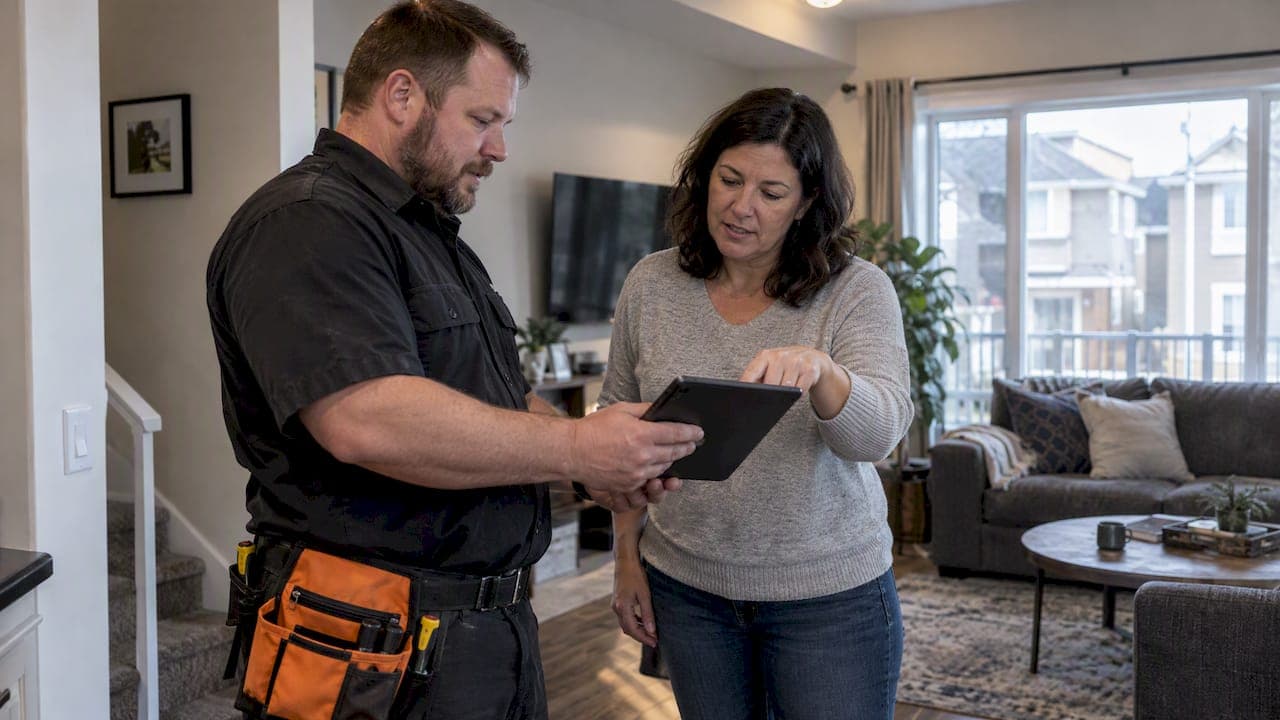
Most Calgary homeowners land in one of three bands: roughly $500 to $2,000 for an entry kit, $6,000 to $12,000 for a mid-tier installed system, or $10,000 and up for whole-home integration. Hardware, infrastructure readiness and labour make up the final number, and site condition decides which end of each range you land on. Before you call an installer, gather photos of your electrical panel and router location so you get a defensible quote.
TL;DR:
- Infrastructure costs in Calgary are the main factor driving price variability, especially in older homes with limited wiring or weak Wi-Fi coverage.
- A detailed site assessment, including photos of panels and network areas, is essential for an accurate, itemized quote that highlights hardware, infrastructure, and labor costs.
- Budgeting 3% to 5% annually for ongoing maintenance, subscriptions, and device replacements is necessary to understand the total ownership costs over time.
- DIY installation suits simple devices like smart plugs or batteries, but anything involving electrical wiring or integrated systems requires professional installation to protect warranties and system functionality.
- Whole-home automation costs can exceed $25,000 in Calgary, especially in older homes, with additional hidden fees like permits, network upgrades, and ongoing subscription services.
Table of Contents
- Calgary price bands explained: what each budget level delivers
- What drives the price: hardware, infrastructure and labour
- How to get an accurate, itemized quote in Calgary
- Budget examples: starter, mid-tier and whole-home sketches
- Why hire a local certified integrator
- Total end-to-end cost: hidden fees and taxes
- DIY vs professional installation costs
- Financing options and rebates available in Calgary
- Prioritize infrastructure or devices first?
- Request an itemized quote from JupiterAV
- FAQ
- Sources
Calgary price bands explained: what each budget level delivers
Your goal, not your postal code, determines which band fits. An entry-level setup covers a handful of smart plugs, a video doorbell and a thermostat, usually installed as off-the-shelf devices with little rewiring. A mid-tier project adds lighting control, climate zoning, security sensors and voice control, and that's where installed pricing commonly runs $6,000 to $12,000 depending on how many rooms and systems are tied together. Whole-home integration folds in motorized shading, whole-house audio, a networked video recorder for cameras and centralized control, and fully integrated systems can exceed $25,000 installed.
Calgary's older housing stock, especially pre-1980 bungalows and infills with finished basements, tends to push projects toward the higher end of each band because cabling has to be fished through finished walls rather than run during framing.
- Entry: smart plugs, one thermostat, a doorbell camera, usually a weekend DIY project or a short electrician visit.
- Mid-tier: multi-room lighting, a security system, climate zoning and voice control, professionally installed and programmed.
- Premium: whole-home audio, motorized blinds, structured wiring and a central processor like Control4 tying every system together.
What drives the price: hardware, infrastructure and labour
Every quote breaks down into three buckets. Hardware is the physical gear: switches, sensors, speakers, cameras and the processor that ties them together. Infrastructure readiness covers what your house needs before that gear works: panel capacity, neutral wires at switch locations, network cabling and Wi-Fi coverage. Labour is the electrician and integrator time to install, program and commission everything.
A typical professionally quoted project splits roughly 45% hardware, 25% infrastructure and 30% labour, but that ratio shifts fast in older Calgary homes.

Older homes commonly push infrastructure costs well above the typical 25% share, which is the single biggest reason two houses with the same device list get very different quotes.
Common infrastructure issues in Calgary homes include:
- Electrical panels without spare capacity for new smart switches or a home-run network cabinet.
- Missing neutral wires at older switch boxes, which some smart switches require.
- Finished basements or lath-and-plaster walls that make fishing new cable expensive.
- Weak Wi-Fi coverage in homes over 2,000 square feet without a mesh network.
How to get an accurate, itemized quote in Calgary
A fair comparison between installers starts with what you bring to the table and what you demand back in writing.
- Photograph your electrical panel, your router's current location, and every room where you want smart devices before the site visit.
- List your goals in plain language: better climate control, security monitoring, whole-home audio, not just a device wish list.
- Request a site assessment before any firm number; a reliable quote depends on an integrator inspecting your panel and network backbone first.
- Require an itemized quote that separates hardware, infrastructure work, labour, permits, commissioning and any annual maintenance contract.
- Ask about Matter and Thread compatibility so your devices aren't locked into one ecosystem that gets discontinued.
- Confirm permit responsibility: electrical work in Calgary typically requires a licensed electrician and permit, and that cost should appear as its own line.
- Get a written timeline, including lead time for backordered hardware, which can stretch a mid-tier project past the installer's first estimate.
If your home has older insulation, vermiculite, or was renovated before the 2000s, it's worth a quick asbestos or hazardous materials check before anyone starts fishing wire through finished walls, since disturbing certain older materials adds cost and delay if discovered mid-project.
Pro Tip: Ask every installer to name the phases in their quote (discovery, design, prewire, install, commissioning, support) so you can compare apples to apples instead of guessing what's bundled.
A red flag worth watching for: a quote with one lump-sum number and no breakdown. That usually means infrastructure problems will surface as change orders once walls are opened.
Budget examples: starter, mid-tier and whole-home sketches
Numbers help more than categories. Here's how three Calgary scenarios typically shake out.
A starter scenario: a smart thermostat, two smart switches and a video doorbell bought at retail might cost $400 to $600 in devices, but if your switches lack neutral wires, electrician labour to add them commonly runs $400 to $900 for a simple set of fixtures.
A mid-tier scenario: whole-house lighting, a security system and zoned climate control typically call for new low-voltage cabling and panel work, and fuller retrofits with structured cabling can run $3,000 to $8,000 in labour alone before hardware is added.
A whole-home scenario adds motorized shading on every window, multi-room audio and a networked video recorder for security cameras, the combination that pushes installed totals past $25,000.
- Budget 3% to 5% of your installation cost annually for service, firmware updates, and system checkups.
- Expect device replacement and subscription costs to add to your five-year total, not just your install-day invoice.
Why hire a local certified integrator
A thorough site assessment checks panel capacity, existing wiring, network coverage and structural access before any number gets written down, which is what prevents the mid-project change orders that blow up budgets. A thorough site assessment by professional installers typically includes sales, installation and service of Control4 systems, Lutron Caseta and Lutron motorized shading, Sonos and WiiM audio, low-voltage wiring, security and CCTV, and custom home theatres for Calgary homes, businesses and builders.
For deeper technical background before your consultation, our guides on smart home networking and smart thermostats for Canadian heating systems cover the groundwork that shapes most quotes.
Total end-to-end cost: hidden fees and taxes
Sticker price rarely matches what lands on your final invoice. Beyond hardware and the quoted labour, expect GST on the full project total, permit fees for electrical work, and often a commissioning fee for programming multi-room systems to work together as one interface.
Network upgrades are a frequent hidden line: if your home needs a mesh Wi-Fi system to support a dozen new smart devices reliably, that's an added cost many initial quotes leave out until the site assessment. Subscription services for cloud video storage, monitoring or voice assistant features add a recurring cost outside the installation price. Over five years, subscriptions, network upgrades and device replacement cycles commonly add 30% to 60% on top of the original sticker price, which is a meaningful gap between what a quote shows and what the system actually costs to own.
A realistic end-to-end estimate includes the device and labour quote, GST, permit costs, commissioning time and a first-year service allocation. Ask your installer to show all five as separate lines rather than one bundled total, since that's the only way to catch a hidden fee before you sign.
If cameras are part of your plan, our CCTV installation cost guide for Alberta breaks down wired versus wireless tradeoffs and ongoing storage costs in more detail.
DIY vs professional installation costs
DIY makes sense for simple, standalone devices: a smart plug, a single thermostat, a battery-powered doorbell camera. These typically clip into existing outlets or Wi-Fi with no electrician needed, which is why entry-level budgets start under $500.
Professional installation earns its cost once a project involves more than one system talking to another, like lighting, security and audio sharing one interface. National pricing data shows DIY starter kits can run under $500, while professionally wired, fully integrated systems scale into six figures for large estates, a gap that reflects labour, custom programming and the infrastructure work DIY installs skip entirely.
The real tradeoff isn't just price, it's risk. A DIY smart switch installed without checking for a neutral wire can trip, flicker or damage the fixture, and a DIY security camera with no professional network setup is more likely to drop footage during an internet outage. Professional installers also commission the whole system as one, testing that lighting scenes, climate schedules and security triggers actually work together, something a stack of individually installed apps rarely achieves on its own.
For straightforward single-device additions, DIY is a reasonable starting point. For anything touching your electrical panel, structured wiring or multiple integrated systems, professional installation protects both your warranty and your wiring.
Financing options and rebates available in Calgary
Several Calgary and Alberta-based integrators offer financing plans that split a mid-tier or whole-home project into monthly payments rather than one upfront cost, which makes a $10,000-plus whole-home system more approachable for many households. Ask any installer directly what financing terms they offer before committing, since terms vary by provider.
On the rebate side, the most reliable starting point for Calgary homeowners is a smart thermostat. Alberta's climate means heating is the largest home energy cost for most of the year, and a properly chosen smart thermostat can pay for itself in under a year for some households through reduced heating bills alone, which makes it one of the few smart home upgrades with a fast, predictable return. Check current utility and provincial program listings before buying, since energy rebate programs change from year to year and eligibility depends on your specific equipment and provider.

Financing and rebates won't offset the full cost of a whole-home system, but combining a thermostat rebate with a staged financing plan is a practical way to spread a premium project over a realistic budget.
Prioritize infrastructure or devices first?
New builds should prewire during framing, since it's far cheaper than opening finished walls later. Retrofits on a budget should stage upgrades, starting with Matter and Thread-enabled devices that avoid locking you into one ecosystem. Staged upgrades deliver the best return when infrastructure work (panel, cabling, network) comes first and devices follow.
Request an itemized quote from JupiterAV
A consultation with professional installers starts with the same site assessment this guide recommends: panel capacity, existing wiring, network coverage and your actual goals for the space. From there, they build an itemized quote covering hardware, infrastructure work, labour, commissioning and a realistic annual maintenance allocation, so there's no guessing what's included.

If you're weighing a lighting upgrade, a security system or a full whole-home build, you can request a quote through our services page and get a site visit booked for your Calgary home or business.
FAQ
How much does it cost to fully automate a house?
A fully automated house in Calgary typically falls between $10,000 and $25,000 or more, depending on how many systems (lighting, climate, security, audio and shading) are integrated and how much infrastructure work your home needs. Fully integrated whole-home systems can exceed $25,000 installed, especially in older homes requiring extensive rewiring.
How much does a home automation system cost?
Costs scale with scope: entry kits run $500 to $2,000, while mid-tier installed systems typically cost $6,000 to $12,000. The split between hardware, infrastructure and labour, roughly 45/25/30 in a typical project, shifts depending on your home's wiring and panel condition.
What is the best smart home system in Canada?
There's no single best system since the right choice depends on your priorities: Control4 suits whole-home integration with centralized control, while Lutron Caseta and Sonos or WiiM work well for homeowners focused on lighting and audio specifically. Choosing Matter and Thread-compatible devices generally offers better long-term flexibility across ecosystems.
How much does it cost to build a custom home in Calgary?
Custom home construction costs in Calgary vary widely by size, finishes and lot, and aren't something this guide tracks directly since our focus is smart home and AV systems. If you're building new, prewiring for smart home systems during framing is significantly cheaper than retrofitting after walls are finished, so it's worth planning that into your build budget early.
How much should I budget for ongoing smart home maintenance?
Plan for roughly 3% to 5% of your total installation cost annually for service, firmware updates and system checkups. Over five years, subscriptions and device replacement can add further to your total cost of ownership beyond that annual service allocation.
Sources
- How much does smart home automation cost in Calgary? A realistic breakdown
- Smart home wiring in Calgary: costs and electrician requirements
- Smart home setup cost breakdown and long‑term cost drivers
- Smart renovations for Calgary homes: 2026 guide