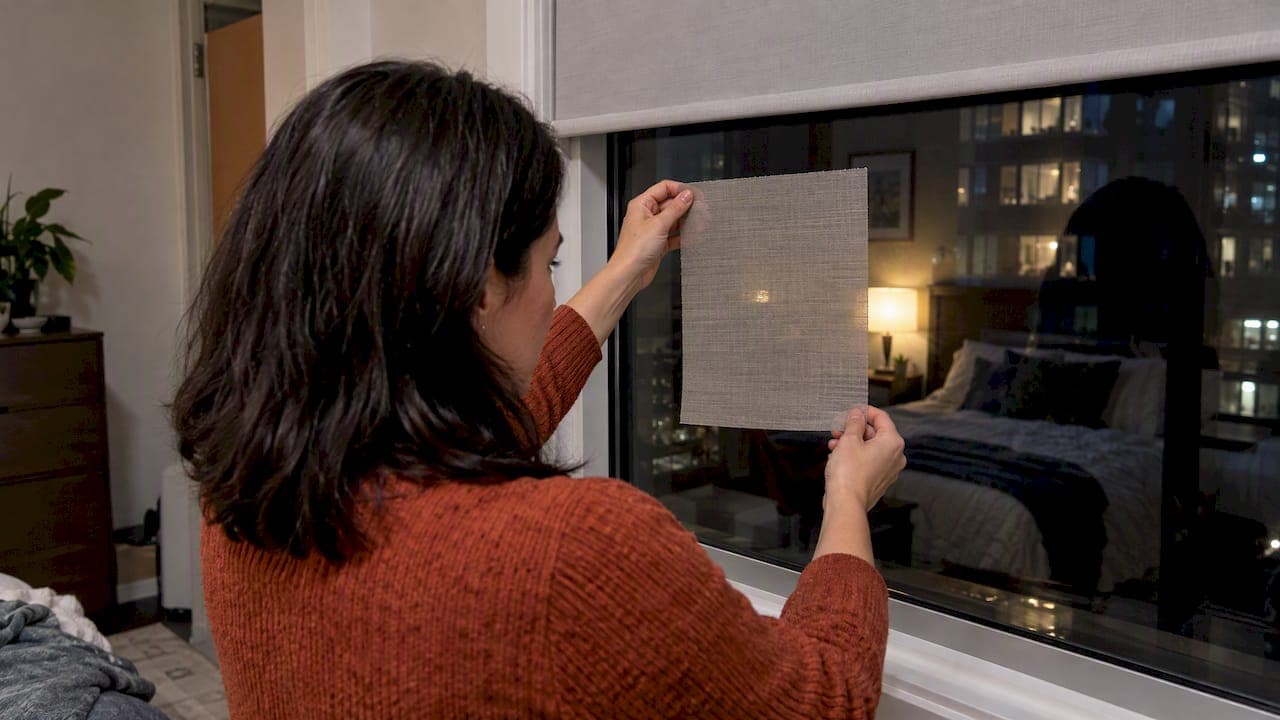
Lutron shade fabrics fall into four families: SheerShade, SheerShade Designer, Privacy and Blackout, each built for a different balance of light, view and glare control. The fastest path to the right choice is the Lutron Fabric App, which lets you filter by shade type, opacity and usable width, then order free samples to test against your own windows before you commit.
TL;DR:
- Compare openness factor and visible transmittance: lower openness reduces glare and improves privacy, while higher transmittance preserves more of the outdoor view.
- Category 1 and 2 samples usually ship within a couple of days; Category 3 and custom fabrics may ship only after project orders.
- Usable widths vary by fabric, and directional prints often cannot be rotated to avoid seams, so confirm width and seam placement before ordering.
- Test samples at midday and after dark with interior lights on; privacy can change with lighting, and daytime checks miss nighttime visibility.
- For media rooms, choose fabrics with an NRC of 0.50 or higher and an openness factor near 1% to reduce echo and reverberation.
Table of Contents
- Overview of Lutron fabric collections and how to browse them
- Fabric categories and core performance properties
- Choosing fabric for glare control, view, energy, and sound
- Ordering samples and using the Fabric App
- Technical constraints and install considerations to confirm before ordering
- Installer and builder guidance on prewire, compatibility and when to call a pro
- Maintenance and cleaning recommendations for Lutron shade fabrics
- Warranty and care support options for Lutron shade fabrics
- Installation considerations specific to different fabric types
- Compatibility of Lutron shade fabrics with different motorized systems
- Why working with an installer speeds selection and reduces surprises
- How we help with Lutron shade fabric selection and installation
- FAQ
- Sources
Overview of Lutron fabric collections and how to browse them
Lutron organizes its fabric library into curated collections that group textures, palettes and finishes by application, so a window facing a bright exterior and a media room asking for full blackout pull from different parts of the catalogue. Each collection page includes application photos that show how a given fabric behaves in daylight and at night, which matters more than a swatch alone.
Browsing effectively means filtering before you fall in love with a colour. The Fabric App lets you narrow results by shade type, opacity band, usable width and price group, so you only compare fabrics that actually fit your window and budget.
A few habits make browsing useful rather than overwhelming for the wrong reasons:
- Save favourites as you browse so you can compare them side by side later.
- Use the inspiration gallery to see fabrics installed in rooms similar to yours.
- Note the exact SKU and family name for each shortlisted fabric, since installers need these to quote accurately.
Treat this stage as narrowing the field to three or four candidates, not picking a winner. The real decision happens once you have physical samples in hand.
Fabric categories and core performance properties
Lutron's four fabric categories map to distinct jobs. SheerShade fabrics are lightweight, typically woven from polyester or fiberglass, and preserve an outward view while softening direct sun. SheerShade Designer expands that family with richer textures and patterns for a similar function. Privacy fabrics block sightlines while still passing diffused daylight, and Blackout fabrics eliminate light transmission entirely for theatres, bedrooms and AV spaces.
- SheerShade: high view-through, moderate glare reduction, common in living areas and offices.
- Privacy: blocks direct sightlines, especially useful on ground-floor or street-facing windows.
- Blackout: full light seal, standard for home theatres and sleep-focused bedrooms.
- Designer lines: add pattern and texture without sacrificing the base category's function.
Two numbers do most of the work when comparing fabrics within a category: openness factor, which describes how much of the weave is open space, and visual transmittance (Tv), which measures how much visible light passes through. A lower openness factor cuts glare and improves privacy; a higher Tv preserves more of the outward view. Lutron's own fabric specification guidelines list solar transmittance (Ts), solar absorptance and solar reflectance (Rs) alongside Tv, and these three solar figures sum to 100% for any given fabric.
Lutron recommends dual-sided fabrics with a lighter colour facing the window and a darker colour facing the room, a construction that balances view preservation with energy efficiency and glare control. The lighter outer face reflects more solar heat before it enters the room, while the darker inner face cuts the glare and washout that a uniform light fabric would create.
Choosing fabric for glare control, view, energy, and sound
Fabric selection should start with the problem you are solving, not the colour palette. Four application paths cover most residential and commercial requests.
- Glare and view preservation: pair a lower openness factor with a dark room-facing side to cut glare, then check the Tv rating against your view priority; a higher Tv keeps more of the outdoor scene visible while the dark facing still manages screen glare.
- Energy performance on sun-facing glazing: favour dual-sided fabrics with high solar reflectance (Rs) or aluminium-backed constructions, since these reduce solar absorption and heat gain on façades more effectively than a single-sided fabric with the same openness factor, per the fabric specification guidelines.
- Acoustic control: choose fabrics with a Noise Reduction Coefficient (NRC) of 0.50 or higher and a lower openness factor, often around 1%, to reduce flutter echo and reverberation in media rooms and open-plan living spaces.
- Privacy: privacy performance changes with interior and exterior lighting, so a fabric that feels private at noon can turn transparent once interior lights come on after dark.
Pro Tip: Tape a sample to the window and check it at midday, at dusk and with your interior lights on before you order, since privacy and glare behave differently at each stage of the day.
For privacy specifically, a daytime mock-up only tells half the story. Order the sample, hold it against the glass after sunset with the room lit, and you will see exactly what a passerby sees.
Ordering samples and using the Fabric App
The Fabric App is built for this stage: search by usable width, opacity or SKU, save shortlisted fabrics to a favourites list, and share that list with whoever is measuring or quoting your windows.
Sample availability depends on which tier a fabric sits in. Category 1 and 2 fabrics are typically kept in stock, so memo samples usually ship within a couple of days. Category 3 and custom fabrics often come from third-party mills and may only ship once a project order is placed, which is worth knowing before you build a timeline around a specific swatch.
- Request samples for every finalist, not just the top choice, since lighting shifts perception more than expected.
- Tape samples up at different times of day to judge glare and view-through accurately.
- Check nighttime appearance with interior lights on if privacy matters.
- Confirm the usable width shown in the app matches your window's actual dimension before ordering.
Technical constraints and install considerations to confirm before ordering
A fabric that looks right on screen can still be the wrong pick once installation details are checked. Usable width is the first constraint: every fabric has a maximum width before seams are required, and some families list usable widths from roughly 96 inches to 116 inches depending on the weave.
Railroadability, meaning whether a fabric can be rotated 90 degrees to avoid a seam on a wide window, varies by pattern and weave direction. A fabric with a directional texture or print often cannot be railroaded, so a wide picture window may need a seam regardless of preference.
Before finalizing an order, confirm:
- Usable width and whether the fabric is railroadable or seamable for your window's dimensions.
- Bottom bar style, since full-wrap, half-wrap and exposed options change both the look and the light seal at the base of the shade.
- Blackout backing choice, which affects whether side and bottom light gaps are fully sealed.
- Fire-rating documentation for commercial projects, and whether a customer's-own-material (COM) request needs Lutron's evaluation before approval.
Skipping these checks is the most common reason a fabric order gets revised after the fact.
Installer and builder guidance on prewire, compatibility and when to call a pro
Getting the electrical groundwork right before shades arrive avoids most of the rework we see on jobs. For hardwired motorized shades, running 18/2 cable to each motor location with enough slack for motor and power access keeps the installation clean and avoids exposed wiring later.
Lutron Caséta systems have practical limits worth planning around on larger installs, and installer-backed fixes for range and device limits exist for homes pushing close to those thresholds.
Pro Tip: If a project involves more than a handful of shades, a tricky window pocket, a customer's-own-material fabric or integration into a broader smart-home system, bringing in a professional installer early avoids the change orders that come from guessing at compatibility.
A few signs it's worth calling a pro:
- Multiple shades on one job, especially mixed fabric types.
- Recessed or shallow pockets that limit roller tube clearance.
- COM fabrics that need Lutron's evaluation before fabrication.
- Shades that need to talk to an existing smart-home hub or voice assistant.
Maintenance and cleaning recommendations for Lutron shade fabrics
Most Lutron shade fabrics are woven from polyester or fiberglass, both of which resist dust buildup better than natural fibres and tolerate light cleaning without losing their coating. Regular care is simple: a vacuum with a soft brush attachment, run gently over the fabric face, removes the dust and pet hair that accumulate between the folds of a lowered shade.

For spot cleaning, a lightly damp cloth with mild soap handles most marks; avoid saturating the fabric, since excess moisture can affect the backing on blackout and dual-sided constructions. Harsh solvents and abrasive cleaners should stay off Lutron fabrics entirely, since they can strip the coating that gives sheer and privacy fabrics their light-control properties.
Fiberglass-based fabrics hold their shape and resist stretching better over years of daily raising and lowering, which is one reason they show up often in SheerShade collections. Blackout fabrics with vinyl or acrylic backings need a gentler touch, since aggressive scrubbing can crack the backing layer over time.
Seasonal upkeep matters more for west- and south-facing windows, where UV exposure and temperature swings are heaviest. A quick visual check twice a year, looking for fading, stiffness or backing separation at the edges, catches wear before it becomes a replacement issue. Motorized shades add one more maintenance habit: keep the hembar and headrail clear of dust so the motor isn't working against debris every time it cycles.
Warranty and care support options for Lutron shade fabrics
Lutron fabrics and the shading systems that house them carry manufacturer warranty coverage, with specific terms depending on the fabric category and the shade system it's installed in. Custom and customer's-own-material fabrics can carry different warranty terms than Lutron's standard catalogue fabrics, since COM materials come from third-party mills rather than Lutron's own production.
The most reliable way to confirm warranty terms for a specific fabric and shade combination is through the dealer who sells and installs the system, since warranty registration and documentation are typically handled at the point of sale rather than after the fact. Keeping your original order details, including SKU and category tier, makes any future warranty claim faster to process.
Care support beyond the warranty period usually comes down to the basics covered above: gentle cleaning, UV monitoring on sun-exposed windows and periodic checks of the motor and hembar hardware. A dealer who installed the system is also the most practical first call if a fabric shows unexpected wear, since they can compare what you're seeing against the original specification and determine whether it falls under warranty or normal wear.
Installation considerations specific to different fabric types
Different fabric categories bring different installation demands, and matching the install method to the fabric avoids a mismatched final look. SheerShade and Privacy fabrics are generally lighter and roll more tightly, which makes them well suited to standard roller shade pockets and smaller headrail profiles.

Blackout fabrics are heavier and often need a bottom bar wrap, either full-wrap or half-wrap, to close the light gap at the base of the shade completely. A full-wrap bottom bar covers the bar entirely in fabric for a cleaner sightline, while a half-wrap or exposed bar shows more metal but can simplify fabrication on wider shades.
Fabrics with directional patterns or prints often cannot be railroaded, which means a seam is required on windows wider than the fabric's usable width. This affects pocket depth and roller tube sizing, since a seamed shade can roll up slightly differently than a railroaded one. Confirming seam placement before installation day avoids a visible seam landing at eye level.
Dual-sided fabrics, with their two-layer construction, are generally heavier than single-layer sheers, which can affect motor sizing on larger shades. A motor rated for a lighter single-layer fabric may need to be upsized for a dual-sided blackout fabric on the same width window.
Window depth and pocket clearance should always be confirmed against the specific fabric's rolled diameter, since a thicker blackout fabric takes up more roller tube space than a thin sheer, especially on shades that stack several fabric layers for a dual-function system.
Compatibility of Lutron shade fabrics with different motorized systems
Lutron fabrics are designed to work across the brand's own motorized shade lines, but compatibility still depends on matching the fabric's weight and rolled diameter to the correct motor and headrail. A heavier blackout fabric on a wide window needs a motor rated for that load, while a lightweight sheer on a narrow window has far more flexibility in motor choice.
For homes already running Lutron Caséta for lighting control, shade motors integrate into the same app and scenes, though larger installs should account for the device limits and range considerations that come up on bigger Caséta systems. Clara motorized blinds, a separate product line, follow their own compatibility rules for fabric weight and width, so a fabric approved for one system isn't automatically approved for another.
Integrating shades with third-party smart-home hubs or voice assistants adds another compatibility layer. Choosing a Matter or Thread-based integration tends to simplify multi-brand households, and a Canadian homeowner's guide to motorized blinds and voice assistants walks through the practical setup steps for connecting shades to an existing smart-home system. Confirming motor compatibility and hub integration before ordering fabric avoids discovering a mismatch after the shade is already fabricated.
Why working with an installer speeds selection and reduces surprises
An installer measures the actual window, not an assumed standard size, which catches width and depth issues before a fabric gets ordered. Coordinating fabric choice with motor sizing and mounting style at the same time tends to mean fewer reorders and a shade that performs the way the samples suggested. Pairing sample testing with an on-site quote is worth doing before placing a final order.
— JupiterAV
How we help with Lutron shade fabric selection and installation
We offer professional measurement and wiring expertise to help with fabric selection. We handle prewire and motor integration details and connect shades into smart-home systems as needed.

- In-home sample testing against your actual windows and lighting.
- Accurate measurement and wiring planning before fabrication.
- Motor and smart-home integration handled as part of the install.
| What we handle | Why it matters |
|---|---|
| Measurement and prewire | Avoids width and seam surprises after fabrication |
| Fabric and motor matching | Keeps motor load and fabric weight compatible |
| Smart-home integration | Shades work with existing hubs and voice control |
If you'd like a quote or an on-site measure for Lutron shades, you can reach our team through our services page.
FAQ
What are the main categories of Lutron shade fabrics?
Lutron groups fabrics into SheerShade, SheerShade Designer, Privacy and Blackout, each built for a different balance of view, glare and light control. SheerShade preserves outward view, Privacy blocks sightlines while passing diffused light, and Blackout eliminates light transmission entirely, per Lutron's fabric specification guidelines.
What does openness factor mean for shade fabric?
Openness factor describes how much of a fabric's weave is open space, which directly affects glare control and privacy.
How quickly can I get Lutron fabric samples?
Category 1 and 2 fabrics are typically stocked, so memo samples usually ship within a couple of days, while Category 3 and custom fabrics often ship only after a project order is placed since they come from third-party mills.
Why does Lutron recommend dual-sided fabrics?
Dual-sided fabrics pair a lighter colour facing the window with a darker colour facing the room, which balances energy efficiency, glare control and view preservation better than a single-sided fabric. The lighter outer face reflects more solar heat while the darker inner face reduces glare and washout.
Can any fabric be used on a wide window without a seam?
No, usable width and railroadability vary by fabric, and some families list usable widths from roughly 96 to 116 inches before a seam is required. Patterned or directional fabrics often can't be railroaded, so confirming these specs before ordering avoids an unexpected seam.
Sources
- Lutron Shades | Quick Fabric Reference Guide Summer 2026
- fabric specification | guidelines
- Lutron Fabric App | lutronfabrics.com (sell sheet)