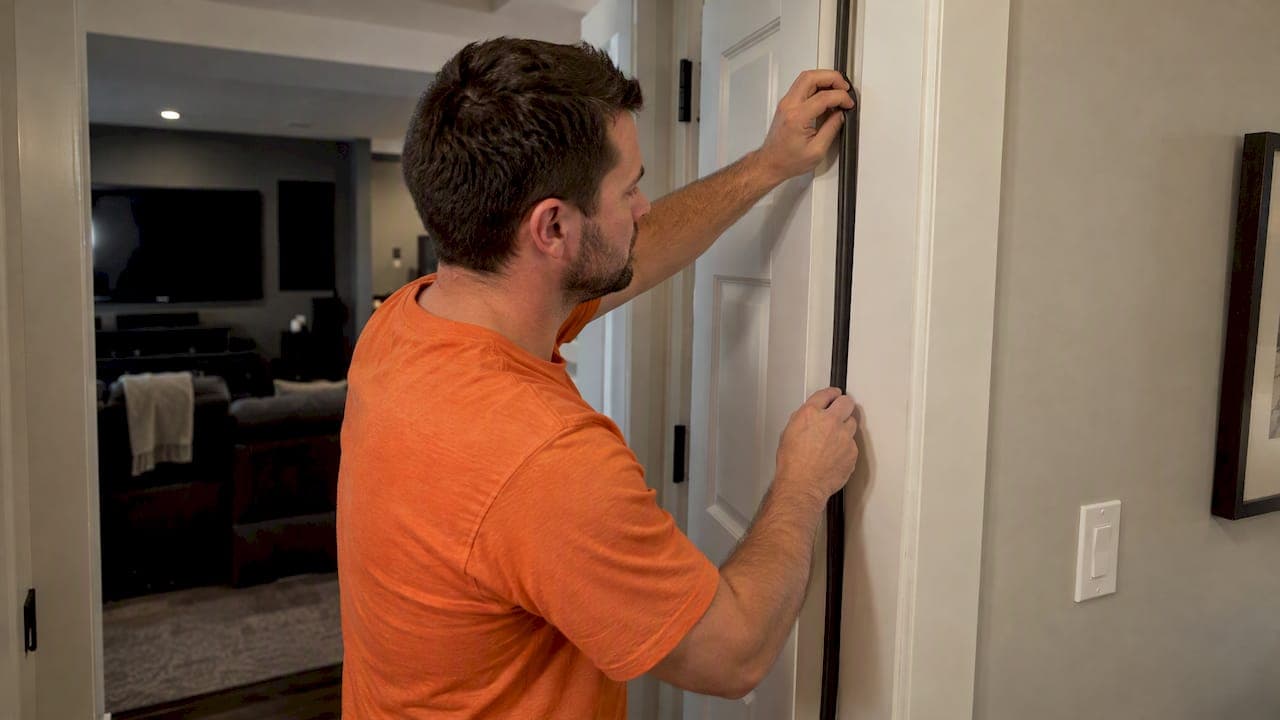
Acoustic door seals reduce the sound that leaks through the gaps around a door: along the top and sides, and under the bottom edge. They work best on a solid-core door, and only when the whole perimeter is sealed. One good gasket on three sides and a gap at the floor will disappoint you. A complete set of jamb seals, an automatic door bottom and a threshold can make a real, audible difference in a home theatre, a media room, a home office or a bedroom next to an open-concept living space.
This guide explains what each part does, which door types suit seals, how to install them without the common mistakes, and where seals stop being enough. We also cover the question that usually follows: do acoustic panels in the living room help with door noise? (Short answer: not the way people hope.)
TL;DR
- A door is only as quiet as its leakiest edge. Seal the top, both sides and the bottom, or the work is wasted.
- A full kit has three parts: adjustable jamb seals, an automatic door bottom and a threshold.
- Seals help most on a solid-core door. A hollow-core door has too little mass for seals alone to transform it.
- Acoustic panels treat echo inside a room. They do not block sound from passing through a door or wall.
- In a new build or a dedicated theatre, plan the door, frame and seals before drywall goes up.
Table of Contents
- Why gaps matter more than the door itself
- The three parts of a proper acoustic door seal
- Which doors respond to seals
- How to install acoustic door seals
- Seals, soundproofing and acoustic treatment are three different jobs
- What the building code says
- When seals are not enough
- Our perspective: treat the room as a system
- Planning a theatre or media room in Calgary
- Choosing seals: a short checklist
- FAQ
- Sources
Why gaps matter more than the door itself
Sound moves through air the way water moves through a crack. A heavy door with a 6 mm gap at the bottom behaves, acoustically, like a door with a hole in it. Manufacturers of sound-rated doors put it bluntly: room isolation is only as good as its weakest link, and an expensive rated door will underperform if the air gaps around it are not sealed with proper gaskets.
One supplier of door seal kits notes that even a small percentage of open area around a door can let a large share of the sound energy through. You do not need to memorize the figure. The practical lesson is that the last few millimetres of gap decide the result.
That is why a standard weatherstrip from a hardware store rarely satisfies people who bought it hoping for a quiet room. Weatherstripping is designed to stop drafts, and it often compresses unevenly or leaves a gap at the corners. Acoustic sealing aims for a continuous, airtight, compressible contact all the way around.
The three parts of a proper acoustic door seal
A complete acoustic door seal system has three components: adjustable jamb seals for the top and sides, a bottom seal (typically an automatic door bottom), and a threshold that gives the bottom seal something airtight to land on.

Jamb seals (top and both sides)
Jamb seals mount on the door frame (the jamb and head) and press against the door face when it closes. Adjustable versions are worth the small extra cost, because no door hangs perfectly square. You can tune the compression on each side so the contact is even.
Common styles include compressible foam or rubber D-section profiles, silicone bulb seals and magnetic seals. In practice, a seal that compresses firmly and consistently beats one that merely brushes the door. If you can slide a sheet of paper out easily after the door is closed, the seal is not doing its job at that spot.
Be wary of the cheapest adhesive-backed strips. Adhesive-backed seals have a limited shelf life and need a properly cleaned surface, and stretching the material while you apply it makes it shrink back over time and open a gap at the corners. Lay it in relaxed, press it down, and never pull it tight.

Automatic door bottom
The bottom edge is where most sound escapes, and a fixed sweep that drags on the floor is a nuisance in daily use. An automatic door bottom is spring-loaded: it stays raised while the door swings and drops a seal when the door closes, forming an airtight contact with the floor or threshold.
Two cautions from installers. First, when you trim the unit to the door width, do not cut so close to the internal mechanism that you damage the spring assembly. Second, the drop is limited, so the gap under the door needs to be small and even. If your floor is uneven, or you have a thick carpet, plan the threshold and the door height before you buy.
Threshold
The threshold is the flat strip on the floor under the door. It gives the dropped seal a hard, level surface to compress against. Without it, the seal is pressing on whatever flooring is there, whether that is hardwood with gaps, tile with grout lines or carpet. A low-profile threshold with a gentle ramp is easy to cross and works well for most interior rooms. If accessibility matters in your home, choose a ramped profile and raise it early in the planning.
Which doors respond to seals
Seals do not add mass. They remove leaks. That means the door itself sets the ceiling on what you can achieve.
| Door type | What seals can do | Realistic expectation |
|---|---|---|
| Hollow-core interior door | Stops the worst leaks | Modest gain; the thin skin still transmits sound |
| Solid-core door, about 1-3/4 in | Lets the door perform near its potential | Best value for a bedroom, office or media room |
| Purpose-built sound-rated door | Keeps the rated performance in the real world | Needed for a dedicated theatre or music room |
| Double or French doors | Possible, with an astragal seal at the meeting edge | Harder; more edges to seal |
As a reference point, one retailer reports that its adjustable kit on a solid-core door reached a tested STC of 45, with a stated maximum of 46. Treat that as a laboratory-style best case for that product. Your result depends on the door, the frame, the wall around it and the quality of the installation.
What about a hollow door?
If you have a hollow-core door, the better first move is often to replace it with a solid-core slab and then seal it. Piling seals on a thin door gets you part of the way. If a room is important to you, such as a theatre or a home office, start with mass and then seal.
How to install acoustic door seals
This is the order we would work in on a typical interior door.
- Check the door first. It should close fully and sit square in the frame. Fix sagging hinges before you add seals, or the compression will be uneven.
- Measure the gaps. Check the clearance at the top, the sides and the bottom with the door closed. Most kits are designed for gaps of a few millimetres. A gap that is much larger needs a different solution, such as a new frame or a bigger bottom profile.
- Clean the surfaces. Dust, paint residue and oils stop adhesive from bonding. Follow the manufacturer's prep instructions. If the paint is fresh, wait until it has cured.
- Fit the jamb seals. Start at the top, then do the sides, and keep the compression consistent. Mitre or butt the corners tightly so no gap is left.
- Fit the threshold. Fix it level and square, and make sure it lines up with the bottom seal's drop point.
- Install the automatic door bottom. Cut it to size carefully, mount it, and adjust the drop so it just seals when the door is closed, without grabbing the threshold.
- Test it. Close the door and run the paper test around the perimeter. Then play a familiar track on one side and listen on the other. Adjust anything that leaks.
A note on longevity: gaskets compress and age, and adhesive weakens. Check the seals once a year, and replace anything that has flattened, peeled or torn. Seasonal humidity swings in Alberta can shift door fits slightly, so a spring and fall check is a sensible habit.
Seals, soundproofing and acoustic treatment are three different jobs
This is where many homeowners get stuck. The queries people type, such as acoustic panels for the living room, treating an open-concept space, or soundproof door seals, mix up three separate goals.
- Sealing stops air leaks around doors, outlets and penetrations.
- Soundproofing keeps sound from travelling between rooms. It relies on mass, air-tightness and structural isolation.
- Acoustic treatment shapes how a room sounds inside, controlling echo and reverb with panels, bass traps, rugs and soft furnishings.
Panels and bass traps are designed for the third job. As one acoustic panel maker explains, they condition sound within a room and do not block transmission through walls or doors. If your goal is to stop the TV from bothering a sleeping child, panels on the living room wall will make the room sound better, but not make the next room quieter.
Both jobs matter in a good theatre or media room, and they are done in sequence: block the sound first, then tune the room. Our guide to acoustic panels for a home theatre covers placement and how many you need, and our realistic retrofit plan for soundproofing a home theatre shows where seals fit among the bigger steps.
Open-concept living rooms
Open-concept homes are a particular challenge. There is often no door at all between the kitchen, the living room and the stairs, so there is nothing to seal. Here, acoustic treatment does the work: soft furnishings, a thick rug, curtains, and carefully placed panels reduce reverberation so voices and TV dialogue stay clear. Some designers also add moss walls and other decorative acoustic features, though it is worth asking how much absorption a given feature really delivers rather than assuming it works like a rated panel.
If you need genuine separation, for example for a theatre or a home office, the answer is a closed room with a proper door, sealed all the way around.
What the building code says
For most single-family renovations, door seals are a comfort upgrade, not a code matter. In new construction and multi-unit housing, rules apply. The 2019 Alberta Edition of the National Building Code is the reference in the province, and sound transmission between dwelling units is regulated under it. If you are a builder working on a duplex, a secondary suite or a multi-family project, confirm the current requirements with your authority having jurisdiction and your designer before you choose door hardware. Fire and smoke ratings on a door can limit which seals are acceptable, so a seal that suits a bedroom may not suit a rated suite door.
Professional-grade gaskets often carry fire and smoke certifications as well as acoustic test data. Ask for the test documentation, not just a marketing number.
When seals are not enough
Seals are the most cost-effective first move, but they have limits. Consider going further when:
- The wall is the weak point. A sealed door in a single-layer drywall wall still lets sound through the wall.
- There are other leaks. Return air vents, ducts, recessed lights, and unsealed outlet boxes can all bypass the door.
- The room is a dedicated theatre. Bass travels through structure, and a theatre often needs a decoupled wall and ceiling, plus a rated door.
- You are still in the framing stage. This is the cheapest time to fix everything.
That last point is critical for builders. Wiring, speaker locations, door sizes and sealing details should be decided before drywall. Our rough-in checklist for builders shows what to finish at that stage so you do not open finished walls later.
Our perspective: treat the room as a system
We design rooms where the equipment is supposed to disappear into the architecture, and sound isolation is part of that. A theatre that leaks into the hallway, or a media room that picks up kitchen noise, is not finished, no matter how good the speakers are.
Our approach is to look at the room as a whole before we talk about products. We ask what the room is for, who is next door and when, what the walls and door are made of, and where the wiring and ducts will run. Then we scale the solution to the space: sometimes that is a solid-core door with a complete seal set and nothing more, and sometimes it is a fully engineered theatre with a rated door, isolated walls and tuned acoustic treatment.
The mistake we see most often is buying the speakers first and thinking about the room later. The second most common is sealing three sides of a door and leaving the fourth. A single point of contact for the audio, the wiring and the room planning helps avoid both, because one person is accountable for how the finished room sounds.
— JupiterAV
Planning a theatre or media room in Calgary
If you are building or renovating a dedicated space, we can help you plan the door, the sound isolation, the wiring and the audio and video system together, so the room works as one. We install custom home theatres, whole-home audio and video and smart home control for homeowners and home builders in and around Calgary. See what we do at JupiterAV, or read more on our blog.
Choosing seals: a short checklist
Before you buy, run through these questions.
- Is the door solid-core? If not, budget for a replacement or accept a modest gain.
- Does the kit cover all four edges? Jambs, head and bottom, plus a threshold.
- Are the jamb seals adjustable? Most doors need tuning.
- Is there test data? Look for acoustic test results and any fire or smoke ratings that your project requires.
- Is the floor suitable? Uneven floors and thick carpet need a plan. A brush-style bottom is sometimes better than rubber on carpet.
- Who will maintain it? Plan an annual check, and keep spare gasket material.
FAQ
Do acoustic door seals really work?
Yes, when they seal the whole perimeter and the door has enough mass. They remove the air gaps that let sound bypass the door. On a hollow-core door the improvement is limited, because the thin door skin still transmits sound.
Do I need to seal the bottom of the door as well as the sides?
Yes. The gap under a door is usually the largest leak, so skipping it undoes most of the benefit of the jamb seals. An automatic door bottom with a threshold is the usual solution, because it seals when the door is closed and lifts clear when you open it.
Will acoustic panels in my living room stop noise from getting out?
No. Panels absorb echo inside the room and make speech and music clearer. Stopping sound from passing through a wall or door depends on mass, air-tightness and structural isolation, so seal the door and address the walls first.
How long do adhesive door seals last?
It depends on the product and the surface preparation. Adhesive-backed gaskets have a limited shelf life before use, and a poorly prepared or stretched seal can shrink or peel later. Check the seals once a year and replace any that have flattened or lifted.
Sources
- Kinetics Noise Control: sound-rated acoustical doors and perimeter gaskets
- PrivacyShield soundproof door seal kit, Acoustical Solutions
- Pemko S773 adhesive-backed gasketing, MDISupply
- Sound Lock acoustic door seal kit, Second Skin Audio
- Acoustic panels, Acoustimac
- National Building Code, 2019 Alberta Edition, National Research Council Canada
- Moss wall acoustics, Greenspace Plants