A properly designed sound masking system measurably improves speech privacy and reduces distraction in open-plan offices. The key word is designed: a system specified without a site survey, installed without zoning, and handed over without commissioning measurements will underperform or actively annoy occupants. Get those three things right and the evidence is consistent.
Three steps before you commit to a purchase:
- Request a site survey from a qualified installer who will measure your existing ambient levels and ceiling type before specifying anything.
- Assess your ceiling and absorption first. Masking works best alongside acoustic panels and modest partitions; it cannot compensate for a completely bare, reverberant space on its own.
- Plan for commissioning and tuning as a line item in your budget, not an afterthought. That final measurement and adjustment phase is what separates a system that works from one that just makes noise.
Key takeaways
A properly specified and commissioned open office sound masking system, targeting 40–47 dBA with level-adaptive control, measurably reduces speech distraction and improves occupant acoustic comfort.
| Point | Details |
|---|---|
| Survey before specifying | Measure existing ambient levels and ceiling type before any hardware is selected or quoted. |
| Target 40–47 dBA with uniformity | Field studies confirm satisfaction gains at 42–47 dBA; hold spatial variation to ±2 dBA across each zone. |
| Level-adaptive systems outperform fixed | Automatic ambient sensing reduces distraction and stress more effectively than a fixed-level system. |
| Combine masking with absorption | Masking alone cannot compensate for a reverberant space; pair it with acoustic panels and modest partitions. |
| JupiterAV for Calgary installs | JupiterAV handles survey, design, install, and commissioning for commercial offices in Calgary. |
Table of Contents
- What open office sound masking actually is (and what it is not)
- How sound masking works in an open-plan office
- What components make up a sound masking system
- Benefits of sound masking backed by field evidence
- Installation and design guidelines for open-plan offices
- Which system type fits your office?
- How systems are tuned and what to measure
- What does a sound masking project cost in Canada?
- Maintenance and remote management after installation
- How to choose a qualified sound masking installer
- What the research says, and what JupiterAV brings to the table
- A perspective on what actually goes wrong in the field
- Ready to get a site survey for your Calgary office?
- Sources
What open office sound masking actually is (and what it is not)
Sound masking is an engineered background sound, shaped to the frequency range of human speech, that is added to an environment to reduce how far away a conversation remains intelligible. The operative word is engineered. The spectrum is not random noise; it is deliberately contoured to match the frequencies where speech carries meaning, roughly 200 Hz to 5 kHz, with a gentle roll-off above 1 kHz so the result feels like soft airflow rather than hiss.
That distinction matters when you compare it to white noise, which has equal energy at every frequency. White noise sounds harsh because the human ear is more sensitive to high frequencies, and that hiss is both noticeable and localisable. Engineered masking targets speech frequencies to reduce intelligibility while avoiding the perceptual problems of broad-spectrum white noise. Pink noise, which rolls off at 3 dB per octave, is closer to the right shape but still not optimised for speech masking.
Sound masking is also not active noise cancellation. Active cancellation uses microphones and inverse waveforms to suppress specific sounds at a listener's ears. Masking works differently: it raises the ambient floor so that distant speech blends into the background rather than standing out. No microphones are monitoring your conversations; the system simply makes the room louder in a controlled, targeted way.
"Natural or water-based masking sounds have been trialled, but many studies and practitioners report they can be more distracting than engineered speech-shaped masking unless very carefully filtered and tested." — Frontiers in Psychology
Consumer white-noise machines and phone apps are not substitutes. They lack the spatial uniformity, zone control, and spectral precision that a properly installed system delivers.
How sound masking works in an open-plan office
Engineered masking raises the ambient level in the speech frequency band so that distant conversation becomes harder to follow. Think of it like trying to hear someone whisper across a busy café versus a silent library. The café's ambient noise does not eliminate the whisper; it just makes it unintelligible beyond a metre or two.
The metric that matters most for facilities teams is the radius of distraction: the distance at which speech remains intelligible enough to pull a listener's attention away from their own work. In a typical untreated open-plan office, that radius runs roughly 10–15 metres. Raising background levels to the 41–43 dBA range compresses that radius to approximately 4–6 metres, meaning a colleague three workstations away is no longer a cognitive interruption.

Speaker placement is what creates a uniform sound field rather than a patchwork of loud and quiet zones. In-plenum systems bounce the masking signal off the concrete deck above the ceiling tiles, which distributes the sound evenly before it reaches the occupied space. Direct-field systems point speakers downward into the room and require tighter spacing to achieve the same uniformity. Either approach, when properly designed, produces a field where no single point in the room is more than ±2 dBA from the target level. Occupants should not be able to point to a speaker; the sound should seem to come from everywhere and nowhere.
What components make up a sound masking system
A complete office masking system has five main hardware and software elements. Understanding each one helps you evaluate a quote and spot gaps in a proposed specification.
- Masking speakers: Small, purpose-built transducers optimised for the speech frequency range. In-plenum units mount above ceiling tiles; direct-field units mount flush with or below the ceiling plane. Speaker count drives a significant portion of project cost. For guidance on ceiling speaker selection, in-ceiling speaker options are worth reviewing before finalising a specification.
- Multizone controllers and amplifiers: The signal processor that generates the masking signal, shapes its spectrum, and distributes it across independent zones. Zoning matters because an open-plan floor and the meeting rooms sharing its plenum need separate control; otherwise masking bleeds into enclosed spaces where it is unwanted and potentially too loud.
- Zone sensors or level-adaptive microphones: Microphones that monitor the actual ambient level in each zone and automatically adjust masking output. Level-adaptive systems measurably reduce stress and reliance on coping strategies like headphones, because the masking tracks real-world noise rather than sitting at a fixed level all day.
- Management software: A browser or app interface that lets facilities staff monitor zone levels, schedule adjustments (lower overnight, ramp up at 8 AM), and receive fault alerts. Remote management capability is the difference between a system you can maintain proactively and one you only notice when someone complains.
- Cabling and mounting hardware: Low-voltage wiring runs from controllers to speakers. Plenum-rated cable is required in most Canadian commercial buildings. Mounting hardware varies by ceiling type: T-bar grids accept tile-replacement speakers, while open ceilings require surface or suspended mounts.
Pro Tip: In-plenum installation is the default for most commercial offices with suspended T-bar ceilings because it hides hardware and achieves excellent uniformity. Choose direct-field when ceilings are concrete, open, or architecturally exposed. Desktop masking units are a legitimate temporary measure during a renovation or for a single sensitive workstation, but they cannot replace a zoned ceiling system for floor-wide privacy.
Benefits of sound masking backed by field evidence
Sound masking improves perceived acoustic comfort and reduces reported distraction across multiple field studies, including work conducted in Canadian offices. The benefits are measurable, not anecdotal, though the magnitude depends heavily on how well the system is specified and commissioned.
A longitudinal field study that raised ambient levels from roughly 28–32 dBA to approximately 41–43 dBA found significant reductions in intelligible speech distraction and positive short-term changes in some mental-health indicators among open-plan office workers. Separately, a Canadian field study conducted in Quebec offices reported statistically higher occupant acoustic comfort and satisfaction at controlled masking levels of 42 dBA and 47 dBA compared with no-masking conditions.
"Controlled masking conditions at 42 dBA and 47 dBA produced statistically higher occupant satisfaction versus no-masking conditions in two Quebec offices." — Canadian field study, Ingenta Connect
For facilities teams, the practical benefits translate into:
- Fewer employees wearing headphones all day as a coping mechanism.
- Improved speech privacy for HR conversations, client calls, and confidential discussions without requiring full-height walls.
- Reduced interruption-driven errors, particularly in roles that require sustained concentration.
- Better compliance with privacy obligations in sectors like finance, healthcare administration, and legal services.
The evidence is strong for well-commissioned systems in the 40–47 dBA range, but it is weaker for systems installed without measurement, which is precisely why commissioning is non-negotiable.
Installation and design guidelines for open-plan offices
Design work and a pre-install site survey are mandatory. Sound masking is not a plug-and-play product; it is an engineered intervention that responds to the specific acoustic conditions of your space.
Pre-install survey checklist:
- Map occupancy zones: identify open-plan areas, enclosed meeting rooms, corridors, and sensitive zones (HR, executive, legal).
- Measure existing ambient levels (dBA) at representative positions during occupied hours.
- Check ceiling type: suspended T-bar, open/exposed concrete, or specialty acoustic tile.
- Measure or estimate RT60 (reverberation time). Highly reverberant spaces need absorption treatment before masking can work uniformly.
- Document furniture and partition layout, including partition heights, which affect how sound travels horizontally.
- Identify any shared plenums between open-plan and enclosed rooms that will need independent masking zones.
Speaker spacing and tolerance targets:
- Typical in-plenum speaker spacing runs 1.8–2.4 metres on centre for standard office heights of 2.7–3.0 metres, though the exact grid depends on the speaker's dispersion pattern and the ceiling's reflective properties.
- Industry specification practice recommends a spatial uniformity tolerance of ±2 dBA across a treated zone, verified with one-third octave band measurements.
- Tile-replacement speakers simplify installation in T-bar grids and maintain the ceiling's visual continuity. Suspended mounts in open ceilings require more careful aiming to avoid hot spots directly below each unit.
Untreated, highly reverberant ceilings create a real problem: reaching confidential privacy class in a bare concrete space may require masking levels above 50 dBA, which most occupants find intrusive. The practical answer is to combine masking with acoustic absorption panels and modest partitions rather than pushing the masking level higher.
Pro Tip: When absorption and masking are specified together, sequence the work correctly: install and measure the absorption first, then design the masking system to the resulting ambient and reverberation conditions. Designing masking for a space before the absorption is in place produces a specification that will be wrong on day one.
Which system type fits your office?
Three deployment types cover most commercial office scenarios. The right choice depends on your ceiling construction, budget, and how much visual disruption you can accept during installation.
In-plenum systems
- Speakers mount above suspended ceiling tiles and reflect the masking signal off the structural deck.
- Pros: hardware is hidden, coverage is typically very uniform, and the install has minimal visual impact on the finished space.
- Cons: requires access to the plenum, which can be complicated in older buildings or where mechanical services are dense; not feasible with open or exposed ceilings.
Direct-field systems
- Speakers point downward into the occupied space, mounted flush with or below the ceiling plane.
- Pros: works with any ceiling type, including exposed concrete; easier to retrofit in architecturally complex spaces.
- Cons: speakers are visible, tighter spacing is needed for uniformity, and localisation (the ability to hear where the sound is coming from) is a greater risk if spacing is too wide.
Desktop or furniture-integrated units
- Small self-contained units that sit on or near a workstation.
- Pros: no installation required, immediately deployable, useful for a single sensitive workstation or as a temporary measure during renovation.
- Cons: coverage is limited to the immediate area, uniformity across a floor is impossible, and they do not address the broader open-plan acoustic environment.
For most Canadian commercial offices with standard T-bar ceilings, in-plenum remains the preferred approach. Direct-field is the practical choice for heritage buildings, creative studios, or any space where the ceiling is part of the design. Desktop units are a stopgap, not a strategy.
How systems are tuned and what to measure
Commissioning and measurement are the step that makes masking work. Without them, you have speakers playing noise at an unverified level with no proof that the system achieves its privacy goals.
Target dBA ranges by zone type:
| Zone type | Target A-weighted level | Notes |
|---|---|---|
| General open plan | 40–43 dBA | Balances privacy and occupant comfort |
| Confidential zones (HR, legal) | 42–47 dBA | Requires combined absorption and barriers |
| Corridors and transition areas | 40–42 dBA | Lower end to avoid fatigue in transient spaces |
| Meeting rooms (independent zone) | 40–42 dBA | Separate zone; prevents bleed from open plan |
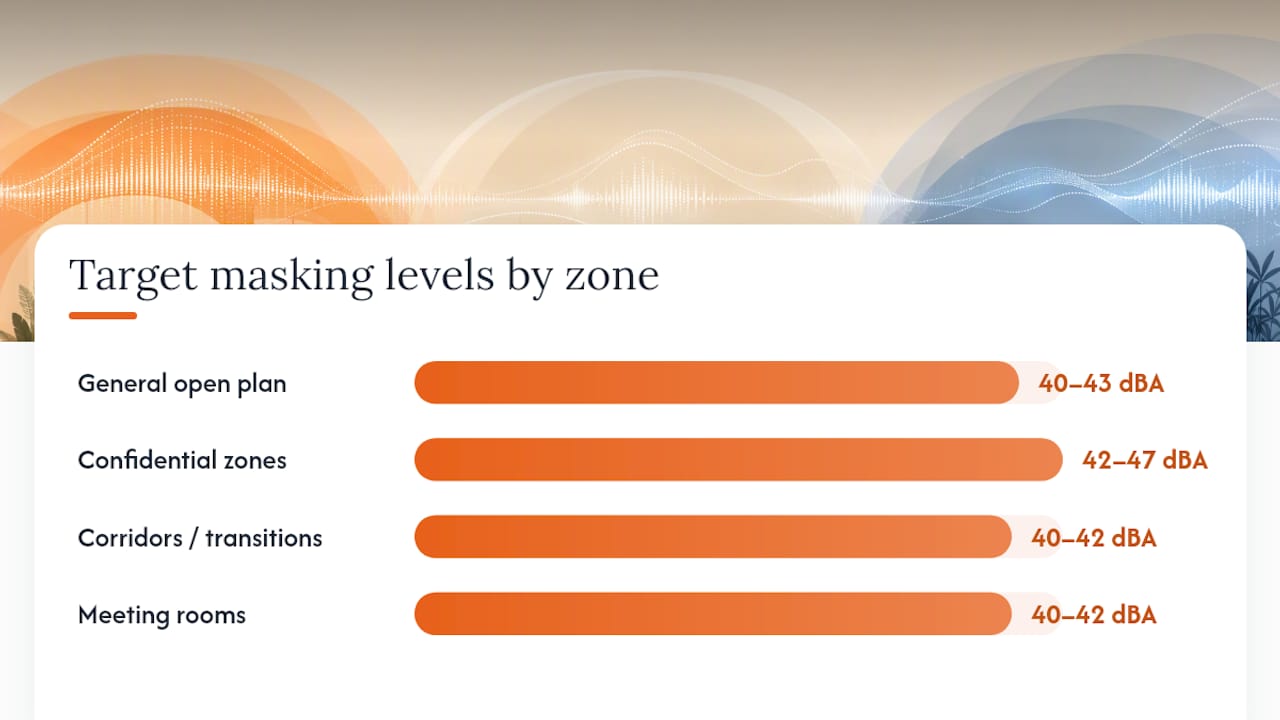
The speech-shaped masking spectrum recommended by industry practice targets approximately 40 dBA normalised in one-third octave bands for general open-plan use, with a gentle roll-off above 1 kHz. Tighter ranges apply for confidential spaces.
Verification checklist:
- Conduct one-third octave band measurements at 1.2 m above floor level at multiple representative receiver positions across each zone.
- Confirm spatial uniformity is within ±2 dBA of the target level across the treated area.
- Check for tonal components: any audible pitch or hum indicates a problem with the signal generator or speaker placement.
- Conduct a subjective occupant walk-through with the commissioning engineer present to catch perceptual issues that measurements alone may miss.
- Document everything in a commissioning report that becomes part of the building's acoustic record.
What does a sound masking project cost in Canada?
Costs vary with office size, ceiling type, and whether acoustic remediation is needed alongside the masking system. There is no single per-square-metre figure that applies across all scenarios, but the primary cost drivers are predictable.
Primary cost drivers:
- Speaker count: Driven by floor area and spacing requirements. More speakers mean more hardware, more cabling, and more commissioning time.
- Cabling complexity: Plenum-rated low-voltage wiring in an occupied building with limited ceiling access costs more than a clean new-construction run.
- Ceiling remediation: If absorption panels or partition upgrades are needed before masking can work effectively, those are separate line items that often exceed the masking hardware cost in reverberant spaces.
- Level-adaptive controllers: Systems with automatic ambient sensing cost more than fixed-level systems, but the longitudinal evidence for their benefit in reducing distraction and stress makes them worth specifying for most occupied offices.
- Measurement and commissioning: Expect this to represent 15–25% of total project cost. It is the phase that determines whether the system actually performs.
Typical project phases and durations:
| Phase | Typical duration |
|---|---|
| Site survey and acoustic assessment | 1–3 days |
| System design and specification | 1–2 weeks |
| Cabling and hardware installation | 2–5 days (per floor, occupied building) |
| Initial commissioning and level-setting | 1–2 days |
| Tuning and occupant trial period | 2–4 weeks |
Canadian projects in Calgary and other major centres typically run 6–10 weeks from survey to final sign-off for a single-floor office. Multi-floor or phased installations extend that timeline proportionally.
Maintenance and remote management after installation
Regular verification and occasional re-tuning maintain performance over time. Offices change: furniture moves, partitions are added or removed, occupancy patterns shift, and the acoustic environment drifts. A system that was perfectly commissioned on day one can underperform two years later if nobody checks it.
Maintenance checklist:
- Schedule an annual verification measurement, particularly after any significant office reconfiguration.
- Apply firmware updates to controllers and management software as they are released; some updates include spectrum refinements or bug fixes that affect performance.
- Keep a small inventory of spare speakers and mounting hardware for the installed system model, since discontinued products can create long lead times.
- Review zone-level logs from the management software quarterly to catch any zones that have drifted outside their target range.
Pro Tip: Remote monitoring subscriptions are worth the cost for offices above roughly 500 square metres or where speech privacy is a compliance requirement (legal, financial, healthcare administration). For smaller offices with stable layouts, a scheduled annual on-site check by the installing contractor is usually sufficient and cheaper. The deciding factor is not office size alone but how quickly a privacy failure would create a real problem for your organisation.
The difference between remote monitoring and a scheduled check is response time. A remote system flags a failed speaker or a zone that has drifted 5 dBA above target within hours. A scheduled check catches the same problem six to twelve months later, after occupants have already noticed and complained.
How to choose a qualified sound masking installer
Choose an installer who performs acoustic pre-surveys, specifies to an industry standard such as ASTM E1130 or its engineering equivalent, and commissions with measurements. Those three criteria eliminate most of the common failure modes before a contract is signed.
Questions to ask during an RFP or quote process:
- What is your measurement methodology, and will you provide a commissioning report with one-third octave band data?
- What masking spectrum and target dBA are you proposing for each zone, and why?
- How do you verify spatial uniformity, and what tolerance do you guarantee?
- How do you handle shared plenums between open-plan areas and enclosed meeting rooms?
- Can you provide examples of prior office installations with measurement reports?
- What does your warranty cover, and what is your response time for a zone failure?
- What training will you provide to our facilities team for day-to-day management?
Red flags that should end a conversation:
- A quote delivered without a site visit or acoustic assessment.
- A promise of "full privacy" at a fixed level without any measurement data to support it.
- No commissioning measurements included in the scope of work.
- No zoning strategy for meeting rooms or sensitive areas.
- Inability to explain the difference between their proposed masking spectrum and white noise.
- No prior office installations they can reference with documented outcomes.
The most common failure mode in office masking projects is procedural, not technical. A well-defined scope with measurement deliverables is the best protection against an ineffective install.
What the research says, and what JupiterAV brings to the table
The strongest research conclusions point in a consistent direction. Level-adaptive masking that raised ambient levels from roughly 28–32 dBA to approximately 41–43 dBA significantly reduced intelligible speech distraction and produced positive short-term changes in mental-health indicators. The Canadian field study conducted in Quebec offices found statistically higher occupant satisfaction at 42 dBA and 47 dBA compared with no-masking conditions. Together, these findings establish a credible evidence base for well-commissioned systems in the 40–47 dBA range.
Key numeric ranges from field studies:
| Metric | Without masking | With masking | Source |
|---|---|---|---|
| Background level (dBA) | 28–32 dBA | 41–43 dBA | Longitudinal field study |
| Radius of distraction | 10–15 metres | 4–6 metres | Longitudinal field study |
| Occupant satisfaction | Baseline | Significantly higher at 42–47 dBA | Canadian field study |
"The most common failure mode is procedural, not technical — well-defined deliverables and measurement reports are the best insurance against an ineffective install." — AcousPlan specification guidance
JupiterAV handles commercial AV and acoustic projects in Calgary, executing a site survey, system design, hardware supply, installation, and commissioning workflow for office environments. The team works with low-voltage cabling, ceiling-integrated audio systems, and multizone controllers as part of its broader commercial AV capability, which also covers whole-office audio, networking, and integrated control systems.
A perspective on what actually goes wrong in the field
The gap between a sound masking system that works and one that frustrates an entire floor almost always comes down to the first two weeks. Occupants who are not told what the system is, why it is there, and what level to expect will label it "that annoying white noise" and push back hard. That first-week reaction is strongly predictive of long-term acceptance.
The fix is straightforward but rarely done: ramp the masking level gradually over five to seven days rather than switching it on at full target level on day one. Pair that with a one-page explanation left at each workstation before the system goes live. Occupants who understand what they are hearing and why tend to stop noticing it within a week. Those who are surprised by it on a Monday morning tend to complain for months.
Pro Tip: Schedule the initial ramp-up to begin on a Wednesday, not a Monday. Occupants arriving mid-week are less stressed, more curious, and more tolerant of something new than those arriving at the start of a full work week. It is a small logistical choice that consistently reduces the volume of complaints in the first week.
Ready to get a site survey for your Calgary office?
JupiterAV covers the full project lifecycle for commercial sound masking in Calgary: site survey, acoustic assessment, system design, hardware supply, installation, commissioning, and ongoing service. The team brings the same structured approach to office acoustics that it applies to commercial AV, smart building controls, and integrated audio systems.

If you are scoping a sound masking project or want an independent acoustic assessment before committing to a specification, the right starting point is a site survey. Request a quote or book a site visit directly through the JupiterAV website. The survey identifies your actual ambient levels, ceiling constraints, and zoning requirements before any hardware is specified, so the proposal you receive is grounded in your building's real conditions.
Sources
The following peer-reviewed studies and specification guides informed this article. Facilities teams can use these links in procurement documents or RFP appendices to support their acoustic specification requirements.
- Level-adaptive sound masking in the open-plan office: How does it influence noise distraction, coping, and mental health?
- The effect of sound masking on employees' acoustic comfort and performance in open-plan offices in Canada
- AcousPlan™ — Sound masking specification guide
- Sound masking versus white noise (Steelcase technical material)