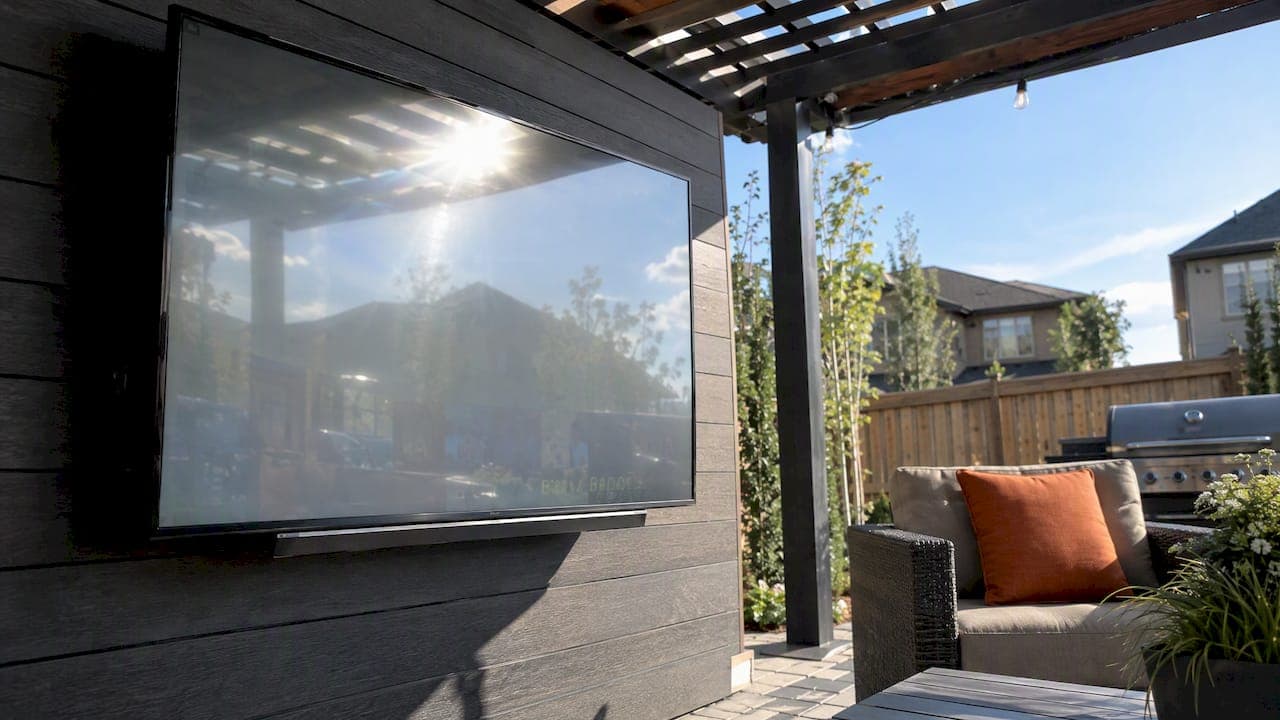
The most effective fix for outdoor TV glare is to keep direct sun off the screen. Put the TV under a roof, pergola or awning, aim it away from the sun and bright reflective surfaces, mount it on a tilting arm, then tune the picture. Anti-glare film and a brighter TV help at the margins, but they do not replace shade. Below is how each fix works, in the order we would apply them on a Calgary patio or deck.
TL;DR
- Shade does most of the work. A covered patio, fixed overhang, awning or pergola with side shades beats any screen treatment.
- Place the TV so it does not face the sun at your usual viewing time, and keep pools, windows and patio doors out of its line of sight.
- Use a tilt or tilt-and-swivel mount so you can move reflections out of view from your seats.
- Anti-glare film diffuses light but cannot eliminate glare, and it can dull colour.
- Match the TV's sun rating to the spot. A partial-shade model is not made for direct sun.
Table of Contents
- Why outdoor screens glare so badly
- Start with shade
- Choose the spot and the angle
- Get the right TV for the amount of sun
- Anti-glare film: what it does and does not do
- Tune the picture for daylight
- Add a cover for the sun and the seasons
- A quick Calgary patio checklist
- Our perspective
- Plan it with a Calgary installer
- FAQ
- Sources
Why outdoor screens glare so badly
A TV indoors competes with a lamp or a window. Outdoors it competes with the sun, which is far brighter than any room light. Glare comes from two sources. The first is reflection: sunlight and bright surroundings bounce off the screen into your eyes. The second is washout: ambient light is so strong that the picture looks faded, even when nothing reflects.
That is why a single trick rarely solves it. You reduce the light reaching the screen, control what the screen can reflect, and then make the picture stronger relative to what is left. We work through the problem in that order.

Start with shade
Shade is the fastest practical fix. Homes & Gardens points to an awning, umbrella, sun sail, pergola or similar cover to reduce direct sunlight striking the screen. For a permanent setup, you have a few options:
- A covered patio or deck roof. The cleanest answer. The TV sits under the roofline and the roof does the work every day without effort from you.
- A fixed overhang or eave. Works well when the TV is mounted on the wall beneath it.
- A retractable awning. Flexible: out for afternoon viewing, in when you want the sky.
- A pergola with side shades. Overhead slats cut the high sun, and side panels handle the low sun that sneaks in from the west.
- A motorized shade. Good when you want the screen covered with a button rather than a ladder.
Overhead cover matters most, but think about the sides too. In Calgary the sun gets low in the late afternoon and evening, which is exactly when many people sit down to watch. A roof alone will not stop a low sun from hitting the screen sideways. Side shades or a wall return on the sunny side fix that.
If you are planning a covered space anyway, our outdoor TV installation guide for Calgary homeowners covers the wiring, power and weather side of the job. The glare plan and the installation plan are best settled together, because the shade structure often decides where the TV can go.
Choose the spot and the angle
Once shade is in place, position does the next layer of work.
Face the screen away from the sun
Homes & Gardens recommends repositioning or angling the TV so that it does not face the sun during viewing. For the Northern Hemisphere, it also suggests orienting the screen toward true north to keep direct sun off it at peak hours. In practice, that means the best wall for an outdoor TV in Calgary is often one that looks north, with the seating area on the opposite side. If your only suitable wall faces south or west, shade and a good mount become more important, not optional.
Time of day matters as much as compass direction. Stand in your seating area at the time you actually watch, usually late afternoon to evening for ball games, or midday on weekends, and look at where the sun falls. If it lands on the wall you picked, move the plan, not just the TV.
Watch what is in front of the screen
Screens reflect whatever faces them. A pool, a large window or a glass patio door can throw bright light straight onto the display. Homes & Gardens advises avoiding reflective surfaces such as windows or patio doors. A darker backdrop in front of the TV, such as dark siding, a fence or shrubs, also helps, because there is less bright light to bounce back.
The same logic applies to a wide-open, bright lawn or hardscape facing the screen. If you can add a planter wall, a screen of evergreens or a darker fence, you cut what the screen can reflect.
Use a mount that moves
A fixed, flat-to-wall mount locks in whatever reflection you get on day one. A tilt or tilt-and-swivel mount lets you angle the screen down a few degrees or turn it a little so the reflection falls somewhere other than your eyes. Outdoor-rated mounting hardware is also worth the care: HGTV's outdoor TV guidance recommends outdoor-rated hardware, mounts that angle or swivel, and a seasonal cover.
Height matters too. A screen mounted too high tilts upward and picks up more sky reflection. Our TV mounting height guide explains how to find the eye-level position, and the same rules apply on a deck, with one change: you are usually seated lower and closer to a lounge angle, so check from the actual chairs. If you are weighing what the mount and labour will cost, see Calgary TV mounting costs.
Get the right TV for the amount of sun
Not every TV belongs outside, and not every outdoor TV handles sun the same way. Outdoor models are generally sold by how much sun they are designed to take: shade, partial sun or full sun. Consumer Reports advises matching the TV's sun rating to the installation site, and notes that full-sun models typically cost substantially more than partial-sun models.
That gap is the reason to be honest about your spot before you buy. A well-shaded covered patio does not need a full-sun screen. An open, unshaded deck does, or it needs shade built first.
There is also a heat limit. Samsung says its Terrace model is designed for partial shade, not direct sunlight. Samsung explains that a temporary dark area can appear when the screen surface rises above 70°C (158°F), typically after about ten minutes in direct sun, and that it goes away when the surface cools. A roof or awning is the remedy. That is a manufacturer's note about one model, but it shows why direct sun is a problem for the TV itself, not only for your eyes. Samsung's Canadian page lists an anti-reflection screen and Adaptive Picture that adjusts to viewing conditions on The Terrace, which is the kind of feature to look for on any outdoor model.
If you are choosing how much brightness and cover your space needs, the thinking in these outdoor living room ideas on designing a covered seating area is a useful companion when you decide where light falls through the day.
Calgary adds one more consideration: cold. Many people think about glare in summer, but a TV that stays up year-round also faces winter. Our guide to outdoor TVs in the cold covers the winter-ready options, so you choose a screen that is right in both seasons.

Anti-glare film: what it does and does not do
Anti-glare film and screen protectors are the most searched fix, so here is the plain version.
They work by scattering incoming light. HP explains that anti-glare screens scatter light and reduce reflections, helping keep a screen readable in bright conditions including sunlight, though they may slightly reduce clarity or colour vibrancy. Homes & Gardens is more direct: film cannot eliminate glare. It diffuses light to improve visibility and can affect colour vibrancy.
So treat film as a finishing touch:
- Fix shade and position first.
- If a glossy screen still shows reflections, then consider film.
- Expect softer reflections, not a mirror-free screen, and a small trade in colour punch.
It also helps to know which screen you have. Film makes sense on a glossy panel. A TV that already has a matte or anti-reflective finish has less to gain.
Tune the picture for daylight
A TV set up for a dim living room looks washed out outside. A few settings changes help:
- Raise the brightness or backlight. This is the biggest lever. Outdoors, you want the picture to be strong relative to the ambient light.
- Adjust contrast and colour intensity. Boosting both can restore punch lost to daylight.
- Expect an over-saturated look indoors. If you move the same TV between settings, switch picture modes so the daytime profile does not follow you inside.
These steps come from guidance such as Homes & Gardens, which lists brightness and screen adjustments alongside shade and positioning. Settings help most when the TV is already shaded. They cannot rescue a screen sitting in direct afternoon sun.
Add a cover for the sun and the seasons
A fitted seasonal cover does two jobs. HGTV notes that a seasonal screen cover shields an outdoor TV from direct sun, moisture, dust and pollen. It does not help while you are watching, but it keeps the screen out of the harshest sun between uses and protects it through Calgary's freeze-thaw months.
Keep the TV clear of heat sources as well. Fire pits and grills are common on the same patios, and the sun is not the only thing that heats a screen. Leave generous space between the TV and open flame or a barbecue, and plan seating and the fire feature so they are not on the same wall.
A quick Calgary patio checklist
Before you pick a wall, walk through this:
- Sit where you will sit. Note where direct sun lands at the hour you actually watch.
- Look behind you. Whatever is bright behind your seats will reflect in the screen. Check pools, windows and glass doors.
- Choose shade. Roof, overhang, awning, pergola with side shades, or a motorized shade.
- Pick a mount that tilts and swivels. Then test angles from each seat.
- Match the TV's sun rating to the real conditions. Do not stretch a partial-shade model into full sun.
- Set the picture for daylight. Brightness first, then contrast and colour.
- Add film only if glossy reflections remain.
- Plan year-round protection. A seasonal cover and winter-ready hardware.
If the TV is going on the same wall as a window or near a living-space opening, the interior view matters too. Our guide to south-facing window blinds shows how to keep the view and cut heat, which pairs well with controlling glare on the glass that faces your patio.
Our perspective
We see the same pattern on most outdoor TV jobs in and around Calgary. People buy the screen first and think about the sun second. The better order is the reverse: decide where the shade is, where people sit and which way the wall faces, then choose the TV and the mount.
Glare is a design problem as much as a product problem. A roofline that drops a metre in the right place, a pergola with a side panel, or a wall in a slightly different spot can do more than any accessory. That is why we like to be involved early, ideally while the deck or covered patio is still on paper, and why builders who bring us in during framing get cleaner results: the wiring is hidden, the mount is backed properly and the screen is placed for the light.
Our approach is fully custom and scaled to the space. We want the install to be discreet and to disappear into the architecture, with one point of contact from planning through ongoing support. For outdoor screens that means choosing equipment for the exposure, mounting it on hardware that lets you adjust the angle, and setting the picture so it looks right in daylight.
If your plan includes motorized shades alongside the TV, we can handle that as part of the same project, so the screen, the shade and the controls work together from one app or remote.
JupiterAV
Plan it with a Calgary installer
If you would rather not guess at sun angles and reflection, we can help. JupiterAV designs, sells, installs and services TVs, outdoor and whole-home audio and video, smart home control, motorized blinds and low voltage wiring for homes, businesses and builders in Calgary. We can look at your patio, deck or acreage build, recommend where the screen should go and what shade it needs, and install it cleanly.

Tell us about your space on the JupiterAV website and we will take it from there. Builders planning outdoor living areas on custom homes or acreages are welcome to contact us before framing.
FAQ
Can an outdoor TV be in direct sunlight?
It depends on the model. Many outdoor TVs are built for partial shade, not full sun, and Samsung says direct sun can cause a temporary dark area on The Terrace once the screen surface passes 70°C (158°F). Full-sun models exist, but they typically cost substantially more, so match the rating to your spot or add a roof or awning.
Do anti-glare screen protectors work in sunlight?
They help, but they do not remove glare. Anti-glare film scatters light and reduces reflections, which makes the screen easier to read in bright conditions. It can slightly reduce clarity or colour vibrancy, so use it after shade and positioning are sorted.
What is the best way to shade an outdoor TV?
An overhead cover is the most effective: a covered patio roof, fixed overhang, awning or pergola. Add side shades or a motorized shade if the low late-day sun hits the screen from the side. The best choice is the one that stays in place when you sit down to watch.
Which direction should an outdoor TV face in Calgary?
Where possible, face the screen toward true north, which keeps direct sun off it at peak hours in the Northern Hemisphere. If the wall you have faces another way, rely on shade and a tilt and swivel mount, and avoid reflective surfaces like windows or pools in front of the screen.
Sources
- How to reduce glare on an outdoor TV: 5 easy, expert steps, Homes & Gardens
- Tips for Installing an Outdoor Television, HGTV
- What to Look For in an Outdoor TV, Consumer Reports
- Enjoy your entertainment outside with the Terrace TV, Samsung US
- Enjoy the outdoors with The Terrace, Samsung Canada
- Pros and Cons of an Anti-Glare Screen, HP