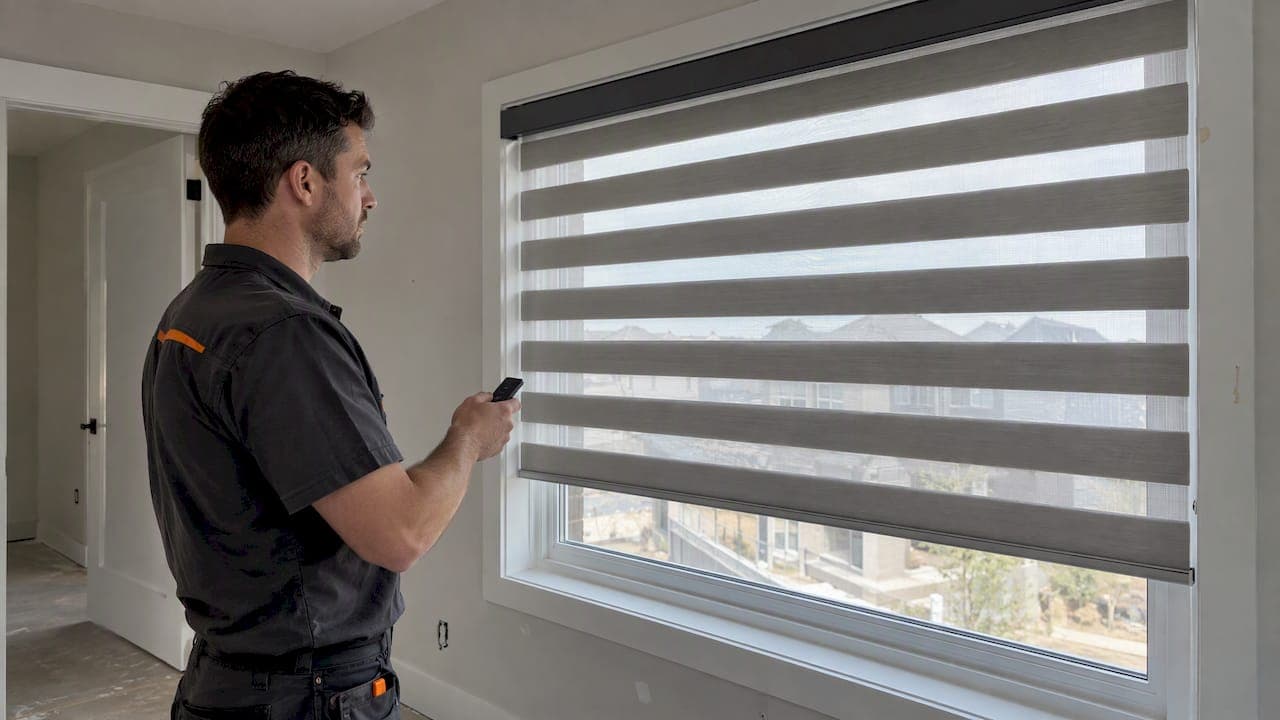
Motorized zebra shades give you automatic control over light and privacy through alternating sheer and opaque fabric bands, operated by remote, app or voice command instead of a wand or chain. For most households, they are a strong choice: convenient scheduling, no dangling cords near kids or pets, and straightforward integration with existing smart-home systems. The sections below cover the features, controls, installation steps, costs and safety details worth knowing before you buy.
TL;DR:
- Choose light filtering fabric for diffused daylight in living spaces, but use room darkening fabric or a liner where sleep and nighttime privacy matter.
- App or voice control requires a hub; if you may automate more shades later, choose one compatible with your existing system before ordering motors.
- For inside mounts, use the narrowest of three width measurements and the longer of two height measurements; outside mounts need extra frame coverage.
- Battery motors simplify retrofits, while hardwired models suit high use or planned renovations; run low voltage cable before drywall to avoid later retrofit work.
- Custom widths cost more and take longer than standard sizes, and existing shades may need a replacement headrail if their hardware cannot carry the motor.
Table of Contents
- How motorized zebra shades work and the features that matter
- Choosing remotes, hubs and smart-home controls
- Measuring, installation and prewiring guidance
- Typical costs, sizing and what drives the price
- Safety, compliance and night-time visibility
- Installer-led advice: prewire, battery life and service expectations
- What sets motorized zebra shades apart from roller or hybrid designs
- Troubleshooting common motorized zebra shades issues
- Why professional measurement and integration pays off
- How we can help with sales, measurement, install and support
- FAQ
- Sources
How motorized zebra shades work and the features that matter
Zebra shades (also sold as day-night shades or vision shades) use two layered fabric sheets, one sheer and one opaque, stitched into horizontal bands on a shared roll. Shifting the layers aligns the sheer sections for soft, filtered light or the opaque sections for privacy and shade. Motorizing that movement replaces the manual chain or wand with a small motor inside the roller tube, so the bands align at a scheduled time, a remote press or a voice command instead of a hand pull.
Fabric choice changes what the shade actually does for a room. Light-filtering fabrics let in a diffused glow even when closed and suit living rooms or kitchens where you still want daylight. Room-darkening and blackout-grade fabrics block more outside light and work better in bedrooms or home theatres where glare and visibility matter more than ambient brightness.
The headrail and mounting style affect both appearance and fit:
- Inside mount sits within the window frame for a flush, built-in look.
- Outside mount covers the frame and trim, useful when you want more light blockage or the frame is too shallow.
- Cassette headrails conceal the roller tube and motor behind a fabric or metal cover, giving a cleaner finish than an open roller.
Power options range from replaceable or rechargeable batteries to a hardwired connection tied into household power. Battery units are easier to retrofit since they need no new wiring, while hardwired motors suit new builds or renovations where a prewire run is already planned. Either option, when sized correctly for the shade's width and weight, holds up well over years of daily cycles.
At delivery or installation, check that the fabric bands align evenly across the full width, the motor runs quietly without grinding, and the headrail sits level against the frame or wall.
Pro Tip: Ask your installer to run the shade through a full open-close cycle before they leave. Misalignment is far easier to fix on install day than after the fabric has settled into a skewed position.
Choosing remotes, hubs and smart-home controls
Motorized zebra shades can be operated several ways, and the right choice depends on how much automation you want and what smart-home system, if any, you already run.
- RF or IR remote: A handheld remote sends a signal directly to the motor, simple and reliable for a single room or a small number of shades.
- Wall switch or in-line control: A fixed switch near the window gives household members a familiar, always-available control point, especially useful in shared spaces.
- App control through a hub: A bridge connects the shades to Wi-Fi, letting you schedule, group and control them remotely from a phone.
For smart-home integration, look for compatibility with the ecosystem you already use. Many motors pair with Lutron Caséta systems or Control4 for whole-home scheduling, while newer models are built with Matter and Thread support for broader interoperability across brands. A bridge or hub is typically required for app or voice control; without one, the shade is limited to its remote or wall switch.
Battery-powered motors work well in most rooms and avoid any wiring, but high-use areas like a frequently adjusted living room shade may benefit from a hardwired connection to skip battery changes entirely.
Before requesting a quote, note down: how many windows need motorization, whether you want app or voice control, which smart-home hub (if any) you already run, and whether any windows are hard to reach for future battery swaps.
Pro Tip: If you plan to add more automated devices later, choose a hub-based system now. Swapping from remote-only to hub-based control after the fact often means replacing motors, not just adding a bridge.
Measuring, installation and prewiring guidance
Accurate measurements make the difference between a shade that fits flush and one that gaps at the edges. For an inside mount, measure the width at the top, middle and bottom of the window opening and use the narrowest figure, then measure the height on both sides and use the longer one. For an outside mount, add coverage past the frame, usually a few inches on each side and above the opening, to block light gaps and allow room for trim.

Prewiring matters most for hardwired motors or homes planning several shades. During construction or a major renovation, running low-voltage cable to each window location is far simpler than retrofitting it later. Our prewire guidance for builders and owners covers cable types, run lengths and switch placement for motorized shade projects.
A few points worth confirming before drywall goes up or before you book an install:
- Confirm whether each window will use battery or hardwired power, since only hardwired units need a cable run.
- Plan switch or control locations away from high-traffic areas but within easy reach.
- Note headrail depth required for cassette-style shades, since shallow frames may need an outside mount instead.
- For retrofits, confirm whether the existing headrail can be reused or needs full replacement to fit the new motor.
Retrofitting an existing manual shade with a motorized headrail is possible in many cases, though a full headrail replacement is sometimes needed if the existing hardware cannot support the motor's size or weight.
Professional installation reduces callbacks because small measurement errors, like an inside mount that is 2 millimetres too wide, often show up only after the shade is hung. When requesting a quote, send clear photos of each window along with its rough measurements, mount preference and whether cable is already run; this lets an installer give an accurate estimate on the first visit rather than after a second site survey.
Typical costs, sizing and what drives the price
Several factors drive the price of a motorized zebra shade: fabric grade, motor type, custom sizing, the complexity of any smart-home integration and labour for installation and programming. A standard-width window with a basic battery motor and light-filtering fabric sits at the lower end of a quote, while a wide custom window with blackout fabric, a hardwired motor and full Control4 or Lutron integration pushes the estimate higher.
When comparing quotes, look for these line items rather than a single bundled number:
- Measurement and fabric cost, tied to window size and fabric grade.
- Motor type, since hardwired units typically add wiring labour that battery units skip.
- Integration and programming, covering hub setup, scheduling and voice-assistant pairing.
- Installation labour, which varies with mount type and access difficulty.
- Warranty terms, since motor warranties often differ from fabric warranties.
Our cost breakdown for motorized shade budgeting walks through typical ranges and how custom dimensions or motor upgrades shift the total. Shoppers should expect custom widths to increase both lead time and cost compared with standard off-the-shelf sizes, since manufacturers build to order rather than pulling from stock.
Upgrading to a hardwired motor or hiring a professional for integration makes the most sense when you are automating several windows together, since a hub-based system scales more smoothly than a pile of standalone remotes. A budget battery option suits a single room or a trial run before committing to a whole-home setup. Many installers offer staged installs, starting with the rooms you use most and expanding later, which spreads the cost over time without losing the ability to add matching shades down the road.
Safety, compliance and night-time visibility
Removing the pull cord is one of the clearest safety advantages of motorizing a zebra shade. Corded shades carry a strangulation risk for young children, which is why federal Regulation SOR/2019-97 restricts corded window coverings sold in Canada. A motorized shade with no exposed cord sidesteps that hazard entirely, though it is worth confirming any remote or control unit also has no accessible cord or cable that could pose a similar risk.
Fabric transparency affects night-time privacy as much as daytime light control. Sheer bands that look private in daylight can become see-through once a room's interior lights are on and it is dark outside, so pairing the shade with a room-darkening liner or closing the opaque bands fully after sunset maintains privacy.
To keep the safety and automation features working reliably, check motor function periodically and replace batteries before they fully drain, since a dead battery mid-cycle can leave a shade stuck in an inconvenient position.
Installer-led advice: prewire, battery life and service expectations
Years of running low-voltage cable for motorized shades have shown us that prewiring during construction, not after, saves the most time and cost. Our prewire checklist covers cable runs up to 50 feet and switch placement that holds up through a full build.
On battery life, our field observations show real variation by motor type and how often a shade cycles. A few habits extend battery life meaningfully:
- Group shades into scheduled scenes rather than triggering each one individually throughout the day.
- Choose rechargeable battery packs for frequently used windows to cut down on manual replacements.
- Reserve hardwired power for shades that cycle many times daily, such as a kitchen or living room window.
Professional integration with smart home systems tends to avoid the dropped connections and clunky scheduling that come from mismatched hubs, while also keeping wiring and motors fully concealed behind trim or inside the headrail.
What sets motorized zebra shades apart from roller or hybrid designs
A motorized zebra shade is built around two stacked fabric layers, sheer and opaque, that slide relative to each other to control how much light passes through the horizontal bands. A standard motorized roller shade, by contrast, uses a single fabric panel that simply rolls up and down, offering only fully open or fully closed positions (or anywhere in between on one fabric) rather than a layered light-and-privacy gradient.
Hybrid designs sometimes marketed as "zebra blinds" combine elements of both: a single roller mechanism paired with a dual-layer fabric, aiming for the zebra shade's light control in a slimmer housing. The practical difference for a buyer is how finely you can tune the light. A true zebra shade lets you dial in a soft, diffused glow by partially overlapping the sheer and opaque bands, something a single-layer roller shade cannot replicate regardless of motor quality. When comparing products, check whether the "zebra" or "sheer" label refers to an actual dual-layer fabric system or a single-layer shade with a similar name, since the fabric construction, not the motor, is what defines the category.
Troubleshooting common motorized zebra shades issues
Most problems with motorized zebra shades trace back to power, alignment or signal, rather than the fabric itself. A shade that stops responding to a remote or app often has a drained battery or a motor that has lost its paired connection to the hub; re-pairing the remote or hub, and checking the battery, resolves the majority of these cases.
Uneven fabric bands, where one side sits higher than the other, usually point to a headrail that was not mounted level or a motor limit that needs recalibrating. Most motors have a reset or limit-setting function, accessible through the remote or app, that lets you reprogram the shade's fully open and fully closed positions.
A shade that moves slowly or struggles partway through its cycle may be carrying a slight obstruction in the fabric path or a motor nearing the end of its battery life. Motors built with positional feedback or obstacle detection catch this kind of stall before it strains the mechanism, which is worth asking about when comparing motor specifications. If a hardwired shade loses power entirely, check the breaker or transformer feeding that run before assuming the motor itself has failed.
Why professional measurement and integration pays off
The shade itself rarely causes problems: misaligned headrails, wrong hub choices and skipped prewiring do. A fraction of a millimetre in a measurement, or a mismatched bridge, turns into a visible gap or a shade that never quite talks to the rest of your smart home. Working through the checklist in this article before requesting a quote catches most of that upfront.
**
How we can help with sales, measurement, install and support
We handle motorized zebra shades from first measurement through to aftercare: sales, custom measurement, professional installation, and integration with smart home systems so your shades work alongside the rest of your smart home rather than as a separate system.

To prepare for a quote, have rough window measurements and photos of each window ready, along with a note on whether you want app, voice or hub-based control. From there, a typical project moves through a site visit, precise measurement and a written estimate before installation is scheduled.
- Sales and selection of fabric, headrail and motor options suited to each room.
- On-site measurement for inside or outside mount, including trim and frame depth.
- Installation and programming, with integration into popular smart home systems.
- Ongoing support for motor service, battery troubleshooting and future expansion.
| Step | What it covers |
|---|---|
| Site visit | Window assessment, mount recommendation, fabric and motor options |
| Measurement | Precise width and height for inside or outside mount |
| Written estimate | Line-item pricing for fabric, motor, labour and integration |
| Install and programming | Mounting, motor setup, hub pairing and scheduling |
Reach out through our services page to book a site visit and get a written estimate for your windows.
FAQ
What standard sizes do blinds come in?
Standard blind widths commonly run in set increments to match typical window openings, though exact ranges vary by manufacturer. Many shoppers need a custom width or height for an unusually large or narrow window, which most suppliers accommodate at a higher cost and longer lead time than off-the-shelf sizes.
Why are zebra blinds so expensive compared with basic blinds?
Zebra blinds cost more because they use two stitched fabric layers instead of one, plus a more complex mechanism to shift those layers in sync. Motorizing adds further cost for the motor, battery or wiring, and any hub or app integration.
Can you motorize existing shades?
Many existing shades can be retrofitted with a motorized headrail, though the original hardware sometimes cannot support the added motor weight and needs full replacement. A professional can check your current shade during a site visit and confirm whether a retrofit kit or a new headrail is the better fit.
Can you see through zebra blinds at night?
Yes, sheer fabric bands can become more visible from outside once interior lights are on after dark, even if they looked private during the day. Closing the opaque bands fully, or adding a room-darkening liner, maintains privacy once the sun goes down.