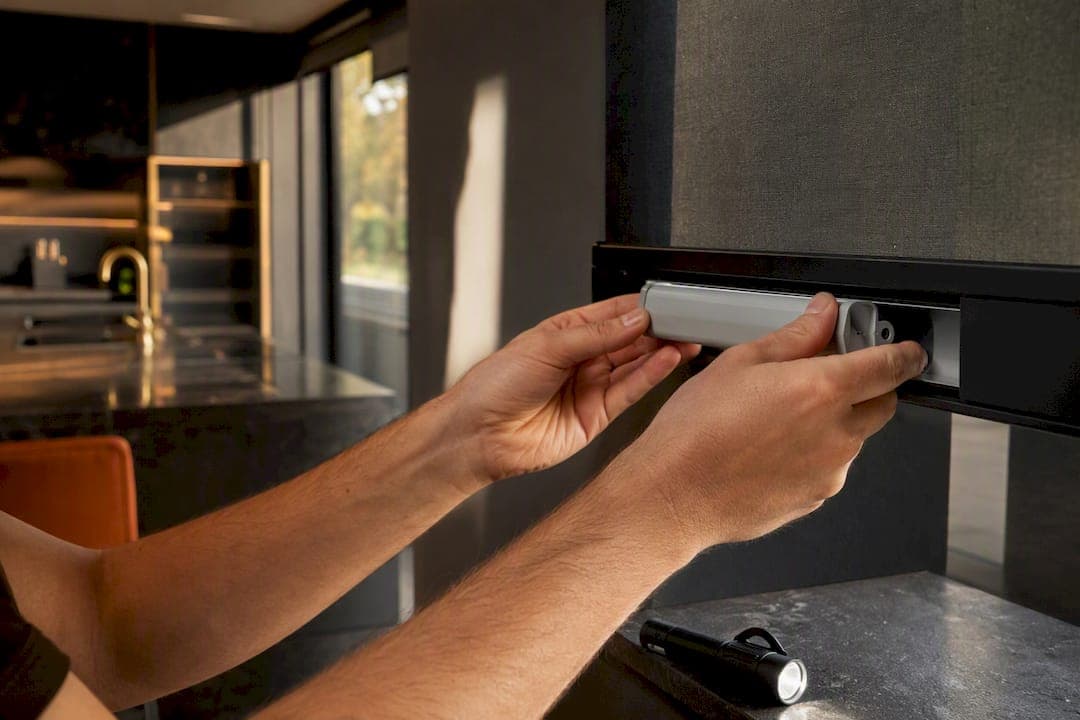
Most motorized blinds run many months on a single charge or battery set under normal household use, and Hunter Douglas pegs its PowerView system at about a year depending on shade size and how often you raise and lower it. Lithium based systems and low-traffic rooms sometimes stretch well past that.
Three things move that number the most:
- Cut daily cycles: group scheduling that raises and lowers shades twice instead of five times a week can double the interval between charges.
- Match the battery chemistry to what the manufacturer recommends, since lithium disposables and rechargeable packs hold voltage more consistently than alkaline.
- Consider solar or hardwiring on large or high-use windows so you stop thinking about charging altogether.
Quick answer: budget for a charge or battery swap every 6 to 12 months, check for early warning signs monthly, and pick the power method that matches how often that specific shade actually moves.
Key Takeaways
Motorized blind batteries typically last 6 to 12 months per charge, and matching battery type, cycle count, and power method to actual usage is what determines whether a given shade lands near the short or long end of that range.
| Point | Details |
|---|---|
| Expect 6 to 12 months per charge | Most rechargeable systems and Hunter Douglas PowerView both fall in this range depending on use and size. |
| Cycle count drives drain | Cutting redundant automations often extends charge intervals more than any battery upgrade. |
| Lithium outperforms alkaline | Lithium disposables and built-in lithium packs hold voltage more consistently across the battery's life. |
| Isolate before replacing | Check whether fast drain hits one shade or all shades before assuming the battery has failed. |
| JupiterAV handles upgrades | JupiterAV installs and services Lutron and Clara motorized blinds, including solar and hardwired power retrofits. |
Table of Contents
- Motorized blinds battery life by system type
- What drains motorized shade batteries faster
- Which battery type is right for your motorized blinds?
- How to charge or power motorized blinds
- Maintenance and troubleshooting fast battery drain
- Replacing motorized blind batteries safely
- How battery life compares to motor and shade lifespan
- When to call a professional for motorized blind service
- Get a professional battery or power upgrade for your motorized blinds
- Frequently asked questions
- Sources
Motorized blinds battery life by system type
Not every motorized shade drains power the same way, and the "typical" range depends heavily on what's inside the housing.
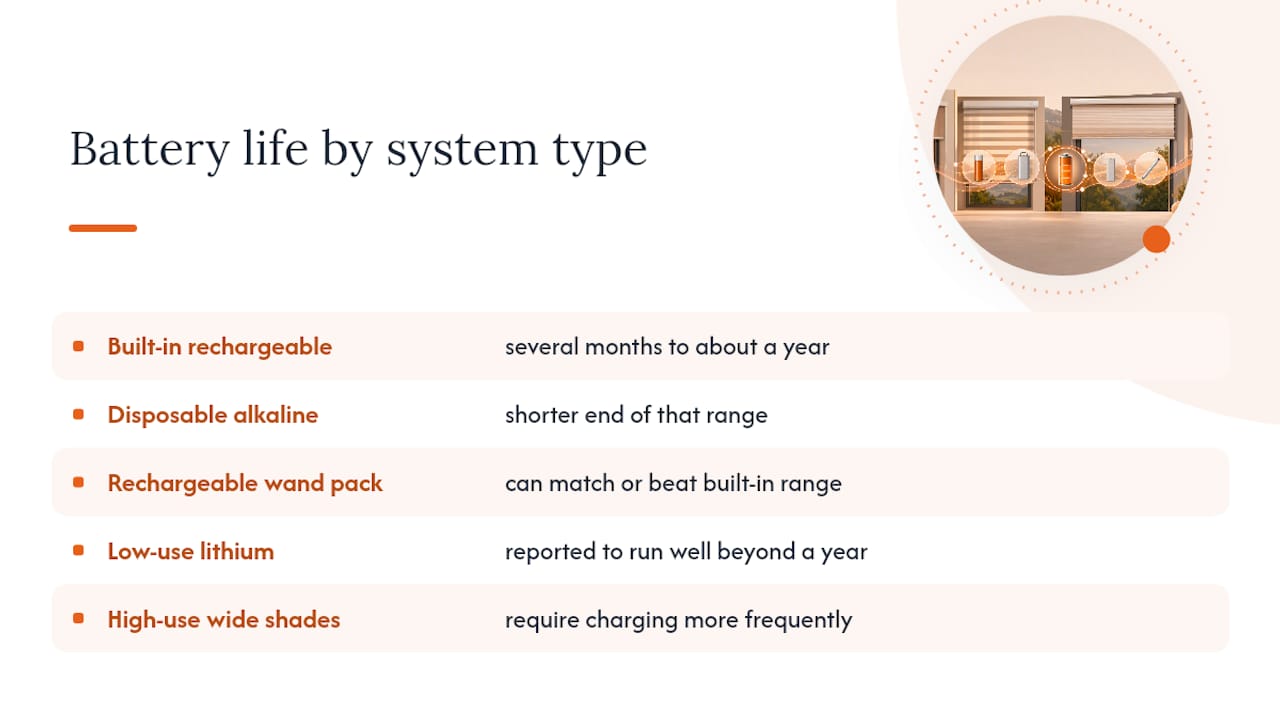
Built-in rechargeable motors, the kind found in most mid-range and premium shades, generally run several months between charges under normal use, according to Hartley Window Coverings. Hunter Douglas backs that up with its own PowerView guidance, citing about a year, though the company is careful to note that shade size, configuration and usage frequency all shift that estimate up or down.
Removable AA battery wands behave differently. Disposable alkaline wands tend to sit on the shorter end of that range, especially on wider shades, while rechargeable wand packs you swap and recharge on a dock can often match or beat the built-in rechargeable numbers.
A few outliers exist. Low-use installations (a media room shade that moves twice a month) and some lithium-powered systems have been reported to run well beyond a year before needing attention. On the flip side, a wide kitchen shade cycling multiple times a day on a strict schedule will require charging more frequently.

What drains motorized shade batteries faster
Usage volume matters more than almost anything else. A shade that opens and closes twice a day uses a fraction of the power a shade running six or seven scheduled cycles does, especially if those cycles are tied to sunrise/sunset automations that fire even when nobody's home to notice.
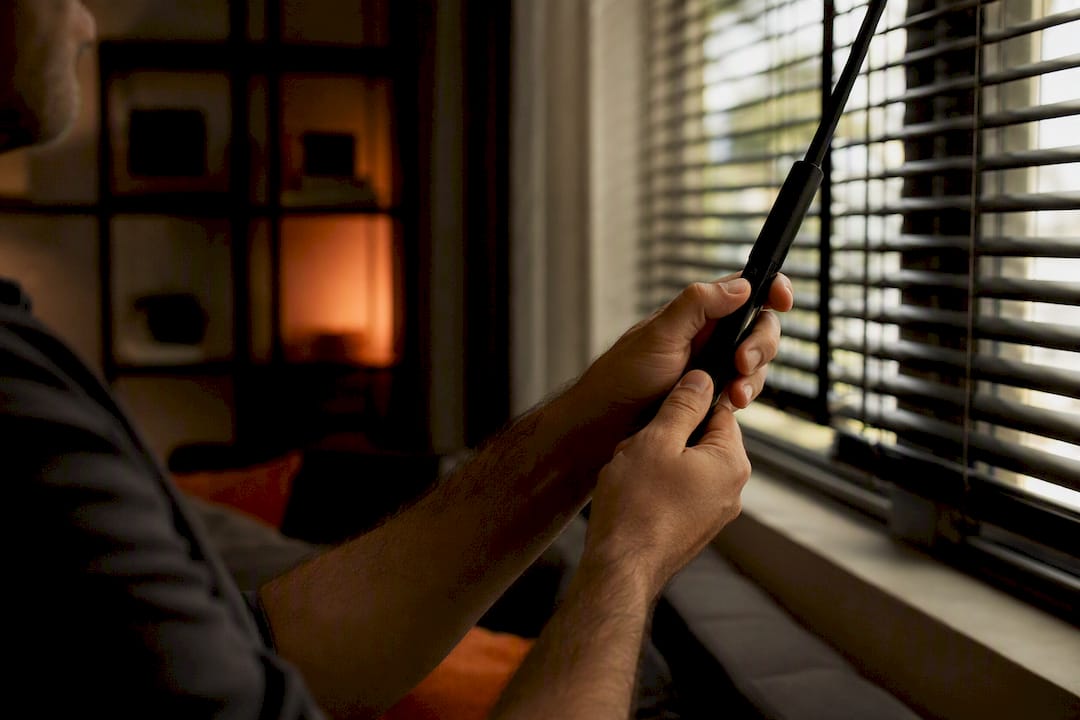
Size and weight play a close second role. Wider spans, heavier fabrics, and blackout material force the motor to work harder per cycle, which pulls more current each time. If you're choosing between fabric weights for a new installation, it's worth reading up on how blackout versus light-filtering shades affect motor load before you commit to a heavier option on a battery-only setup.
A few other factors worth knowing:
- Motor torque rating: higher-torque motors built for oversized shades draw more per cycle than standard residential motors.
- Group commands: whole-room "all shades down" scenes run every motor at once, which is convenient but adds up in cycles across a season.
- Temperature extremes: cold rooms and sun-baked window wells reduce battery efficiency, particularly with alkaline cells.
- Smart-home automations: redundant timers or overlapping app schedules can trigger silent extra cycles you never see.
Pro Tip: A rough rule of thumb: every 30 to 40 extra full up/down cycles in a month is roughly equivalent to a month of "typical" use on top of your normal schedule. If a shade suddenly needs charging twice as often as its siblings, check its automation rules before assuming the battery itself is failing.
Which battery type is right for your motorized blinds?
Alkaline AA batteries remain the default many manufacturers ship with, mostly because they're cheap and available at any grocery store. They're fine for low-use shades, but runtime drops faster than other chemistries once cycle counts climb, and cold rooms make that worse.
Lithium disposables cost more upfront but hold a more stable voltage across their full life and have a longer shelf life sitting unused. Some manufacturers specifically recommend lithium for larger or heavier shades where alkaline cells tend to fade unevenly.
Rechargeable NiMH packs and built-in lithium ion battery packs are where most premium systems have landed. A rechargeable lithium pack built into the motor housing can deliver months of continuous use between charges, and you skip the ongoing cost of disposables entirely.
- Alkaline AA: lowest upfront cost, widely available, shortest realistic runtime on high-cycle shades.
- Lithium disposable: better voltage stability, longer shelf life, higher per-battery cost.
- NiMH rechargeable wands: no landfill batteries, moderate upfront cost, needs a charging dock.
- Built-in lithium packs: longest typical runtime, charges via USB or magnetic port, factory-installed.
Pro Tip: Never mix battery chemistries or ages in the same wand. A single weak alkaline cell paired with fresh ones can cause uneven motor performance and trip false low-battery alerts.
How to charge or power motorized blinds
Motorized shades are powered through several distinct methods, and Hunter Douglas outright supports multiple options across its lineup rather than locking every product into one system.
The main methods you'll run into:
- Removable AA battery wands (disposable or rechargeable)
- Rechargeable lithium wand packs charged on a separate dock
- USB or magnetic charging ports built into the bottom rail or motor housing
- Integrated solar strips on the top rail for continuous trickle charging
- Plug-in transformers for shades near an outlet
- Hardwired 120/240V connections, common on large commercial or whole-home installs
Charging itself is straightforward. Most systems connect a USB or magnetic cable to the bottom rail, and a full charge typically takes a few hours depending on the battery size.
For scheduling, match the interval to actual use:
- Low use (a few cycles a week): check and charge every 9 to 12 months.
- Typical use (daily automation): charge every 6 to 9 months.
- Heavy use (multiple cycles daily, commercial spaces): charge every 3 to 6 months.
- Set a recurring phone reminder tied to a season change, so multiple shades in a room stay on the same cadence instead of drifting out of sync.
Solar strips and hardwiring both remove the charging task entirely. Solar makes sense on sun-facing windows; hardwiring is the better call for large-panel or commercial installations where stable 100 to 240V power is already available.
Maintenance and troubleshooting fast battery drain
Before assuming a battery has failed, run through a short diagnostic. Common warning signs include slower-than-usual movement, shades that stop short of full travel, inconsistent remote or app response, and app-based low-battery alerts.
Basic upkeep goes a long way toward avoiding those symptoms:
- Wipe down rails and mounting brackets periodically so dust doesn't add resistance to the motor.
- Audit your automation rules every few months and remove overlapping timers that fire redundant cycles.
- Update firmware through the manufacturer's app when prompted, since outdated firmware occasionally causes phantom battery drain.
- Restart or reset the shade through the app if it stops responding before assuming the battery is dead.
If the issue affects one shade only, it's usually the battery, the motor, or a loose connection specific to that unit. If every shade on the same hub or automation is draining fast at the same time, look at your scheduling rules first. That distinction alone saves a lot of unnecessary battery swaps.
Pro Tip: Isolate the problem before replacing anything: run one shade manually with a known-good battery. If it behaves normally, the automation setup is the culprit, not the hardware.
Replacing motorized blind batteries safely
Swapping a battery wand is quick once you know the sequence:
- Put the shade into service mode or power it down through the app if the system supports it.
- Remove the battery wand from the headrail or motor housing.
- Swap the cells, matching polarity exactly and using the same battery type throughout.
- Reinsert the wand and test full up and down travel before closing everything up.
- Dispose of old cells at a battery recycling drop-off rather than the trash; most municipal recycling programs and hardware stores in Canada accept alkaline and lithium cells for free.
For rechargeable wands or built-in packs, connect the USB or magnetic charger, let it run its full cycle (typically a few hours), and confirm the app shows a full charge before disconnecting.
Never mix battery chemistries in one wand, and follow the manufacturer's specific guidance. Using an unapproved battery type can void your warranty even if the shade still functions.
How battery life compares to motor and shade lifespan
Motors and fabrics are built to outlast batteries by a wide margin. Where a battery is a consumable you replace or recharge every 6 to 12 months, the motor and shade assembly on a well-installed system commonly runs for many years without needing service.
That gap matters for troubleshooting: if a shade that used to hold a charge for months suddenly needs charging every few weeks, that's not always the battery aging out. Erratic or slow movement paired with fast drain more often points to motor wear than to the power source.
- Batteries: consumable, expect replacement or recharge every 6 to 12 months.
- Motor and shade: structural, typically lasts years under normal residential use.
- Registering your product with the manufacturer can simplify warranty claims if a motor issue does turn up.
When to call a professional for motorized blind service
Some issues are worth booking a technician for rather than troubleshooting solo: repeated unexplained fast drain across multiple shades, a noisy or grinding motor, a shade that won't move despite a freshly charged battery, or a multi-shade automation acting unpredictably.
A qualified installer will run power diagnostics, check the motor's torque response, inspect wiring on hardwired units, and review your group programming for conflicting schedules.
- Recurring drain with no clear cause
- Motor noise or no movement on a charged battery
- Hardwiring or solar retrofit requests
- Automation conflicts across multiple shades
Pro Tip: If you're already troubleshooting one shade every season, that's usually the signal it's time for a hardwired or solar upgrade rather than another battery swap.
A publisher's perspective on motorized blind batteries
The mistake we see most often isn't a bad battery. It's automations set to run far more cycles than anyone actually needs, quietly burning through charge. Homeowners with large or high-traffic windows are usually happier switching to solar or hardwired power once they realize how often they'd otherwise be charging.
Get a professional battery or power upgrade for your motorized blinds
JupiterAV handles the part most homeowners would rather not deal with themselves: diagnosing why a shade drains fast, deciding whether solar, hardwiring, or a straight battery swap is the right fix, and installing it without putting your warranty at risk.

If you're already tracking charging schedules across several rooms, or you're planning a larger motorized blind project and want a realistic budget before committing to hardwiring, that's exactly the kind of call we take. Every install and service visit follows manufacturer guidance, including Lutron and Clara systems, so nothing you do on our end voids the coverage you're already paying for. If you're weighing whether your current smart-home setup can even support solar or hardwired shades, our notes on Control4 and dealer versus DIY control cover that groundwork too.
Book a diagnostic or installation visit through JupiterAV and get a power setup that matches how you actually use your shades, not a generic default.
Frequently asked questions
How long do motorized blind batteries actually last? Most systems run 6 to 12 months per charge under normal use, with Hunter Douglas citing about a year for PowerView depending on shade size and configuration.
How often should I charge motorized shades? Low-use shades can go 9 to 12 months between charges, typical daily-use shades need charging every 6 to 9 months, and heavy-use or commercial installations often need it every 3 to 6 months.
How do I replace batteries in a motorized blind? Remove the battery wand, swap cells matching polarity and chemistry, reinsert it, and test full travel before disposing of old cells at a battery recycling drop-off.
Do all motorized blinds use batteries? No. Options range from disposable and rechargeable battery wands to USB charging ports, solar strips, and hardwired 120/240V connections, so battery use depends on the system you choose.