
For most Canadian homeowners, the best practical alternative to Control4 is a dealer-backed platform installed by a local certified integrator, with Savant or Crestron at the premium end and Loxone or RTI as strong mid-tier options. If budget is the deciding factor, Home Assistant or Hubitat offer genuine whole-home capability at a fraction of the cost, though both require hands-on technical comfort. The shortlist breaks down cleanly: dealer-backed (Savant, Crestron, Loxone, RTI), hybrid (Lutron Caseta, Sonos), and open/DIY (Home Assistant, Hubitat, KNX for new builds).
The single biggest differentiator for Canadian buyers is not the platform itself — it is whether a certified dealer within a reasonable service radius can support it after installation. A system that works perfectly on day one but has no local technician within 500 km is a liability, not an asset.
Control4 reports interoperability across thousands of third-party products, which is a genuine strength, but that breadth also creates driver-dependency risk. The alternatives market now spans fully managed dealer platforms, integrated hardware ecosystems, and open-source stacks, so there is a credible option at every price point. JupiterAV supports several of these platforms directly in Alberta, including Control4, Lutron Caseta, Sonos, and motorized blinds from Lutron and Clara.
Table of Contents
- How do the main Control4 alternatives compare?
- How do you choose the right alternative for your home?
- What does each alternative actually offer?
- What does installation actually cost in Alberta?
- Key takeaways
- Why local dealer support matters more than the platform name
- JupiterAV: local smart home installation and service in Alberta
- Useful sources and further reading
How do the main Control4 alternatives compare?
The table below maps the major categories of home automation alternatives by the dimensions that matter most to Canadian buyers. Named products appear as examples within each category, not as ranked endorsements.
| Category | Best for | Typical cost (CAD) | Install model | Scalability | Key integrations | Openness | Reliability & support in Canada | Certified dealers in Canada |
|---|---|---|---|---|---|---|---|---|
| Dealer-backed platforms (Savant, Crestron, RTI) | Luxury whole-home, commercial | a high upfront cost with dealer labour extra | Dealer only | Whole-home | Voice assistants, Sonos, Lutron, blinds, security, AV | Low (dealer programs) | High; warranty tied to dealer SLA | Yes, in major cities |
| Integrated hardware ecosystems (Loxone) | New builds, large retrofits | a mid to high price range | Dealer / certified partner | Whole-home | Lighting, HVAC, blinds, AV, security | Medium (proprietary but open API) | Good; fewer third-party driver risks | Growing; check regional coverage |
| Open-source / local-first stacks (Home Assistant, Hubitat) | Tech-savvy DIY, budget-conscious | low hardware cost | DIY / self-managed | Whole-home (with effort) | Alexa, Google, Sonos, Lutron, most Z-Wave/Zigbee devices | Very high | Community support; no commercial SLA | None (self-supported) |
| Lighting-first hybrid (Lutron Caseta) | Single-room to whole-home lighting | moderate hardware cost | DIY or dealer-assisted | Room to whole-home | Alexa, Google, Apple HomeKit, Sonos | Medium | Strong; Lutron hardware is highly reliable | Yes, widely available |
| Audio ecosystem (Sonos) | Whole-home audio, AV rooms | a range of moderate hardware costs | DIY or dealer-assisted | Room to whole-home | Alexa, Google, Apple AirPlay 2, Control4, Lutron | Low (closed ecosystem) | Excellent; Sonos app widely supported | Yes |
| Wired building standard (KNX) | New builds, commercial, large estates | a high price range | Certified KNX installer | Whole-building | HVAC, lighting, blinds, AV, security | High (open standard) | Strong long-term; requires KNX-certified trades | Limited in Canada; mainly commercial |
A note on recurring fees: Dealer-backed platforms (Savant, Crestron, Control4) typically involve annual dealer service agreements and software licence renewals. Home Assistant and Hubitat are largely free to run locally, though cloud-connected features may carry optional subscription costs. Loxone has no mandatory annual subscription for core functions.
- Savant and Crestron are the go-to choices for projects where budget is secondary to polish and reliability.
- Home Assistant has one of the largest active user communities globally, which means driver support and troubleshooting resources are abundant, but that community is your support desk.
- Lutron Caseta is the most reliable entry point for lighting automation and pairs well with almost every other platform on this list.
How do you choose the right alternative for your home?
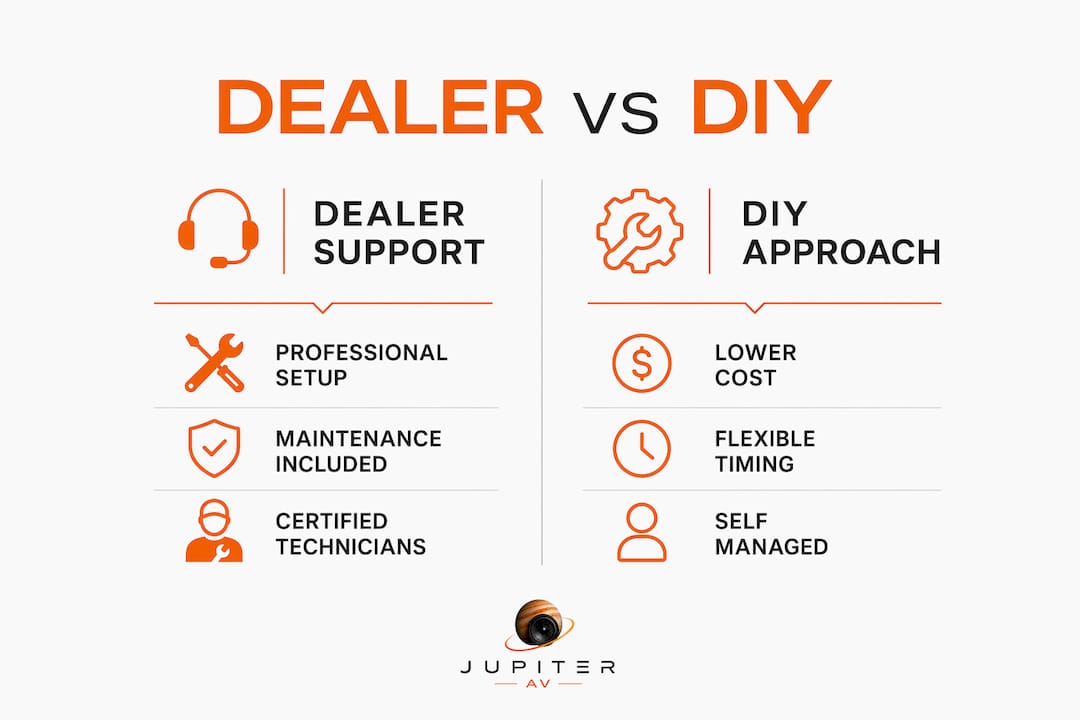
The single decisive axis is this: do you want a dealer to own the system, or do you want to own it yourself? Every other trade-off flows from that choice.

Dealer-supported systems (Savant, Crestron, Loxone, RTI, Control4) suit buyers who want a finished, maintained system and are willing to pay for it. Expect a professional site survey, structured installation, and an ongoing service relationship. DIY/open platforms (Home Assistant, Hubitat) suit buyers who enjoy tinkering, can tolerate occasional maintenance windows, and want maximum flexibility without recurring dealer fees.
Five criteria worth evaluating carefully
1. Total cost of ownership. The hardware price is rarely the whole story. Factor in dealer programming hours, annual service agreements, software licence renewals, and the cost of adding devices later. A $3,000 DIY stack can balloon to $15,000 once a dealer is involved for integration work.
2. Installation model and timeline. A DIY Home Assistant setup can be running in a weekend. A full Crestron or Savant install in a mid-size Alberta home typically takes several weeks from site survey to commissioning, especially if low-voltage wiring is involved.
3. Local dealer availability and SLAs. This is where Canadian buyers face a real constraint. Ask any prospective dealer: What is your typical response time for a service call? Do you offer a service-level agreement? Who covers warranty if your business closes? A dealer in Calgary is meaningfully different from one who services Alberta remotely.
4. Ecosystem openness and third-party drivers. Platforms that rely heavily on third-party drivers carry fragility risk. Integrated hardware-software ecosystems reduce that risk by keeping more of the stack in-house. Ask how many third-party drivers your proposed system depends on, and what happens when one breaks after a software update.
5. Long-term reliability and update path. Ask whether the platform has a published update policy. Closed dealer systems can leave you stranded if the dealer relationship ends. Open platforms like Home Assistant are community-maintained and unlikely to disappear, but they also require you to manage updates yourself.
Questions to ask any installer before signing
- "Can you show me a completed project similar in scope to mine, with a reference I can contact?"
- "What is your warranty on labour and programming, and how long does it cover?"
- "If I need a service call six months from now, what is the typical response window?"
- "Are there annual software licence or cloud fees I should budget for?"
- "What happens to my system if your business changes or closes?"
Red flags to watch for
- Heavy reliance on third-party drivers with no fallback plan
- Recurring fees that are not disclosed upfront in writing
- No local certified dealer within a practical service radius
- Mobile-app customisation that requires a dealer visit for every change
- Vague or verbal-only warranty commitments
Pro Tip: Ask to see the dealer's manufacturer certification documentation before committing. In Canada, platforms like Control4, Crestron, and Savant require dealers to hold current certifications to perform programming and warranty work. A dealer who cannot produce that paperwork is a risk.
What does each alternative actually offer?
Control4 (baseline)
Control4 is the reference point for this comparison: a dealer-only platform with broad third-party interoperability and a large Canadian installer network. It suits buyers who want a polished, maintained system and are comfortable with dealer dependency for changes. Whole-home installs typically start at a price point suitable for mid to upper range home automation projects in labour and hardware combined.
- Pros: Huge device compatibility, mature dealer network, strong UX
- Cons: All programming requires a certified dealer; recurring costs add up; driver fragility on older integrations
Home Assistant (open-source DIY)
Home Assistant runs locally on inexpensive hardware (a Raspberry Pi or a dedicated mini-PC) and supports an enormous range of devices via Z-Wave, Zigbee, Wi-Fi, and cloud integrations. It is free to run and has an active global community. The trade-off is that you are your own support desk.
- Pros: No licensing fees, maximum openness, massive community, works with Sonos and Lutron Caseta natively
- Cons: Steep learning curve, no commercial warranty, updates require user management
Loxone (integrated hardware + software ecosystem)
Loxone builds its own hardware and software together, which means fewer points of failure from third-party driver breakage. It emphasises 250 built-in function blocks for automation logic, making complex whole-home programming faster and more stable. It requires a certified Loxone partner for installation.
- Pros: Tight hardware-software integration, no mandatory annual subscription, strong reliability
- Cons: Requires certified installer, fewer dealers in Canada than Control4, proprietary hardware
Hubitat (local-first automation hub)
Hubitat is a local-processing hub that runs automations without cloud dependency, which means it keeps working even when your internet goes down. It supports Z-Wave, Zigbee, and a wide range of integrations. Hardware costs are low (the hub itself is under $200 CAD), and the platform is DIY-friendly.
- Pros: Local processing, no mandatory cloud, affordable, active community
- Cons: Less polished UI than dealer platforms, self-supported, limited professional installer ecosystem
Savant (premium dealer-led)
Savant targets the luxury end of the premium smart home market, with a refined multi-user interface and tight AV integration. It is a strong choice for high-end new builds or whole-home retrofits where the client wants a concierge-level experience. Expect project costs starting well above $20,000 CAD.
- Pros: Exceptional UX, strong AV and lighting integration, premium support
- Cons: High cost, fully dealer-dependent, limited dealer network outside major Canadian cities
Crestron (fully custom dealer-led)
Crestron is typically chosen for very large or highly custom installations where bespoke programming and specialised hardware are acceptable trade-offs. It is the most powerful and most expensive option on this list, and it requires a dealer who specialises in Crestron programming.
- Pros: Unlimited customisation, enterprise-grade reliability, strong commercial track record
- Cons: Very high cost, long programming timelines, fully dealer-dependent for every change
RTI (integrator-friendly control)
RTI sits between Control4 and Crestron in terms of complexity and cost. It is popular with integrators who want flexible control system design without Crestron's price tag. Good for mid-to-large residential and light commercial projects.
- Pros: Flexible programming, integrator-friendly, competitive pricing vs Crestron
- Cons: Less consumer-facing brand recognition, dealer-dependent
Lutron Caseta (lighting-first hybrid)
Lutron Caseta is the most reliable lighting automation system available at the consumer level, and it integrates with virtually every major platform: Alexa, Google Home, Apple HomeKit, Sonos, and Control4. It can be self-installed or dealer-assisted, and it works as a standalone lighting system or as part of a larger automation stack.
- Pros: Rock-solid reliability, broad compatibility, DIY-friendly, widely available in Canada
- Cons: Lighting-focused only; for full home automation, needs a companion platform
Sonos (audio ecosystem)
Sonos is not a home automation controller, but it is a critical integration point for almost every platform on this list. It provides whole-home audio that works with Alexa, Google, AirPlay 2, and most dealer platforms. It is available through retailers and dealers across Canada.
- Pros: Excellent audio quality, broad platform compatibility, easy setup
- Cons: Closed ecosystem, limited to audio, no automation logic
KNX (wired building automation standard)
KNX is an open wired standard used widely in European commercial and high-end residential builds. In Canada, it is rare in residential projects but appears in commercial and institutional settings. It requires KNX-certified trades and is best suited to new construction where wiring can be planned from the start.
- Pros: Open standard, extremely reliable, no vendor lock-in
- Cons: High cost, limited Canadian residential installer base, complex to retrofit
JupiterAV (local integrator and service provider)
JupiterAV is a Calgary-based integrator that sells, installs, and services several of the platforms discussed here, including Control4, Lutron Caseta, Sonos, and motorized blinds from Lutron and Clara. For Alberta homeowners who want dealer-backed support without flying in a technician from another province, JupiterAV offers local site surveys, full-system programming, and ongoing service.
- Pros: Local Alberta presence, multi-platform support, covers AV, lighting, blinds, and networking
- Cons: Serves primarily the Calgary region; for remote Alberta locations, confirm service radius before committing
What does installation actually cost in Alberta?
Canadian installation costs vary significantly by project scope, retrofit complexity, and whether low-voltage wiring is already in place. The figures below are representative ranges in CAD; actual quotes will depend on your home's size, existing infrastructure, and chosen platform.
| Installation route | Hardware (CAD) | Labour / programming (CAD) | Typical timeline | Notes |
|---|---|---|---|---|
| DIY stack (Home Assistant / Hubitat) | a low cost range | — | 1–3 days | Requires technical comfort; no warranty |
| Hybrid (DIY hardware + local installer for key subsystems) | a moderate cost range | $1,000+ | 1–2 weeks | Good balance of cost and support |
| Dealer-installed mid-size project (lighting, AV, blinds, controller) | a moderate to high hardware cost range | a range of dealer labour costs | 2–4 weeks | Includes site survey, wiring, programming |
| Full custom whole-home (Crestron / Savant / Loxone) | a very high cost range | a high labour and programming cost range | 4 weeks | Complex wiring, custom programming, commissioning |
A typical mid-size Alberta home example (three bedrooms, lighting automation on main floor, whole-home audio with Sonos, motorized blinds in living and primary bedroom, smart controller, low-voltage wiring): expect a dealer-installed project to land in the $15,000–$30,000 CAD range all-in, depending on the platform chosen and whether wiring is already roughed in. Retrofitting an older home with no existing low-voltage infrastructure adds cost and time.
Timeline is also affected by permitting. In Alberta, low-voltage wiring for automation systems generally does not require an electrical permit, but any work touching the main electrical panel does. Confirm with your installer and local municipality before work begins.
Shipping and import duties on automation hardware can add 5–15% to equipment costs for products sourced from the US, particularly for commercial-grade Crestron or KNX components. A local dealer who stocks inventory in Canada can reduce that exposure significantly.
On subscriptions and long-term maintenance: budget annual budget for dealer service agreements varies based on system tier, with premium systems typically costing more. DIY platforms like Home Assistant and Hubitat have no mandatory fees, but factor in your own time for updates and troubleshooting. Driver updates and third-party integrations occasionally break after platform updates, which is the primary long-term maintenance risk for any driver-dependent system.
Key takeaways
The right home automation alternative to Control4 depends on three things: your budget, your technical comfort, and whether you have a reliable local dealer within reach.
| Point | Details |
|---|---|
| Dealer support is the deciding factor | If no certified dealer is within a practical service radius, a dealer-backed platform becomes a liability regardless of its features. |
| DIY stacks cost less but require ongoing effort | Home Assistant and Hubitat can deliver whole-home automation for under $2,000 CAD in hardware, but you own all maintenance and troubleshooting. |
| Driver dependency is a real long-term risk | Platforms that rely on many third-party drivers are more likely to break after software updates; integrated ecosystems like Loxone reduce this risk. |
| Lutron Caseta and Sonos work with almost everything | Both are reliable, widely available in Canada, and integrate with dealer and DIY platforms alike, making them safe starting points. |
| JupiterAV offers local dealer support in Alberta | For Calgary-area homeowners who want professional installation and ongoing service across multiple platforms, JupiterAV is a practical local option. |
Why local dealer support matters more than the platform name
The smart home industry has a habit of selling the platform and underselling the relationship. After fifteen years of watching homeowners wrestle with systems that worked perfectly at commissioning and then slowly degraded as drivers broke, dealers moved, or software updates introduced incompatibilities, the pattern is clear: the platform is secondary to the support structure around it.
This is especially true in Canada, where dealer networks are thinner outside of Vancouver, Calgary, and Toronto. A homeowner in Red Deer or Lethbridge who installs a Savant system through a dealer based in Calgary needs to know, in writing, what the service response window looks like and whether remote diagnostics are available. The same question applies to Crestron, RTI, and even Control4.
The DIY argument is genuinely compelling for the right buyer. Home Assistant, in particular, has matured to the point where it handles complex whole-home automation reliably, and its community is one of the most active in the industry. But "community support" is not the same as a technician who can be on-site within 48 hours when your HVAC integration stops working in January.

The hybrid approach, where a homeowner self-installs commodity hardware like Lutron Caseta and Sonos and then brings in a local integrator for the controller layer and wiring, often delivers the best value. You get reliable, proven hardware at retail prices, paying for professional services only when necessary.
JupiterAV: local smart home installation and service in Alberta
Most homeowners researching home automation alternatives eventually reach the same conclusion: the platform matters less than who installs and supports it. JupiterAV is a Calgary-based integrator that covers the full range of services discussed in this article, from a simple Lutron Caseta lighting upgrade to a whole-home Control4 or Sonos installation with motorized blinds and custom home theatre.

Services include site surveys, low-voltage wiring, full-system programming, AV installation, smart lighting, motorized blinds (Lutron and Clara), networking, and ongoing maintenance. Whether you are a homeowner starting from scratch, a builder looking for a reliable AV and automation partner, or a business needing a commercial AV solution, JupiterAV works across all three.
For Alberta homeowners who want a straight answer on which platform fits their home and budget, the best next step is a conversation. Request a local quote or reach out to JupiterAV directly to arrange a site survey and get a clear, itemised estimate before committing to any platform.
Useful sources and further reading
- Control4 — About Us: Official overview of Control4's platform, interoperability claims, and dealer network. Useful for understanding the baseline before comparing alternatives.
- Loxone vs Control4 comparison: Loxone's own comparison page, which covers hardware-software integration advantages and driver dependency arguments. Read with the understanding that it is vendor-produced.
- CB Insights — Control4 alternatives and competitors: Market intelligence grouping of Control4 competitors by category. Useful for understanding the breadth of the alternatives market.
- Softwaresuggest — Control4 alternatives: Aggregated directory of paid and free alternatives with pricing model notes. Good for a quick scan of mid-tier and open-source options.
- Sumble — Control4 competitors and complementary tech: Community and review-based summary of user experience differences between premium and DIY stacks.
- Control4 vs Savant vs Josh.ai comparison: Industry comparison of premium platforms with useful notes on multi-user UX and interface refinement.
- Control4 vs Crestron — Definitive Electronics: Practical breakdown of when Crestron makes sense over Control4, with useful guidance on large or highly custom installs.
Vendor pages describe product strengths from their own perspective. For regional case studies and honest assessments of local dealer responsiveness in Alberta, ask prospective installers directly for references from completed projects in your area.