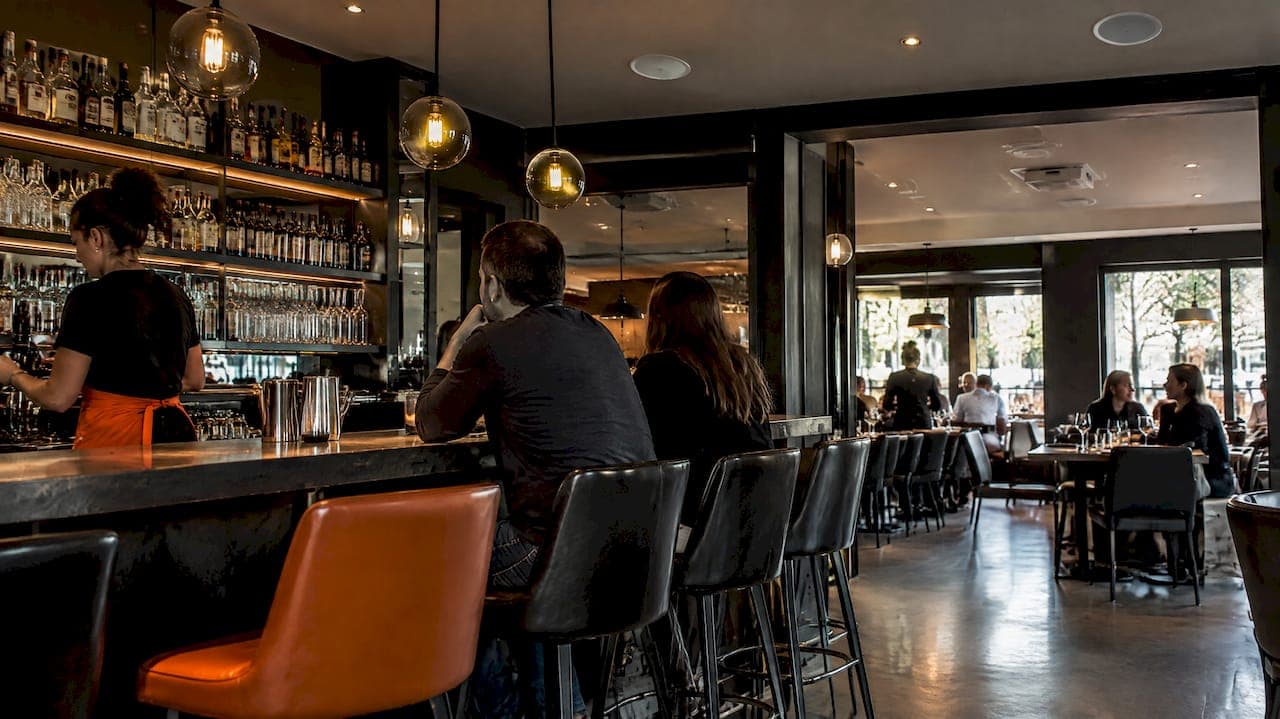
Most restaurants benefit from a two-zone 70V system with central control and a professional install: one zone for the bar, one for dining, each with its own volume. Patios and private rooms usually warrant a third zone. Before you buy anything, confirm your music licensing is in order and bring in an installer who can survey the space first.
TL;DR:
- Add a third zone only for separate patios, private rooms, or floors; measure occupancy, ceiling height, reflective surfaces, and sound bleed before setting boundaries.
- Choose a commercial 70V amplifier with independent zone outputs, a business media player, and dashboard scheduling; lock each zone’s maximum volume during commissioning.
- Space speakers no more than 40 feet apart and use weather rated patio models; panels can reduce dining room noise by 4 to 7 dBA.
- Retrofits can cost more when ceiling access is limited or fire rated assemblies need work, so survey first and compare quotes with matching scopes.
- In Canada, restaurants need public performance licenses through SOCAN and Re:Sound, often combined through Entandem; online broadcasts require separate reproduction rights.
Table of Contents
- How multi-zone audio works: 70V systems, commercial amps and zone control
- Planning practical zones for typical restaurant layouts
- Equipment choices and control options that deliver dependable multi-zone performance
- Installed costs and a realistic project timeline
- Acoustic factors and speaker placement for even coverage and speech clarity
- Music licensing practicalities in Canada: SOCAN, Entandem and Re:Sound
- How we design and install multi-zone restaurant systems
- Installer perspective: common mistakes and simple rules to avoid them
- How JupiterAV can help and next steps
- FAQ
- Sources
How multi-zone audio works: 70V systems, commercial amps and zone control
A 70V distributed audio system is the backbone of nearly every commercial restaurant install. Instead of running speaker-level cable from a home-style amplifier to each speaker, a 70V system steps up the voltage so one amplifier can feed many speakers over long cable runs without losing power or needing thick, expensive wire. According to one complete guide to restaurant sound systems, this approach is the usual choice for commercial restaurant installs under about 5,000 square feet, and a single amp with zone control covers many locations outright.
Consumer amplifiers are not built for this job. A commercial, zone-capable amplifier splits output into independent channels, so the bar can run louder music during a game while the dining room stays conversational. Some models add built-in paging or intercom functions, a feature borrowed from facility-wide paging systems used in larger commercial buildings.

A business-grade media player sits ahead of the amplifier and handles the actual source: streaming playlists, satellite radio, or a scheduled rotation for happy hour. Pair it with a remote dashboard and a manager can adjust volume, swap playlists, or mute a zone from a phone instead of walking across the floor.
The wiring itself is simple when planned correctly:
- A central equipment rack houses the amplifier, media player, and network switch in one location.
- Speaker wire runs from the rack to each zone, grouped by circuit so zones never cross.
- A single low-voltage line connects the rack to a wall-mounted controller or router for remote access.
Keeping everything in one rack, rather than scattered amplifiers tucked above different ceiling tiles, makes future service calls faster and cheaper.
Planning practical zones for typical restaurant layouts
Start with two zones and resist the urge to add more unless a space is physically separated from the rest of the floor. Most restaurants need no more than two zones, according to the same sound systems guide, because independent volume control between bar and dining solves the complaint that drives most zoning requests in the first place.
A few common layouts guide the decision:
- Bar and dining room: the classic two-zone split, since the bar often wants higher energy and volume than tables nearby.
- Dining and patio: outdoor seating needs its own zone and weather-rated speakers, plus independent control since ambient noise outside differs from inside.
- Private or banquet rooms: these usually get a dedicated zone so events don't bleed into the main dining experience.
- Multiple floors: each floor functions as its own zone regardless of layout, since sound rarely needs to match between levels.
Before finalizing a layout, run a short site survey: measure square footage per zone, note typical occupancy, record ceiling heights, and flag hard surfaces like tile, glass, or exposed brick that will bounce sound. Guest flow matters too. A narrow walkway between the bar and dining room will carry bleed-through even with separate zones, so plan speaker placement and volume limits with that transition in mind rather than treating each zone as acoustically sealed.
Equipment choices and control options that deliver dependable multi-zone performance
Commercial 70V-capable amplifiers scale well because adding a zone or two extra speakers rarely means replacing the whole system, you simply add output to an existing channel or expand the rack. Retail listings for multi-zone commercial amplifiers show the features operators look for: several independently controlled zones, 70V outputs, and networked or Bluetooth inputs sized for typical restaurant speaker loads.
Speaker choice depends on where it's going:
- In-ceiling speakers suit dining rooms and bars where a clean, invisible look matters.
- Surface-mount or pendant speakers work in spaces with no accessible ceiling cavity, like exposed-beam rooms.
- Patio and kitchen speakers need weather or grease resistance, since heat and moisture degrade standard drivers quickly.
A business-grade media player and dashboard should offer scheduling (so happy hour music starts automatically), source switching between streaming and live broadcasts, and the ability to lock maximum volume per zone. That locked-dashboard approach, rather than staff-facing knobs on the wall, is what centralised control systems are built around, and it removes the guesswork that leads to customer complaints when a server bumps a dial by accident.
Pro Tip: Lock volume ceilings in the dashboard during commissioning, not after the first noise complaint.
Maintenance is light but not zero. Amplifiers and media players benefit from a firmware check every few months, and outdoor speakers should get a visual inspection each season for weather seal wear.
Installed costs and a realistic project timeline
Installed costs vary with zone count, equipment grade, and how much retrofit work the building needs. A small two-zone system in a straightforward space costs far less than a larger multi-zone commercial project with extensive wiring, and the main drivers are equipment tier, the number of zones, and ceiling or wall access.
A realistic project moves through a few predictable stages:
- Site survey: an installer measures the space, checks ceiling access, and confirms zone boundaries.
- Design and quote: equipment is specified and a quote covers hardware, wiring, and labour.
- Installation and commissioning: cabling is run, speakers mounted, and the system tuned zone by zone.
- Staff walkthrough: the dashboard and any staff-facing controls are explained before opening.
Retrofits in occupied buildings often cost more than new builds because of limited ceiling access, firestopping requirements where cable passes through fire-rated assemblies, and unexpected ceiling work once tiles come down. A proper site survey before committing to a layout catches most of these issues before they become change orders. When comparing quotes, make sure each one lists the same zone count, speaker grade, and commissioning scope, since a lower number sometimes means less equipment rather than a better price.
Acoustic factors and speaker placement for even coverage and speech clarity
More speakers running at lower power deliver smoother coverage than a few loud ones, and that single principle fixes most of the hot-spot and dead-zone complaints restaurant owners run into. Background speaker-spacing guidance commonly caps distributed 70V speakers at roughly 40 feet apart, which keeps volume consistent across a room rather than loud near the speaker and faint everywhere else. Our own in-ceiling placement guidance covers the 18 to 24 inch spacing rule that avoids costly retrofits later.
A few placement habits matter more than raw power:
- Aim for even coverage across the room rather than maximum volume at any one point.
- Keep speaker spacing tighter in rooms with lower ceilings, since sound disperses less before it reaches guest level.
- Treat reflective surfaces like glass, tile, and exposed brick with acoustic panels or soft furnishings to cut echo.
- Choose weather-rated speakers for patios, since standard indoor drivers degrade quickly outdoors.
Documented acoustic retrofits in restaurant settings, such as microperforated stretch ceilings and wall panels, can reduce dining-room noise by roughly 4 to 7 dBA, a difference guests notice as clearer conversation rather than competing with background music. Most acoustic complaints trace back to hard surfaces and too few speakers, not underpowered amplifiers, so treatment and placement usually solve more than adding wattage ever will.
Music licensing practicalities in Canada: SOCAN, Entandem and Re:Sound
Playing recorded music in a restaurant, even through a well-designed zoning system, requires the right licences. SOCAN covers public performance rights for songwriters and publishers, while Re:Sound covers rights for performers and record labels. Entandem was created to simplify this by combining both licences into a single application for most businesses.
Fee drivers typically include:
- The size of your establishment and how many seats or square feet it covers.
- Whether you host live performers in addition to recorded or streamed music.
- Whether music is broadcast online, such as through a livestream, which triggers separate reproduction rights beyond standard public performance.
Reach out to Entandem or SOCAN directly before opening your sound system to the public, since licensing is tied to actual use, not just equipment ownership.
How we design and install multi-zone restaurant systems
We start every restaurant project with a site survey, mapping zones against your actual floor plan before specifying a single speaker. From there, we design a system around your layout, whether that means a straightforward two-zone bar-and-dining split or a more layered setup with Sonos, WiiM, or Control4 integration where it fits the space.
Installation stays discreet: speakers and wiring disappear into the architecture rather than sitting as visible add-ons. A typical quote covers equipment, wiring, commissioning, and a staff walkthrough so your team understands the dashboard before opening night. Our commercial AV work extends beyond sound to cover related low-voltage systems restaurant owners often need under one point of contact.
Installer perspective: common mistakes and simple rules to avoid them
The biggest mistake we see is over-powering a handful of speakers instead of spreading out more units at lower volume, which creates hot spots near the bar and dead zones at the back tables. Kitchens and patios need commercial-grade speakers built for grease and weather, not household drivers pulled from a home theatre closet. Lock down controls during commissioning so a busy server can't accidentally crank the patio zone to match a hockey game next door.
— JupiterAV
How JupiterAV can help and next steps
We handle sales, service, and installation for restaurant multi-zone audio from first site visit to final commissioning. Reach out and we'll walk your space, map zones against your floor plan, and put together a quote that covers equipment, wiring, and timeline details before you commit to anything.

For digital signage or centralized content alongside your audio zones, a platform like Zoney pairs well with a zoned sound system when a restaurant also runs menu boards or promotional screens across multiple areas.
Get in touch through our main services page to book a site survey and get a tailored quote for your space.
FAQ
What is the best sound system for a small restaurant?
For most small restaurants, a two-zone 70V distributed system with a single commercial amplifier and central dashboard control covers the space without unnecessary complexity. This setup lets you run independent volume between a bar and dining area while keeping wiring and maintenance simple.
What are some good commercial speakers for restaurants?
In-ceiling and surface-mount commercial speakers rated for 70V distribution work well in dining rooms and bars, while weather-rated models are needed for patios and grease-resistant designs for kitchen areas. Choosing several lower-power speakers spread evenly tends to deliver more even coverage than a few high-output units.
What is the best music system for a restaurant?
A business-grade media player paired with a 70V amplifier and a remote dashboard gives you scheduling, source switching, and locked volume limits per zone. This combination is the standard approach for restaurants that want reliable, staff-proof control without constant manual adjustment.
What is the best sound system for commercial use?
Commercial use generally calls for a 70V distributed system with zone-capable amplification, since it allows one amplifier to feed multiple speakers across different areas without the wiring and power limitations of consumer-grade equipment. The right scale depends on square footage, zone count, and how much centralized control you need.
Do I need a music licence to play background music in my restaurant?
Yes, playing recorded or streamed music publicly in a restaurant requires clearing public performance rights through SOCAN and related rights through Re:Sound, often combined through Entandem. Licensing is based on actual use of music in your space, not just the equipment you own.
Sources
- Restaurant Sound Systems: The Complete Guide
- Tariffs | Re:Sound Music Licensing Company
- Episode 11: How to play someone's music on-site and online
- Restaurant and commercial stretch ceiling in Toronto: Acoustic Class A for King West and Yonge | RenoHouse